
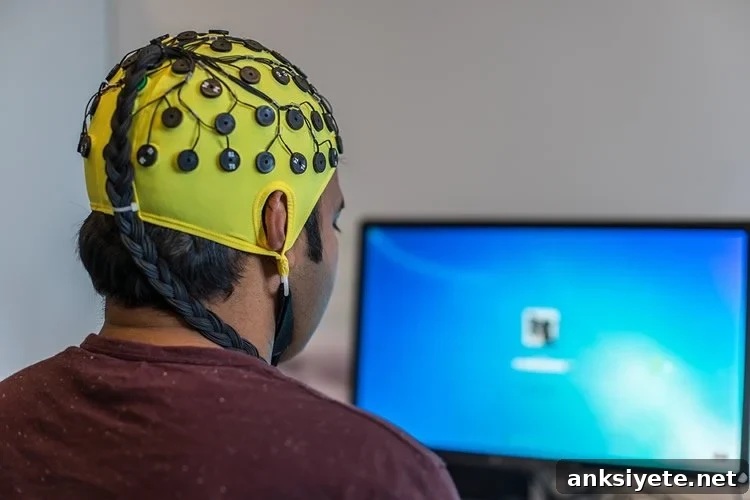
Summary: EEG recordings can reveal how people evaluate risk. Researchers found that higher frontal midline theta power corresponds with stronger cognitive control during decisions, and predicts a greater tendency to select low-risk options.
Source: Friedrich Schiller University Jena
Anxious individuals tend to take fewer risks. A team of psychologists from Friedrich Schiller University Jena, collaborating with colleagues in Würzburg and the University of Victoria in Canada, has identified a clear neural marker that links anxiety to risk-avoidant choices. Using electroencephalography (EEG) while participants played a simple risk game, the researchers were able to observe decision-related brain activity and predict individual choice behavior. Their findings are reported in the journal Psychophysiology.
“For the study, we screened participants with a questionnaire and selected 20 people with high anxiety and 20 with low anxiety,” explains Dr. Barbara Schmidt of the University of Jena, who led the project. “During the experiment each person completed a series of trials in which they flipped one of two cards. In every trial the maximum possible gain was 11 cents, but the two options differed in risk. The high-risk option paid either 11 cents or nothing, while the low-risk option yielded either five or six cents. Importantly, both options had the same expected value of 5.5 cents, so choosing either option was statistically equivalent in long-term payoff. Nonetheless, we observed robust differences in choice patterns: participants with higher anxiety levels opted for the low-risk option more often.”
Beyond those behavioral differences, the EEG recordings revealed the study’s most important result. While participants weighed their options, a particular band of brain activity known as frontal midline theta power became especially pronounced. “Previous studies had shown that this frontal midline theta signal is often stronger in anxious individuals, but its behavioral relevance was not fully understood,” says Schmidt. “Our data show that increased frontal midline theta power reflects enhanced cognitive control during the decision process — essentially a deeper, more effortful weighing of the available options — and this enhanced control is associated with safer, lower-risk choices.”
Predicting behavior from brain activity
Psychologists commonly search for neural correlates of mental states, but linking those correlates to actual choices can be challenging. In this study the pieces fit together: an initial psychological disposition (trait anxiety), a specific decision-related brain signal (frontal midline theta), and a consistent pattern of choice (preference for lower-risk options). “Because we can observe the decision process directly in the EEG and relate it to subsequent choices, the connection between anxiety and risk-avoidant behavior is much better explained,” Schmidt notes. This makes frontal midline theta a promising neural marker for predicting how an individual will behave in risk situations.
Knowing that frontal midline theta is linked to more intensive evaluation of risk enables researchers to make informed predictions about individual choices in comparable situations. When theta power is elevated during deliberation, the person is more likely to select the safer option.
Dr. Schmidt plans to apply these insights in follow-up research within her specialization in hypnosis. “I am interested in whether altering subjective safety through hypnotic suggestion changes risk preferences and whether those changes are reflected in frontal midline theta activity,” she explains. “If people feel safer under suggestion, do they exhibit reduced theta-related control and consequently take more risks? The current results give us a clear neural target to examine in those experiments.”
Source: Barbara Schmidt – Friedrich Schiller University Jena
Publisher: Organized by NeuroscienceNews.com
Image source: NeuroscienceNews.com (public domain)
Original research: The study appears in the journal Psychophysiology.
Friedrich Schiller University Jena. “Reading Risk Behavior in the Brain.” NeuroscienceNews. 20 June 2018. (Original research published in Psychophysiology.)