
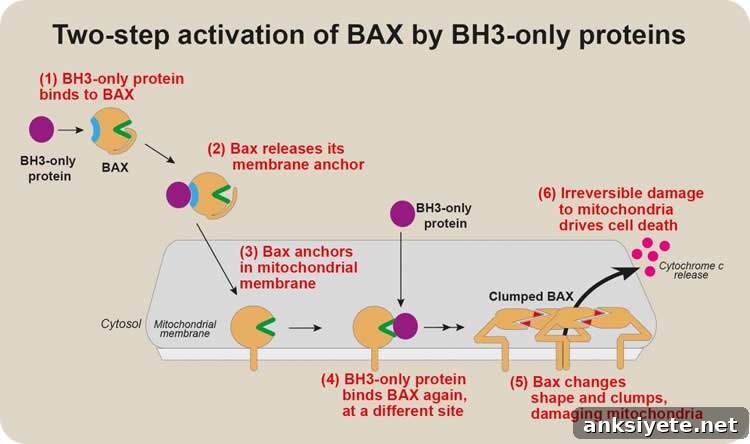
Summary: Two distinct regions on the BAX protein can bind BH3-only proteins, and these binding sites act at separate stages of BAX activation. A transient, “hit-and-run” interaction at one of these regions triggers BAX to relocate to mitochondria, enabling it to later disrupt mitochondrial membranes and drive cell death.
Source: Walter and Eliza Hall Institute
A transient “hit-and-run” interaction between proteins can trigger programmed cell death, new research from the Walter and Eliza Hall Institute shows.
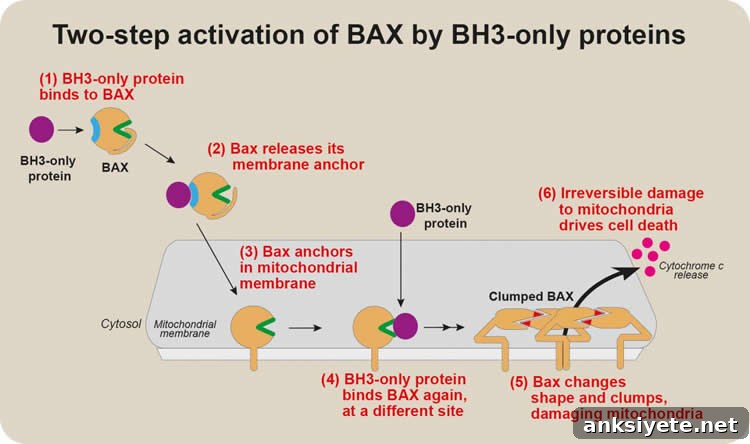
Researchers examined the sequence of events that activate BAX, a central protein in apoptosis. Addressing a long-standing puzzle in the field, they found that BH3-only proteins activate BAX through brief interactions at two separate sites on the molecule. These interactions occur at different stages: one promotes BAX’s recruitment to mitochondria, and the other enables BAX to damage the mitochondrial membrane.
The study, led by Dr Michael Dengler and Professor Jerry Adams, was published in Cell Reports.
Key points
- Activation of BAX is a critical step in apoptosis, the programmed removal of cells.
- The team identified a transient, “hit-and-run” interaction between BH3-only proteins and BAX that initiates BAX recruitment to mitochondria.
- Two separate BH3-binding regions on BAX serve distinct roles: one drives mitochondrial association, the other triggers membrane-damaging activity that leads to cell death.
- Understanding these steps could guide new therapeutic strategies to either promote or prevent cell death in diseases such as cancer or neurodegeneration.
How BAX triggers cell death
Apoptosis removes damaged or unneeded cells. Various signals converge on pathways that activate BAX and its close relative BAK. Once activated, BAX and BAK form assemblies that create openings in the outer membrane of mitochondria. Damage to mitochondria is effectively the point of no return for a cell: it commits the cell to die.
Professor Adams explained that while the activation of BAX at the mitochondrial membrane was already relatively well understood, the trigger that moves BAX from the cytosol to the mitochondria was less clear. “We knew BH3-only proteins change BAX’s shape at the mitochondrial surface, enabling it to disrupt membranes. But whether BH3-only proteins also serve as the signal that relocates BAX from the cytosol to mitochondria had been uncertain,” he said.
Two-step activation mechanism
To map how BAX uses BH3 interactions, Dr Dengler and colleagues created subtle mutations across different BAX regions. Comparing mutant forms with normal BAX allowed them to determine the roles of specific regions in BAX’s activation pathway.
“We discovered that two different parts of BAX could bind BH3-only proteins,” Dr Dengler said. “Importantly, these sites operate at different stages of BAX activation.”
One of the binding sites controls BAX’s translocation to the mitochondrial membrane. When a BH3-only protein briefly engages this site, BAX releases a C-terminal “tail” that serves as a membrane anchor, allowing BAX to insert into the mitochondrial outer membrane. Binding at the second site then activates BAX’s membrane-disrupting activity, enabling it to form the oligomers that permeabilize mitochondria.
This early step—recruitment to mitochondria—appears to involve a short-lived, “hit-and-run” interaction, which likely explains why it had been difficult to detect and characterize in previous studies. The transient nature of this step suggests a mechanism for fine-tuning BAX activation in response to different cellular contexts and stress signals.
Structural biology and proteomics were essential to these findings. The research team collaborated with structural biology and proteomics groups at the Institute and used resources at the Australian Synchrotron and the CSIRO Collaborative Crystallisation Centre to reveal how mutations alter BAX conformation and BH3 binding.
Potential therapeutic impact
BAX mediates a critical decision point in cell fate, and many diseases involve imbalances in cell death: too little apoptosis can enable cancer, while too much can worsen neurodegenerative disease and stroke. By distinguishing the two activation steps—mitochondrial recruitment and membrane-disrupting activation—this work could inform drug discovery approaches that either promote apoptosis (for cancer therapy) or prevent it (to protect neurons).
Professor Adams noted that targeting specific stages of BAX activation might allow more precise interventions. Drugs that mimic BH3-only activity at the membrane-activation site could promote apoptosis in cancer cells, while agents that block the transient recruitment interaction might protect cells from inappropriate death in degenerative conditions.
Funding
The research was supported by the Australian National Health and Medical Research Council, the US-based Leukemia and Lymphoma Society, and the Victorian Government.
Source:
Walter and Eliza Hall Institute
Media contact:
Vanessa Solomon – Walter and Eliza Hall Institute
Image credit:
Walter and Eliza Hall Institute, Australia.
Original research (open access):
“BAX Activation: Mutations Near Its Proposed Non-canonical BH3 Binding Site Reveal Allosteric Changes Controlling Mitochondrial Association” by Michael A. Dengler et al., Cell Reports. Published April 9, 2019. DOI: 10.1016/j.celrep.2019.03.040
Abstract summary
The study shows that BAX transforms from an inactive cytosolic monomer into membrane-integrated oligomers that permeabilize the mitochondrial outer membrane. Mutations near a proposed non-canonical BH3 binding site involving helices α1 and α6 reduce BH3 binding at that region, stabilize inactive BAX conformations, and impair BAX translocation and integration into the mitochondrial membrane. Those changes reveal allosteric links that sequester the α9 membrane anchor inside the groove and point to distinct roles: the α1–α6 region promotes mitochondrial association and integration, while groove binding supports later steps that lead to oligomerization and membrane permeabilization.