
Summary: Using a nonlinear signal-processing approach on experimental recordings, researchers have revealed a clear link between motor behavior and brain activity. These findings offer promising directions for brain-computer interface design, neurorehabilitation, and applied artificial intelligence.
Source: American Institute of Physics
Accurate detection, quantification, and classification of motor-related brain activity remain major goals for researchers aiming to support patients with motor or cognitive impairments and to improve neurorehabilitation strategies.
Motor and cognitive functions in the human brain are tightly intertwined. One well-known physiological marker of motor-related brain activity is the suppression of rhythmic neuronal activity in the sensorimotor cortex called the mu-rhythm (8–14 Hz). Traditional analysis methods — including time-frequency decomposition, spatial filtering, and machine learning — have exposed useful motor-related features in EEG signals, but these methods often suffer from variability between and within subjects, limiting robust classification and real-time applications.
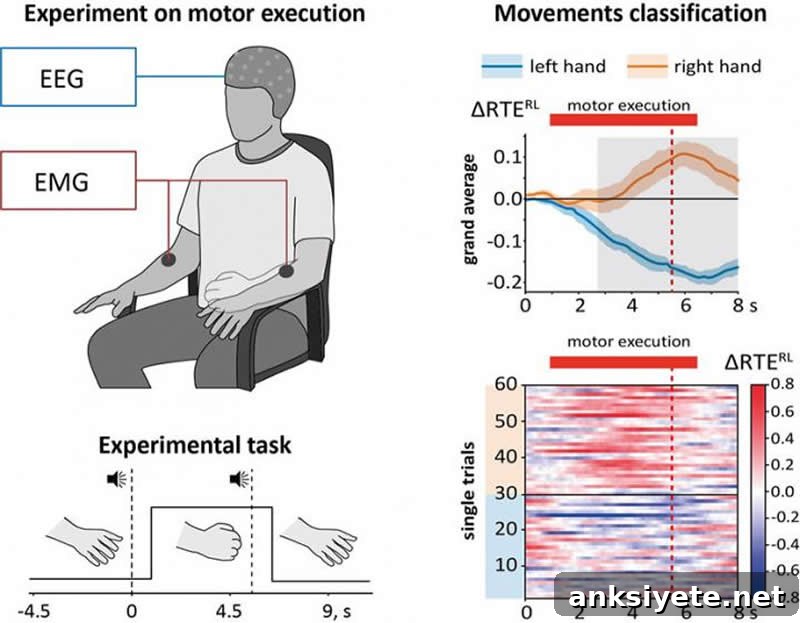
In the journal Chaos, Nikita Frolov and colleagues at Innopolis University, Russia, adopt a different strategy to identify reliable features of brain activity linked to motor actions. They apply recurrence quantification analysis (RQA), a nonlinear dynamics toolbox designed to assess complexity and structure in time series, to electroencephalographic (EEG) data recorded during simple motor tasks.
“We hypothesized that suppression of mu-oscillations during movement would reduce the variability of measured brain signals and simplify the underlying neuronal dynamics,” Frolov explained. “Recurrence quantification analysis lets us evaluate that simplification directly by measuring changes in signal complexity.”
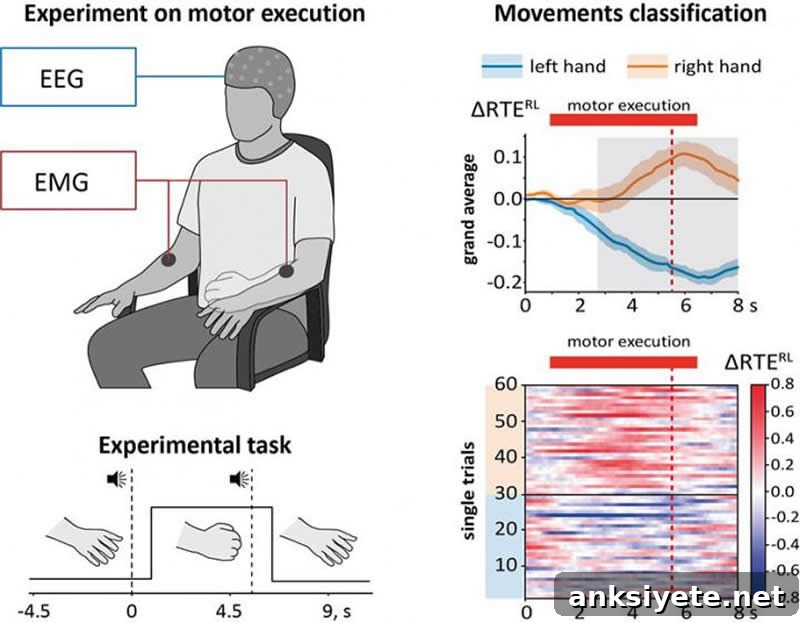
The research confirms, for the first time with RQA, that neuronal dynamics in the sensorimotor cortex become simpler during motor execution. In other words, when participants performed hand-squeezing tasks, measures of EEG complexity decreased, consistent with event-related desynchronization (ERD) of the mu-band oscillations. This reduction of EEG complexity supports the idea that fewer neuronal populations participate in the dominant oscillation, producing more regular and less complex dynamics.
Frolov and co-authors show that RQA-derived measures are sensitive to the onset of movement and can distinguish movement laterality — whether the left or right hand was used. Unlike standard spectral or filtering approaches, RQA captures nonlinear structure in EEG time series, making it a promising complement to existing methods for detecting motor states from brain activity.
“By embedding EEG signals into an appropriate state space, we treat the measured cortical region as a dynamical system,” Frolov said. “RQA quantifiers then reveal how that system’s complexity changes during motor actions.”
Potential applications of this approach include embedding RQA-based analysis into the computational core of brain-computer interfaces (BCIs) for online detection and training of motor functions. Such systems could enable closed-loop feedback for motor skills rehabilitation, enhance diagnostic tools for cognitive or motor impairments, and track age-related changes in brain dynamics. Because RQA focuses on dynamical complexity rather than only spectral power, it may improve robustness across individuals and recording conditions.
Source:
American Institute of Physics
Media Contacts:
Larry Frum – American Institute of Physics
Image credit:
Nikita Frolov / Innopolis University.
Original Research (open access):
“Motor execution reduces EEG signals complexity: recurrence quantification analysis study.” Elena N. Pitsik, Nikita S. Frolov, Kai Hauke Kraemer, Vadim V. Grubov, Vladimir A. Maksiemenko, Juergen Kurths, and Alexander E. Hramov. Chaos. DOI: 10.1063/1.5136246.
Abstract (summary)
This study introduces new features of motor-related brain activity revealed by recurrence quantification analysis. The authors focus on event-related desynchronization (ERD) of the mu-rhythm in the sensorimotor cortex and propose that motor-related ERD corresponds to suppression of random fluctuations in the mu-band, caused by a reduction in the number of neuronal populations contributing to the oscillation. As a result, EEG dynamics become more regular and less complex during movement. Applying RQA measures, the researchers demonstrate that specific quantifiers reliably detect movement onset and allow classification of movement laterality. These findings point to RQA as a useful tool to improve detection, quantification, and classification of motor-related EEG patterns for brain-computer interfaces and neurorehabilitation.