
About a dozen years ago, researchers identified ghrelin as a hormone that stimulates appetite. Known as the “hunger hormone,” ghrelin quickly became a target for drug development aimed at treating obesity, though those efforts have not yet produced effective weight-loss therapies.
New work by neuroscientists at MIT shows that ghrelin’s role extends well beyond appetite regulation. The team found that ghrelin released during prolonged stress makes the brain more susceptible to traumatic experiences, indicating it may increase the risk of developing posttraumatic stress disorder (PTSD).
Ki Goosens, an assistant professor of brain and cognitive sciences at MIT and senior author of the study published online in the journal Molecular Psychiatry, suggests that medications that lower ghrelin levels—originally developed to fight obesity—might be repurposed to protect people at high risk for PTSD, such as soldiers about to be deployed to combat zones.
Lead author Retsina Meyer, a recent MIT PhD recipient, conducted this work with coauthors including Anthony Burgos-Robles, Elizabeth Liu, and Susana Correia. Their experiments connect stress, ghrelin, growth hormone activity in the amygdala, and heightened fear responses.
Stress and fear
Stress is an adaptive response that helps animals and humans react to danger, mobilizing physiological and behavioral actions to escape or fight. But when stress becomes chronic—driven in people by factors like prolonged unemployment, bullying, or the loss of a loved one—it can lead to anxiety, depression, and persistent fear-related disorders.
The MIT team focused on the amygdala, a brain region central to generating fear. They found that the amygdala responds to chronic stress by producing increased amounts of growth hormone, a change not observed in many other brain regions. Crucially, the researchers discovered that ghrelin—a hormone produced mainly in the stomach that travels through the bloodstream to the brain—controls this local release of growth hormone in the amygdala.
Ghrelin levels rise with chronic stress. In the study, rats exposed to prolonged stress showed elevated circulating ghrelin and increased growth hormone in the amygdala, and they formed stronger fear memories. To measure fear, researchers trained rats to associate a previously neutral tone with a mild aversive stimulus and then measured how long the animals froze after hearing the tone. Rats with prolonged ghrelin-receptor stimulation or with experimental overexpression of growth hormone in the amygdala froze for longer periods, indicating stronger fear responses.
Conversely, blocking the receptors for ghrelin or growth hormone returned fear responses in chronically stressed rats to normal levels. These findings suggest that ghrelin-mediated enhancement of growth hormone signaling in the amygdala strengthens fear memory formation, a core feature of PTSD.
“A history of chronic stress appears to change brain biology so that a later traumatic event is encoded as an unusually strong memory,” Goosens explains. “That excessively strong memory is one factor that drives PTSD symptoms.”
New drugs, new targets
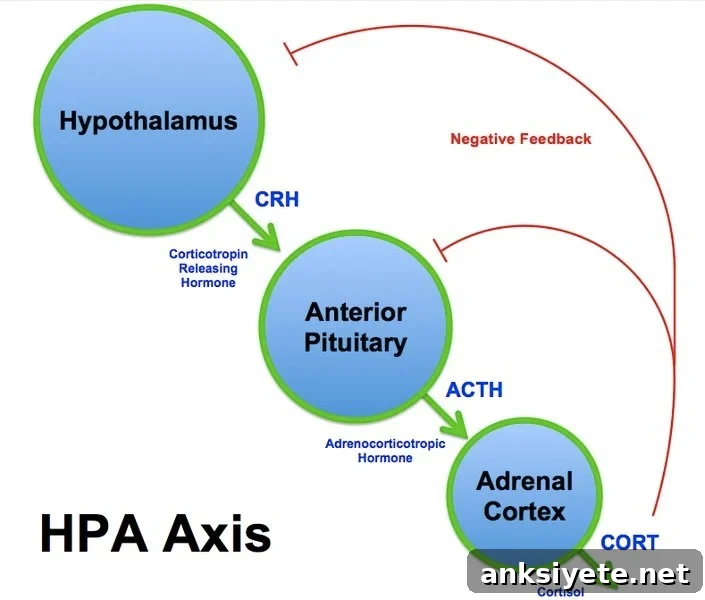
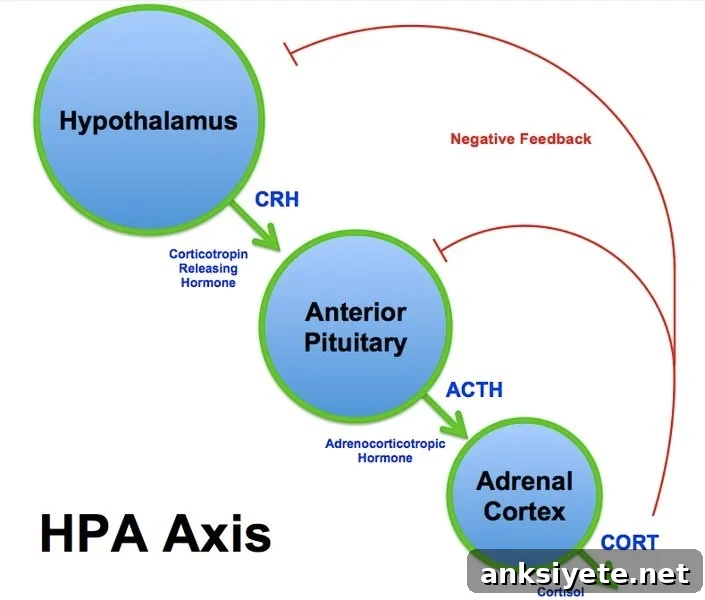
For decades, stress research has emphasized the hypothalamic–pituitary–adrenal (HPA) axis—the network that produces cortisol, adrenaline, and related hormones involved in “fight or flight” reactions. After uncovering ghrelin’s role in stress, the MIT researchers checked whether ghrelin acts through the HPA axis. They were surprised to find it does not. Even after removal of the adrenal glands in their animal experiments—the organs that release stress hormones like corticosterone and adrenaline—rats still developed heightened fear under chronic stress.
Additional experiments showed that repeated stimulation of the ghrelin receptor did not trigger release of HPA hormones, and blocking ghrelin receptors did not reduce HPA hormone release. Together, these results indicate a ghrelin-initiated stress pathway that functions independently of the traditional HPA axis. Identifying this separate pathway opens a new target for therapeutic development to treat or prevent stress-related disorders.
Several pharmaceutical compounds that interfere with ghrelin signaling have already been developed and assessed for safety in humans, primarily in trials aimed at weight loss. Although they showed limited success for obesity, these ghrelin-blocking agents could be repurposed to reduce vulnerability to traumatic memory formation. The researchers propose that such drugs might be used prophylactically—for example, given to people before deployment—or as part of treatment for those who already have PTSD, since ghrelin levels can remain elevated long after chronic stress ends.
PTSD affects millions of people, including veterans and survivors of crimes, accidents, and natural disasters. According to the researchers, an estimated 7.7 million American adults have PTSD; about 40 to 50 percent recover within five years, while many others continue to experience symptoms for much longer. The team hypothesizes that sustained elevation of ghrelin after trauma may be one factor that helps maintain PTSD symptoms in affected individuals.
“Immediate reversal of established PTSD may be unlikely, but lowering ghrelin could make patients more responsive to therapies such as cognitive behavioral therapy, and over time contribute to recovery,” Meyer says.
The MIT group is collaborating with clinicians at Massachusetts General Hospital to measure ghrelin levels in people with anxiety and fear disorders and to explore clinical trials of ghrelin-blocking drugs, including trials to test whether such drugs can prevent relapse of depression in vulnerable patients.
Notes about this PTSD research
The study received funding from the U.S. Army Research Office, the Defense Advanced Research Projects Agency (DARPA), and the National Institute of Mental Health.
Written by Anne Trafton
Contact: Anne Trafton, MIT
Published in: Molecular Psychiatry
#PTSD, #psychology, #openaccess