

Summary: New research provides evidence that specific human herpesviruses are associated with Alzheimer’s disease. The study found higher levels of human herpesvirus 6A (HHV‑6A) and human herpesvirus 7 (HHV‑7) in brain tissue with Alzheimer’s neuropathology, and describes network-level interactions that suggest viral activity may contribute to disease mechanisms.
Source: Arizona State University.
Alzheimer’s disease remains one of the most challenging illnesses facing humanity. Despite decades of study, effective prevention and disease‑modifying treatments are still lacking. As populations age, clarifying risk factors and underlying mechanisms is essential for developing new therapeutic and preventive strategies.
A multidisciplinary team led by researchers at the Arizona State University‑Banner Neurodegenerative Disease Research Center (NDRC) and collaborators at the Icahn School of Medicine at Mount Sinai has produced a first‑of‑its‑kind, large‑scale analysis linking herpesviruses to Alzheimer’s disease (AD) neuropathology. Published in the journal Neuron, the study integrates genomic, transcriptomic, clinical, and neuropathological data to explore how viral activity may intersect with known Alzheimer’s risk genes and pathological hallmarks.
Big challenges, big data
To investigate potential viral contributions to AD, researchers analyzed DNA and RNA sequencing data from 944 human brain donors: 622 with clinical and neuropathological features of Alzheimer’s disease and 322 without the disease. These data came from the NIH‑sponsored Accelerated Medicines Partnership for Alzheimer’s Disease (AMP‑AD). Whole‑exome sequencing provided information on inherited genetic variation, while RNA sequencing profiled gene expression across multiple brain regions. Clinical assessments obtained before death documented the participants’ cognitive trajectories; neuropathological examinations after death quantified amyloid plaques and neurofibrillary tangles, the microscopic hallmarks used to diagnose AD.
Using advanced computational and network biology methods, the team examined viral RNA and DNA abundance across six brain regions known to be vulnerable in Alzheimer’s disease. This multiscale approach allowed the researchers to place viral activity in the context of human gene networks and neuropathological markers.
Uninvited guests: herpesviruses in the Alzheimer’s brain
The analyses revealed increased abundance of two common herpesviruses, HHV‑6A and HHV‑7, in brain samples showing Alzheimer’s neuropathology compared with control brains. Although many viral species are detectable at low levels in normal aging brains, HHV‑6A and HHV‑7 stood out for their higher prevalence and apparent interactions with Alzheimer’s‑related genetic networks.
Lead author Ben Readhead explained that the team was not initially searching for viruses, but viral signals became prominent in their unbiased analyses. Using multiple network biology approaches, the researchers identified putative interactions between these herpesviruses and human genes known to affect Alzheimer’s risk or amyloid processing.
Senior author Joel Dudley emphasized that while the study does not establish herpesviruses as the primary cause of Alzheimer’s disease, the data show that viral activity is perturbing molecular networks directly implicated in AD pathophysiology. In other words, viruses appear to participate in the same networks that underlie hallmark features of the disease.

Network news: viral regulation of Alzheimer’s genes
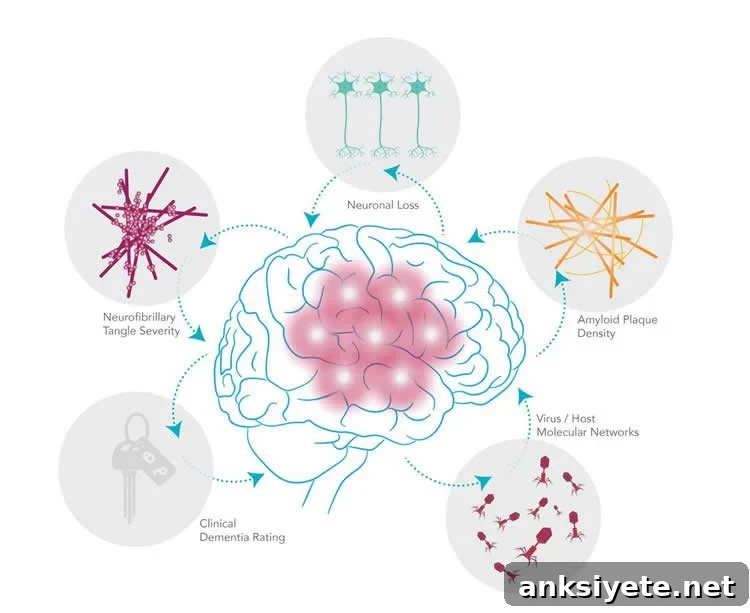
Applying probabilistic network models, the research team integrated viral abundance with expression of human genes and neuropathological markers. The resulting multiscale networks suggest that hallmark AD pathology—amyloid deposition, tau tangles, and neuronal loss—may arise at least in part from the brain’s response to viral insult. This idea aligns with the pathogen hypothesis of Alzheimer’s, which proposes that proteins such as amyloid beta can act as part of an innate immune response, sequestering pathogens to limit infection but also promoting plaque formation.
Specifically, HHV‑6A was associated with regulation of multiple known AD risk genes and genes involved in amyloid precursor protein (APP) metabolism, including APBB2, APPBP2, BIN1, BACE1, CLU, PICALM, and PSEN1. These interactions provide a plausible mechanistic link between viral activity and processes that drive amyloid production and aggregation.
Mounting evidence from experimental models
To support observations from human tissue, the study included experimental data from mice. Depletion of miR‑155, a microRNA that regulates immune responses, led to increased amyloid plaque deposition and behavioral changes in mice. Given that HHV‑6A is known to reduce miR‑155 levels, this finding strengthens the plausibility that viral activity can influence pathways relevant to AD pathology.
Results discovered in initial samples were replicated across multiple independent brain banks, including collections from Mount Sinai, the Mayo Clinic, Rush Alzheimer’s Disease Center, and the Banner‑Sun Health Research Institute. This replication across geographically diverse cohorts increases confidence in the associations observed between herpesvirus abundance and Alzheimer’s features.
Implications and next steps
The study does not claim that Alzheimer’s disease is contagious. Rather, it highlights viral activity as a recurring feature in AD‑affected brain tissue and identifies specific molecular interactions that could contribute to disease processes. If future studies confirm causal roles for viruses in initiating or exacerbating Alzheimer’s, antiviral or immune‑modulating therapies could become candidates for prevention or early intervention.
Co‑author Eric Reiman noted that this work demonstrates the power of large human tissue datasets, advanced computational methods, experimental models, and collaborative research to reveal new biological insights and therapeutic opportunities for neurodegenerative disease.
About this neuroscience research article
Contributing institutions included Arizona State University, Banner Alzheimer’s Institute, Icahn School of Medicine at Mount Sinai, Translational Genomics Research Institute (TGen), Mayo Clinic, Rush Alzheimer’s Disease Center, the Banner‑Sun Health Research Institute, Institute for Systems Biology, and other collaborators. Postmortem brain tissue was collected and made available through NIH‑designated brain bank resources and multiple institutional brain donation programs. Funding sources included the NIH/National Institute on Aging and the Accelerated Medicines Partnership for Alzheimer’s Disease, among others.
Abstract
Multiscale Analysis of Independent Alzheimer’s Cohorts Finds Disruption of Molecular, Genetic, and Clinical Networks by Human Herpesvirus
Highlights:
- Common viral species are frequently detected in normal, aging brain.
- Increased HHV‑6A and HHV‑7 abundance was observed in brains from subjects with Alzheimer’s disease.
- Findings were replicated in two additional independent cohorts.
- Multiscale network analyses reveal viral regulation of AD risk genes and APP processing pathways.
Summary:
Investigators constructed integrated molecular networks using genomic, transcriptomic, proteomic, and histopathological data from human postmortem brain tissue to study associations between the brain virome and late‑onset Alzheimer’s disease. They observed increased abundance of HHV‑6A and HHV‑7 in AD brains compared with controls, with replicated results across independent cohorts. Analyses identified regulatory relationships linking viral abundance to modulators of APP metabolism and known AD risk genes, supporting the interpretation that viral activity is a consistent molecular feature associated with Alzheimer’s disease.