
New research reveals how experimental antidepressants target glutamate signaling via an amplification mechanism in specific neurons
A growing class of fast-acting antidepressant drugs appears to exert effects by altering neuronal responses to the neurotransmitter glutamate. Until now, the precise cellular mechanism behind these drugs’ antidepressant action was unclear. A team led by researchers at Rockefeller University has identified a molecular amplification system centered on the metabotropic glutamate receptor mGluR5 that helps explain how these experimental therapies change signaling in particular neurons and produce antidepressant-like effects in animal models.
The study, published in Molecular Psychiatry, focuses on mGluR5, a signal receptor on neurons that modulates responses to several neurotransmitters.
According to senior author Paul Greengard, Vincent Astor Professor and head of the Laboratory of Molecular and Cellular Neuroscience, the new findings indicate that “mGluR5 amplifies the cellular response to a chemical signal, and that blocking mGluR5 receptors in specific inhibitory neurons involved in depression can produce an antidepressant effect.” Greengard notes that mGluR5 is being explored as a therapeutic target for multiple neurological conditions beyond depression, including Parkinson’s disease and Fragile X Syndrome, so these results may have broader implications for other disorders.
The investigation began with the protein S100A10, commonly referred to as p11. In 2006, Greengard’s laboratory and collaborators showed that reduced p11 levels, which normally increase neuronal sensitivity to serotonin, are linked to depression. That work helped explain how selective serotonin reuptake inhibitors (SSRIs) act and opened paths to improve antidepressant strategies.
In the current study, first author Ko‑Woon Lee and colleagues tested whether p11 also regulates a different signaling pathway—specifically the mGluR5 glutamatergic system targeted by the newer class of antidepressants. p11 and mGluR5 are present in both glutamatergic neurons, which excite neural circuits, and GABAergic neurons, which inhibit activity. Disruption of the balance between glutamate and GABA signaling has long been implicated in mood disorders, including depression.
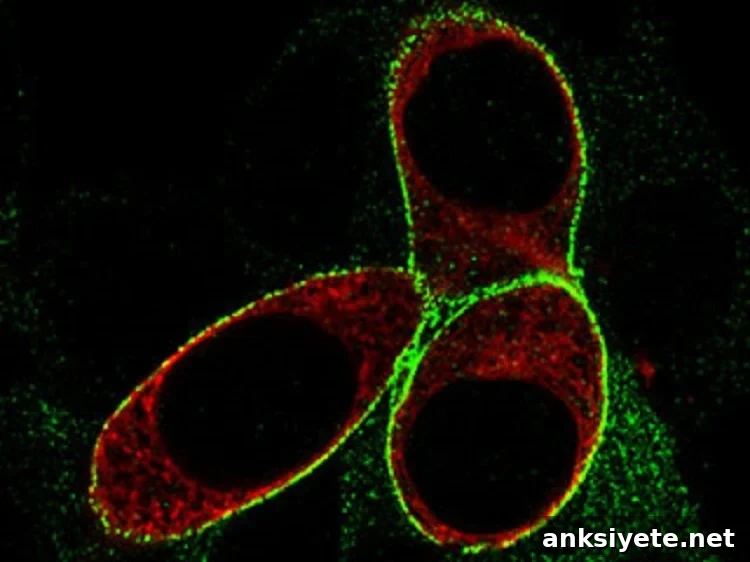
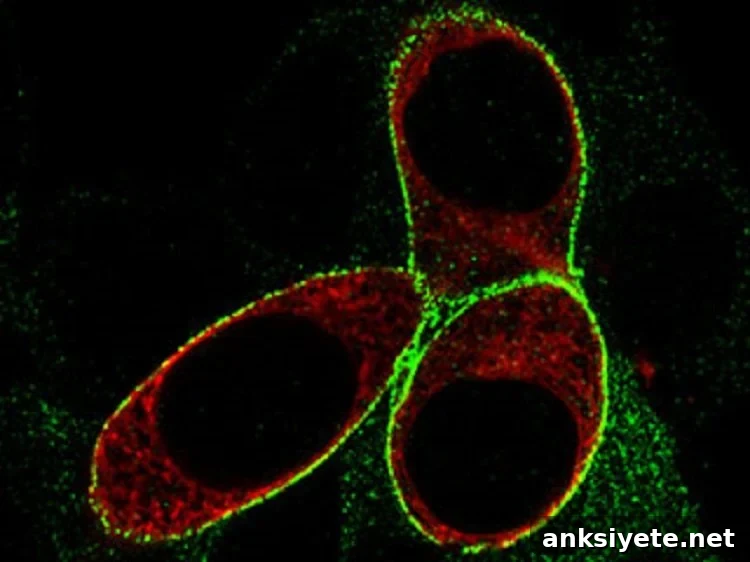
Biochemical experiments demonstrated that p11 binds directly to the cytoplasmic tail of mGluR5 and promotes the receptor’s localization at the cell surface. p11 and mGluR5 mutually enhance each other’s membrane presence, effectively increasing the receptor’s availability to respond to signaling molecules. In cultured cells, overexpression of p11 potentiated mGluR5-driven calcium responses, while a mutant form of mGluR5 that cannot interact with p11 reduced those responses.
To determine the behavioral impact, the researchers selectively deleted p11 or mGluR5 in either glutamatergic or GABAergic neurons in mice and then evaluated depression-related behaviors using established tests. One behavioral measure involved placing a food pellet in the center of an open arena and timing how readily the animal retrieved it as an indicator of anxiety- and depression-like behavior.
Results revealed opposing roles for p11 and mGluR5 depending on cell type. Removing either p11 or mGluR5 from GABAergic (inhibitory) neurons reduced inhibitory signaling and produced antidepressant-like behavior: mice became more willing to pick up food from an exposed location, which is interpreted as increased resilience. In contrast, deleting p11 or mGluR5 from glutamatergic (excitatory) neurons produced depression-like behavior, with animals showing hesitation to retrieve the food.
The experiments suggest that a specific subset of parvalbumin-positive GABA interneurons normally dampens excitatory glutamate output. The researchers found that pharmacological inhibition of mGluR5 with an antagonist such as MPEP reduced firing in these inhibitory interneurons, which disinhibited glutamatergic neurons and increased overall excitatory activity—producing an antidepressant-like effect in mice. Importantly, this behavioral effect required p11, indicating that p11’s role in trafficking and amplifying mGluR5 is essential for the drug action.
Co-corresponding author Yong Kim, a research assistant professor in the Greengard lab, explains that p11 mediates actions of two distinct antidepressant classes across two very different cell types. The team further suggests that mGluR5 may serve a broader role across cell types by intensifying signals transmitted by multiple neurotransmitters, including GABA and glutamate. This model offers a cellular and molecular framework for how mGluR5 antagonism can achieve antidepressant benefits and points to potential translational opportunities for other neurological diseases.
Source: Wynne Parry — Rockefeller University
Image credit: The researchers / Rockefeller University
Original research article: “Alteration by p11 of mGluR5 localization regulates depression-like behaviors” by K‑W Lee et al., published in Molecular Psychiatry. Published online September 15, 2015. DOI: 10.1038/mp.2015.132
Abstract (summary)
The protein p11 (S100A10) regulates serotonin receptors and has been implicated in depression and SSRI action. This study demonstrates that p11 also controls the localization and function of metabotropic glutamate receptor 5 (mGluR5). p11 binds to mGluR5, promoting their accumulation at the plasma membrane and increasing receptor availability and signaling. Cell experiments show that p11 enhances mGluR5-driven calcium responses, while mGluR5 mutants unable to bind p11 show reduced responses. In mice, deletion of mGluR5 or p11 in glutamatergic neurons produces depression-like behaviors, whereas deletion in GABAergic neurons yields antidepressant-like behaviors. Antagonism of mGluR5 with compounds such as MPEP induces antidepressant-like effects in a p11-dependent manner, acting through parvalbumin-positive GABAergic interneurons to lower inhibitory firing and thereby increase excitatory neuronal activity. These findings identify a molecular and cellular mechanism by which mGluR5 antagonism can produce antidepressant-like activity.