
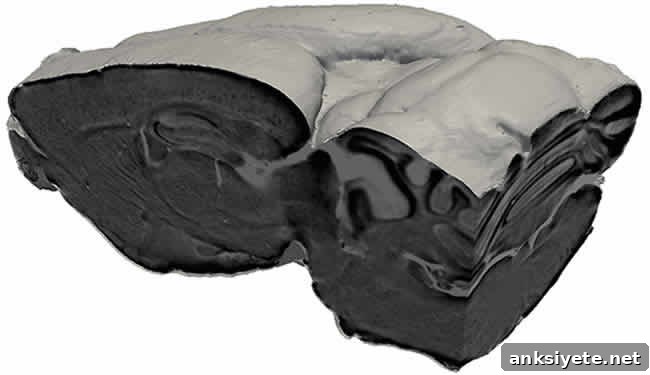
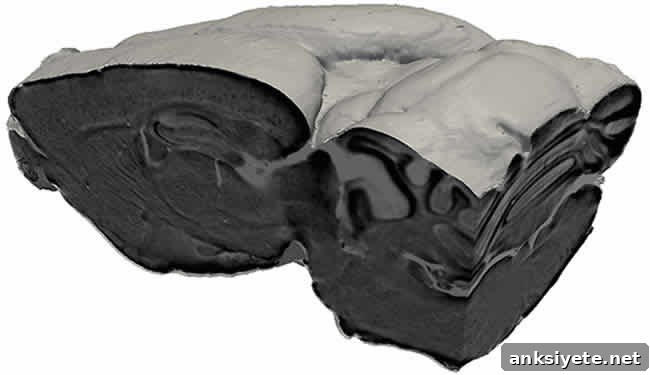
Alzheimer Plaques in 3D – Swiss researchers have generated detailed three-dimensional images that reveal the spatial distribution of amyloid plaques in the brains of mice with Alzheimer’s disease.
These amyloid plaques are extracellular accumulations of protein fragments and represent a hallmark of Alzheimer’s pathology. The new imaging approach offers an exceptionally precise research tool to study plaque formation and spread, and it could lay the groundwork for improved diagnostic techniques in the future. The results come from a collaboration between teams at the Paul Scherrer Institute (PSI) and ETH Zurich, and researchers at the École Polytechnique Fédérale de Lausanne (EPFL), and were published in the journal NeuroImage.
Mapping Plaque Distribution in Three Dimensions
Alzheimer’s disease accounts for approximately 60–80% of dementia cases and typically begins with memory impairment as regions involved in forming new memories are affected first. As the disease progresses, characteristic brain lesions—including amyloid plaques—spread to additional areas. Detecting and quantifying these plaques is critical for understanding disease progression and for developing diagnostics.
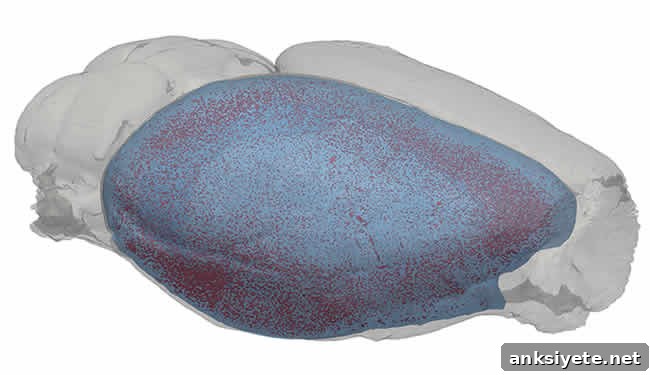
Until now, researchers commonly relied on histological methods: brains are sliced into thin sections, stained by hand, and examined under a microscope to locate individual plaques. While this remains a reliable approach, it is labor-intensive, time-consuming, and limited in the amount of three-dimensional information it can provide. The new method, based on grating-based differential phase contrast tomography (a form of phase contrast imaging), makes it possible to visualize single plaques throughout an intact brain volume with high spatial resolution, enabling comprehensive 3D maps of plaque distribution.
Phase Contrast Imaging at the Swiss Light Source
The experiments were performed at PSI’s Swiss Light Source (SLS), which produces intense, well-focused synchrotron X-rays. Unlike conventional X-ray imaging that measures attenuation (essentially the shadow cast by structures), phase contrast imaging also measures subtle shifts in the X-ray wavefront caused by differences in how tissues bend X-rays. These phase shifts are reconstructed into images that provide far greater contrast between soft tissues, allowing researchers to distinguish plaques from surrounding brain structures.
“Our instrument measures tiny X-ray phase shifts very precisely and transforms that data into clear images,” explains Marco Stampanoni, Professor of X-Ray Microscopy at ETH Zurich and Project Manager at PSI. The measuring station and experiment were specifically designed by the team to maximize sensitivity to these small optical effects.
Validation and Advantages Over Traditional Methods
Investigators validated the tomographic phase contrast results against the conventional histological gold standard and found excellent agreement. Because the new method images the intact brain, it provides a complete volumetric view that reveals plaque load and spatial patterns across the whole organ. The researchers used this capability to compare plaque distributions across mice at different disease stages, producing three-dimensional representations that make it possible to follow disease development in much greater detail than before.
Although the current implementation requires a high radiation dose for the resolution achieved—precluding use in living patients or animals—the technique is already a powerful research tool. It will enable more precise studies of how plaques form, how they spread through brain tissue, and how their distribution relates to clinical symptoms of Alzheimer’s disease.
Toward Better Diagnostic Tools
One important goal is to use phase contrast tomography as a benchmark to improve and validate in vivo diagnostic imaging methods, such as PET imaging that uses plaque-binding tracers to detect amyloid deposition. By directly comparing 3D images from PET and other diagnostic modalities with the high-resolution phase contrast tomographic maps produced ex vivo, researchers can evaluate the sensitivity and specificity of potential clinical markers and refine imaging protocols.
While use of phase contrast tomography in routine clinical diagnosis is not currently feasible due to dose constraints, the technique is driving translational work in other areas. For example, phase contrast imaging has shown promise in mammography pilot studies by revealing tissue contrast not visible in conventional X-ray mammograms, and prototypes are being developed for clinical settings.
Research Team and Publication
The study was carried out by researchers from the Paul Scherrer Institute (PSI), ETH Zurich, and the École Polytechnique Fédérale de Lausanne (EPFL). Key contributors include B. R. Pinzer, M. Cacquevel, P. Modregger, S. A. McDonald, J. C. Bensadoun, T. Thuering, P. Aebischer and M. Stampanoni. The full research appears in NeuroImage under the title “Imaging brain amyloid deposition using grating-based differential phase contrast tomography.”
Contacts and Notes
Contacts for this research include Dr. Bernd Pinzer (Laboratory for Macromolecules and Bioimaging, Paul Scherrer Institute), Prof. Marco Stampanoni (Laboratory for Macromolecules and Bioimaging, Paul Scherrer Institute; Institute for Biomedical Engineering, University of Zurich and ETH Zurich), Lionel Pousaz (EPFL press office), and Dr. Matthias Cacquevel (EPFL Brain Mind Institute).
Images used in this report are adapted from press images credited to Paul Scherrer Institut/B. Pinzer. The original research article provides further technical detail, methodology and quantitative results for grating-based differential phase contrast tomography applied to amyloid imaging.