
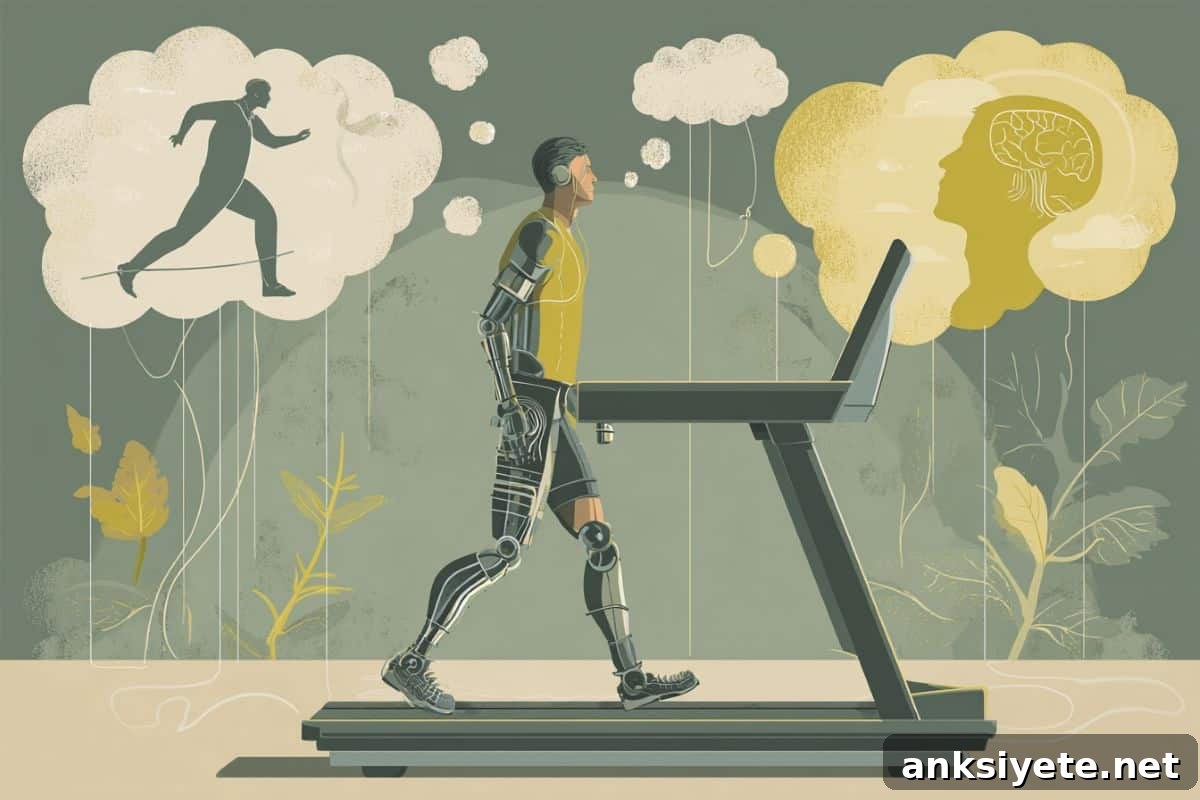
Summary: Learning to use a robotic prosthetic is not only a physical challenge but also a cognitive one. New research shows that a person’s body image—the internal map of how their body moves—has difficulty accurately representing robotic limbs. That mismatch can produce early pessimism about movement and later overconfidence, either of which may impede rehabilitation.
When people first try a robotic leg, they tend to judge their walking as more awkward and unsteady than objective measures show. As they train and movement improves, that perception can reverse: users begin to believe their gait is more natural and fluid than it actually is. This shift toward overconfidence can reduce motivation to continue refining technique and slow long-term recovery.
Key Facts
- Perceptual flip: Novice users overestimate awkwardness; more experienced users overestimate naturalness.
- Persistent inaccuracy: Even after clear gains in physical performance across days of practice, mental assessments of movement remained biased.
- Torso-centered judgments: Users judged their gait largely by how their torso felt and moved, not by the prosthesis’ behavior.
- Sensory feedback gap: Because robotic prostheses deliver little direct sensory feedback, the brain fills missing information with inaccurate assumptions.
- Clinical risk of overconfidence: Believing one’s gait is already ideal can create a training plateau and raise risk of long-term joint problems or falls.
Source: North Carolina State University
Why this matters: Our internal sense of body structure and motion—often called body image or proprioception—guides how we learn physical skills, from sports to everyday walking. In typical motor learning, repeated practice aligns the mental image of movement with actual movement, improving performance. This study explores how that process unfolds when a wearable robot becomes part of the body system.
“When people first start walking with a prosthetic leg, they think their bodies are moving more awkwardly than they really are,” explains Helen Huang, corresponding author of the study and Jackson Family Distinguished Professor of Biomedical Engineering. With practice, people still misjudge their movements, but the direction of the error changes: they become more confident and tend to overestimate the naturalness of their gait.
The researchers set out to answer whether and how users incorporate a robotic limb into their body image, whether that incorporation changes with experience, and whether perception relates to actual performance when training with a wearable robot.
Nine able-bodied participants walked with a robotic prosthetic attached to a knee fixed at a right angle over four days. Each session involved treadmill walking at the fastest comfortable speed without using handrails. After practice, participants watched animations showing a range of walking gaits and chose the animation that best matched how they thought they had walked.
Initially, participants rated their gait as more off-balance and mechanical than objective measures indicated. Over four days, objective gait performance improved significantly for all participants. Yet self-assessments remained inaccurate; by the end of training participants reported their gait as smoother and more natural than reality suggested. In short, performance improved but perception lagged and then became overconfident.
One clear pattern emerged: participants based their judgments largely on torso motion while paying little attention to the prosthetic limb itself. That focus likely stems from limited direct sensory signals from the device—unlike a biological limb, a robotic prosthesis does not provide proprioceptive feedback. Without that sensation, the brain relies on indirect cues, often producing a distorted internal model of movement.
These findings point to practical interventions. Providing targeted feedback—visual displays of one’s gait, real-time motion cues, or other sensory augmentation—could help users calibrate their body image to match actual motion. Correcting distorted self-assessments may preserve motivation to practice and reduce the risk of incomplete rehabilitation or secondary injuries.
Funding: This work was supported by the National Institutes of Health (grant R01HD110519) and the National Science Foundation (grant 2211739).
Key Questions Answered:
A: A robotic prosthetic does not provide the same internal “feeling” signals (proprioception) that a biological limb does. Without direct sensory feedback, the brain infers prosthetic motion from the way the torso and remaining limb feel, which often leads to inaccurate judgments.
A: Confidence helps morale, but perceptual overconfidence is risky. If a user believes their gait is already natural while objective measures show lingering instability or asymmetry, they may stop practicing and miss correcting issues that could cause pain or falls later.
A: The study suggests providing clear external feedback—such as video playback, graphical gait metrics, or other sensory cues—so users can calibrate their internal model to match real movement. Regular calibration during training may improve long-term outcomes.
Editorial Notes:
- This article was edited by a Neuroscience News editor.
- The journal paper was reviewed in full.
- Additional context was added by the editorial staff.
About this prosthetics and neuroscience research news
Author: Matt Shipman
Source: North Carolina State University
Contact: Matt Shipman – North Carolina State University
Image: The image is credited to Neuroscience News
Original Research: Open access. “Projecting the New Body: How Body Image Evolves During Learning to Walk with a Wearable Robot” by I-Chieh Lee, Huan Min, Ming Liu, He Huang. DOI: 10.1093/pnasnexus/pgag016
Abstract
Projecting the New Body: How Body Image Evolves During Learning to Walk with a Wearable Robot
Wearable robotics are reshaping how people move and how they perceive their own bodies. While these devices can enhance motor capability, less is known about how they affect the wearer’s subjective sense of bodily movement, especially for dynamic tasks like walking. This study tracked changes in perceived body image and gait performance over multi-day training with a robotic leg. Results show that practice improves objective gait patterns and that wearers begin to incorporate the prosthesis into their sensorimotor system. However, a persistent gap between perceived and actual motion remained, and later-stage perceptual overestimation could limit further motor gains. The findings emphasize the need for feedback strategies and frequent perceptual calibration to support effective training and embodied assistive technology development.