Summary: Thalamic inputs to the superficial layers of the cerebral cortex are sparse and individually weak, yet they display remarkable diversity in their distribution. Together, however, these varied inputs form a reliable and efficient representation of sensory information.
Source: Picower Institute for Learning and Memory
The cerebral cortex constructs perception from sensory signals relayed through the thalamus.
“How the thalamus communicates with the cortex is a fundamental aspect of how the brain interprets the world,” said Elly Nedivi, William R. and Linda R. Young Professor in The Picower Institute for Learning and Memory at MIT. Despite the thalamus’s crucial role, researchers have long been puzzled by the apparent scarcity of direct synaptic connections between thalamus and cortex and how such limited inputs can reliably support perception.
To tackle this question, Nedivi led a multidisciplinary collaboration within and beyond MIT, combining advanced imaging, tissue expansion, and computational modeling.
Published in Nature Neuroscience, the study shows that thalamic inputs onto superficial cortical neurons are not only rare and typically small, but also highly heterogeneous in number and location. Paradoxically, this heterogeneity supports reliable and efficient encoding of visual information when the inputs are considered collectively.
The researchers meticulously mapped every thalamic synapse on 15 layer 2/3 pyramidal neurons in mouse primary visual cortex, and then used biophysically detailed models to simulate how those inputs shaped neuronal responses to visual stimuli. They found that variability in synapse count and arrangement made different neurons selectively sensitive to distinct visual features. While individual neurons could not represent the entire stimulus faithfully, small ensembles of neurons could jointly decode the full visual signal with high accuracy.
“This heterogeneity appears to be a feature, not a flaw,” Nedivi said. “It reduces the synaptic cost of accurate readout, while providing flexibility and resilience to perturbation.”
Aygul Balcioglu, a research scientist in Nedivi’s lab and the lead author, emphasized the technical advance the work represents: tracking many individual inputs to a single neuron in a living, behaving animal and characterizing their identities and positions as they are active.
“Thousands of information streams converge onto a single neuron, which must integrate them before sending its own output,” Balcioglu said. “Our approach lets us identify and describe which inputs arrive where on a neuron’s structure in living animals — information that was previously inaccessible.”
Mapping inputs and expanding resolution
The team focused on layer 2/3 because it retains considerable plasticity in adulthood and has expanded significantly during evolution, making it particularly relevant for understanding human cortical function. Yet until now, comprehensive characterization of thalamic innervation in this layer was lacking.
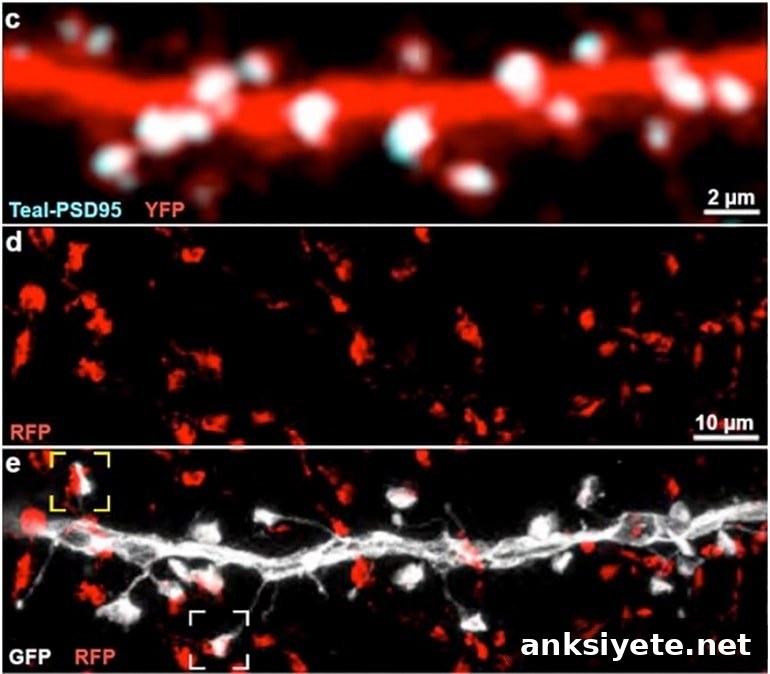
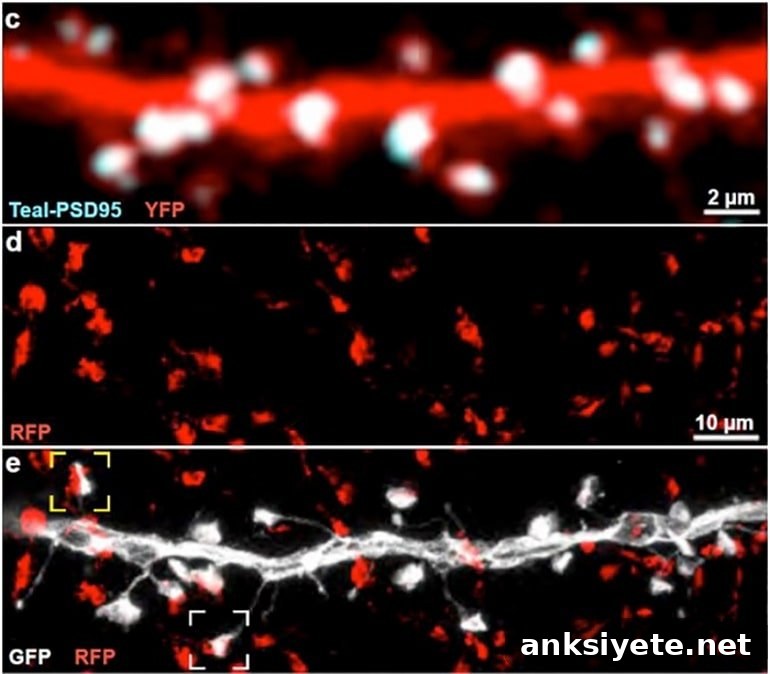
Using a multi-color labeling strategy developed in Nedivi’s lab, the researchers imaged whole cortical neurons in vivo under a two-photon microscope while labeling thalamic axons and excitatory synapses. Overlap between the thalamic label and synapse markers indicated candidate thalamocortical contacts. Two-photon imaging provides deep tissue access in living brain, but its resolution cannot definitively confirm synaptic contact.
To validate and resolve these candidate contacts, the team applied MAP, a tissue-expansion technique developed in the Picower Institute’s Chung lab. MAP physically enlarges biological tissue, boosting effective resolution so standard microscopes can resolve synaptic structures. Combining the labeling strategy with MAP allowed the researchers to confirm, count, map, and measure the sizes of all thalamic-cortical synapses on entire neurons.
This whole-cell synaptic mapping revealed that thalamic synapses were generally small and accounted for roughly 2–10 percent of a given neuron’s excitatory synapses. The number and density of thalamic inputs varied widely across neurons and even across different dendritic branches within the same neuron, with some branches receiving no thalamic contacts and others receiving nearly half of their excitatory synapses from thalamus.
Collective encoding: the “wisdom of the crowd”
These observations raised an important question: if thalamic inputs are sparse, small, and unevenly distributed, how can they reliably convey sensory information? To address this, Nedivi collaborated with computational neuroscientist Idan Segev (Hebrew University) and his student Michael Doron, who used the anatomical data and physiological properties from the Allen Brain Atlas to build anatomically accurate, biophysical models of the mapped neurons.
When the modeled neurons received simulated visual input (for example, drifting gratings), their electrical responses differed according to each cell’s unique thalamic innervation. Some cells were more responsive to contrast, others to shape or orientation, but no single neuron fully represented the entire stimulus. Importantly, ensembles of roughly 20 such neurons could collectively decode the visual input with high fidelity — a neural “wisdom of the crowd.”
Segev compared ensembles with realistic sparse, weak, and heterogeneous thalamic inputs to hypothetical ensembles composed of many copies of the single best-performing neuron. For total synapse counts up to about 5,000, the “best” homogeneous ensemble performed better. Above that threshold, however, the heterogeneous ensemble matched and then surpassed the homogeneous one. To achieve 90 percent decoding accuracy, the heterogeneous group required about 6,700 synapses, while the homogeneous best-cell group needed over 7,900.
“Heterogeneity lowers the synaptic cost required for accurate readout of visual features,” the authors conclude.
Nedivi noted two implications: the small size of thalamic synapses suggests they may be highly plastic, and the advantage of diverse inputs may generalize beyond visual processing in layer 2/3. Further experiments will be needed to determine how broadly these principles apply.
In addition to Nedivi, Balcioglu, Gillani, Ku, Chung, Segev, and Doron, the study’s authors include Kendyll Burnell and Alev Erisir.
Funding: The National Eye Institute (NIH), the Office of Naval Research, and the JPB Foundation supported this research.
About this neuroscience and perception research news
Author: David Orenstein
Source: Picower Institute for Learning and Memory
Contact: David Orenstein – Picower Institute for Learning and Memory
Image: The image is credited to Nedivi Lab/MIT Picower Institute
Original Research: Closed access.
“Mapping thalamic innervation to individual L2/3 pyramidal neurons and modeling their ‘readout’ of visual input” by Elly Nedivi et al. Nature Neuroscience
Abstract
Mapping thalamic innervation to individual L2/3 pyramidal neurons and modeling their ‘readout’ of visual input
The thalamus is the principal gateway for peripheral sensory signals to the mammalian cerebral cortex. A longstanding puzzle is the mismatch between the thalamus’s central feedforward role and the relative sparsity of thalamocortical synapses reported in cortex.
Here we combine genetic labeling with scalable tissue expansion microscopy to map synapses onto entire layer 2/3 pyramidal cells in mouse primary visual cortex, quantifying the number, density, and size of thalamic versus cortical excitatory synapses.
We find that thalamic inputs are sparse and highly heterogeneous across neurons and dendritic branches, and that thalamic synapses are generally smaller than cortical synapses. Incorporating these measurements into anatomically faithful biophysical models shows how neurons with sparse, weak thalamocortical inputs, when assembled into small heterogeneous ensembles, can reliably read out visually driven thalamic signals.