
Regions of parrots’ brains likely duplicated at least 29 million years ago
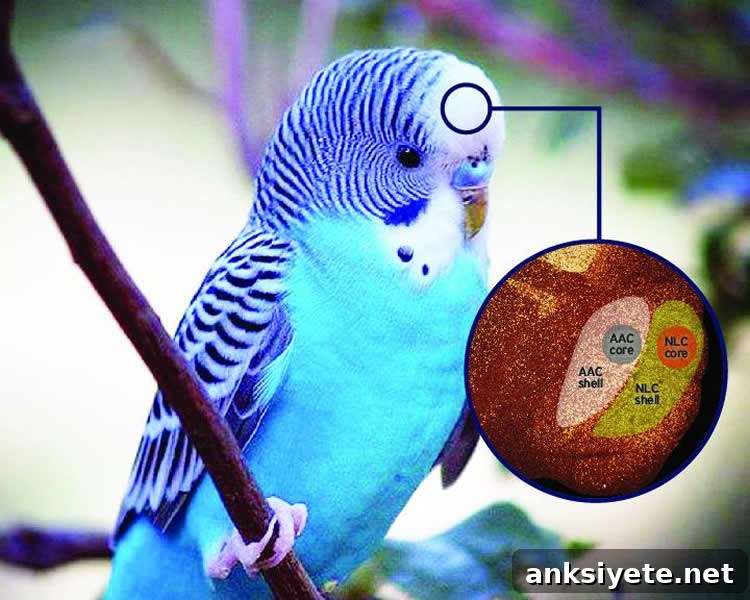
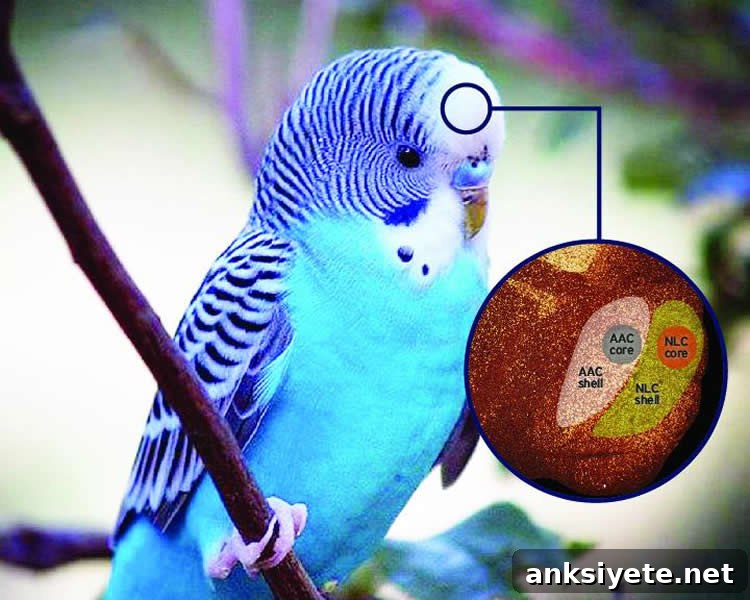
An international team led by researchers at Duke University has identified previously unrecognized structural features of parrot brains that may explain their exceptional talent for imitating sounds, including human speech. The study, reported June 24 in PLOS ONE, describes a nested “core and shell” organization in the parrot vocal-learning system that had been overlooked in decades of prior work.
By analyzing gene expression and neural connectivity across multiple parrot species, the researchers found that parrots possess distinct inner “core” vocal centers surrounded by outer “shell” rings that also participate in vocal learning. The shell regions are proportionally larger in species best known for vocal mimicry, suggesting a relationship between shell size and imitation ability.
“This finding opens up a major new avenue of research into how parrots process information to copy novel sounds and what neural mechanisms underlie their capacity to reproduce human speech,” said Mukta Chakraborty, a postdoctoral researcher in the lab of Erich Jarvis, associate professor of neurobiology at Duke and a Howard Hughes Medical Institute investigator.
Vocal learning—the ability to imitate sounds—is rare in the animal kingdom and is found in only a few bird groups: parrots, songbirds and hummingbirds. Although researchers have long noted differences in the sizes of certain brain regions among these groups, the presence of a layered core-and-shell structure unique to parrots had not been established.
Previous investigations of parrot neural anatomy focused mainly on the budgerigar (the common pet parakeet). To broaden the comparative picture, this collaboration included donated brain tissue from researchers in Denmark and the Netherlands and examined eight additional parrot species: conures, cockatiels, lovebirds, two Amazon parrot species, a blue-and-gold macaw, the New Zealand kea and the African grey parrot.
The team searched for specific gene markers known to show specialized activity in the brains of humans and song-learning birds, then compared those expression patterns with neural-tracing experiments in budgerigars. These complementary approaches revealed that parrots have a distinctive nested organization: a core system that closely resembles the vocal-learning circuits of songbirds and hummingbirds, and an outer shell that is unique to parrots and also engaged during vocal behavior.
Even the kea, one of the most evolutionarily basal living parrot species, displays a rudimentary shell region. That observation implies the core-and-shell arrangement emerged at least 29 million years ago. The presence of both core and shell across diverse parrots indicates this nested architecture is an ancient and conserved feature of the parrot lineage.
For years, there was disagreement about whether the regions surrounding the established vocal cores were distinct structures or simply extensions of the same circuit. In earlier work, some researchers treated core and shell as one continuous region, contributing to varying estimates of the brain areas responsible for vocal learning. To address these inconsistencies, Jarvis collaborated with colleagues including Steven Brauth and Sarah Durand to reexamine the anatomical and molecular evidence across species.
“When Mukta and I examined the new data, it was striking how obvious the shell becomes once you know what to look for,” Jarvis said. “It highlights how scientific expectations and search strategies can shape what we notice in brain anatomy.”
The discovery supports the broader hypothesis that vocal learning systems in birds and humans may have arisen through duplication of neural pathways—essentially creating a mirrored or copied circuit that could be adapted for specialized functions. Exactly how such a duplication could have occurred remains an open question.
Most bird vocal-learning regions are embedded within motor-control areas. In parrots, those surrounding motor regions show distinctive gene-expression patterns as well, which could help explain not only parrots’ vocal mimicry but also their propensity for complex motor behaviors such as dancing to music.
“Imitating another species’ sounds requires substantial neural resources to process auditory input and to coordinate the motor sequences that produce matching vocalizations,” Chakraborty explained. “We still need to determine whether parrots’ capabilities arise from a small set of specialized genes, from novel neural projections, or from other circuit-level differences.”
The research team is particularly interested in testing whether the shell regions directly enhance parrots’ ability to reproduce human speech. If the shells do confer greater imitation capacity, that would answer a long-standing question in the field about what makes parrots such exceptional vocal learners.
This work is part of a larger international initiative to sequence the genomes of all bird species over the coming years, known as the Bird 10K Project, which will provide broader evolutionary context for studies of vocal learning and brain evolution.
Other contributors to the study include Solveig Walløe and Torben Dabelsteen from the Department of Biology at the University of Copenhagen; Signe Nedergaard, now at the National Centre of Forensic Services in Vanløse, Denmark; Emma Fridel of Duke; Bente Pakkenberg of Bispebjerg University Hospital in Copenhagen; Mads Bertelsen of the Copenhagen Zoo; Gerry Dorrestein of the Dutch Research Institute of Avian and Exotic Animals; Steven Brauth of the University of Maryland, College Park; and Sarah Durand of LaGuardia Community College in New York.
Funding The research received support from the Howard Hughes Medical Institute and the National Institutes of Health (DP1 OD000448), with additional assistance from the University of Copenhagen, Framework Grants from the Danish Council for Independent Research, and the Copenhagen Zoo.
Source: Karl Bates — Duke University
Image Credit: Jonathan E. Lee, Duke University
Original Research: Full open-access research titled “Core and Shell Song Systems Unique to the Parrot Brain” by Mukta Chakraborty et al., published in PLOS ONE, June 24, 2015 (doi:10.1371/journal.pone.0118496).
Abstract
Core and Shell Song Systems Unique to the Parrot Brain
Imitation of complex sounds is uncommon in the animal kingdom and among birds is limited to parrots, songbirds and hummingbirds. Parrots display the most sophisticated vocal mimicry observed outside humans. Earlier studies noted differences in connectivity and shape of vocal learning systems in parrots compared with songbirds and hummingbirds, but detailed comparisons were limited because only a single parrot species, the budgerigar, had been thoroughly examined. To investigate whether parrots possess distinctive vocal circuits, this study combined constitutive and activity-dependent gene-expression mapping with neural connectivity tracing across multiple parrot species. Results reveal that parrots uniquely possess a nested song system: an inner “core” comparable to the song systems of songbirds and hummingbirds, and an outer “shell” system exclusive to parrots. The kea exhibits a rudimentary shell, indicating that the core-and-shell arrangement existed in early parrot evolution at least 29 million years ago. Species-level differences in the relative sizes of core and shell regions may relate to variation in vocal and cognitive abilities among parrots.
“Core and Shell Song Systems Unique to the Parrot Brain” by Mukta Chakraborty, Solveig Walløe, Signe Nedergaard, Emma E. Fridel, Torben Dabelsteen, Bente Pakkenberg, Mads F. Bertelsen, Gerry M. Dorrestein, Steven E. Brauth, Sarah E. Durand and Erich D. Jarvis. PLOS ONE. Published online June 24, 2015. doi:10.1371/journal.pone.0118496