
Summary: Researchers have measured synchronized brain activity between infants and adults while they interact during play.
Source: Princeton University
Have you ever played with a baby and felt an unmistakable connection even though the child can’t yet speak? New research indicates that this feeling may reflect real neural synchrony: similar patterns of brain activity in both baby and adult occurring at the same time.
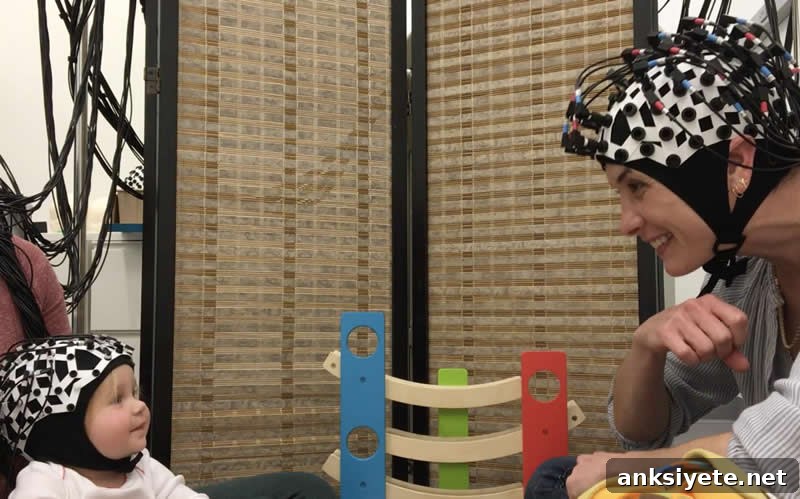
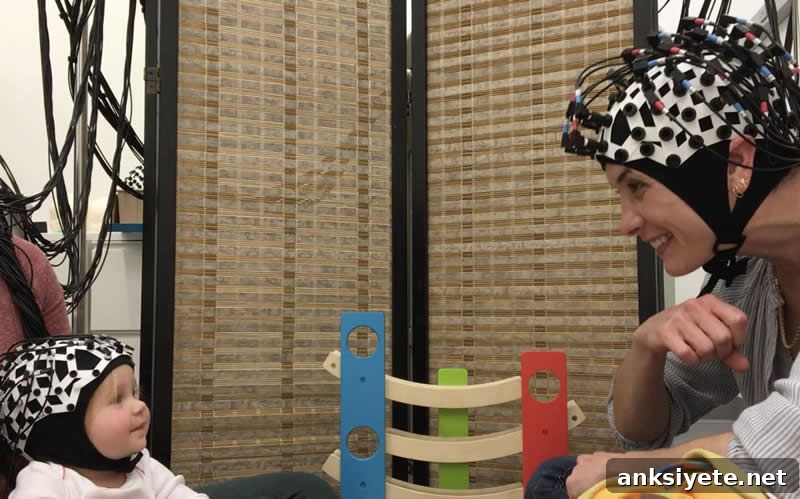
A team at the Princeton Baby Lab conducted the first study to measure how infant and adult brains coordinate during natural, face-to-face play. Using a child-friendly dual-brain recording method, the researchers found that neural activity in infants and adults rose and fell together while they shared toys, made eye contact, sang, and listened to a story. This work offers a window into how early social interaction shapes learning and attention.
“Past work has shown that adults’ brains synchronize when they watch movies or listen to stories, but we know little about how this kind of neural synchrony emerges in infancy,” said Elise Piazza, an associate research scholar in the Princeton Neuroscience Institute and lead author of the study published Dec. 17, 2019, in Psychological Science.
Piazza and her colleagues — Liat Hasenfratz, Uri Hasson and Casey Lew-Williams — proposed that neural synchrony plays an important role in social development and early language learning. To test this idea, they needed a way to measure both infant and adult brain activity at the same time during natural interactions, a challenge because most neuroimaging studies use methods that are not suitable for live face-to-face play.
Instead of conventional fMRI, which requires participants to lie still inside a scanner, the team used functional near-infrared spectroscopy (fNIRS). fNIRS is safe and mobile and measures changes in blood oxygenation as a proxy for neural activity. With support from the Eric and Wendy Schmidt Transformative Technology Grant, the researchers built a dual-brain fNIRS system designed specifically for interactions between infants and adults. The system enabled continuous recording from both members of the dyad while they engaged in play, singing and reading.
The study tested 42 infants and toddlers, all interacting with the same adult experimenter. Many could not be included in the final analysis: 21 infants were excluded because they moved excessively, and three refused to wear the recording cap. The final sample consisted of 18 children between 9 and 15 months of age.
Each session had two conditions. In the interactive condition, the adult sat facing a child on a parent’s lap for five minutes, exchanging toys, singing nursery rhymes and reading Goodnight Moon. In the control condition, the adult turned away to tell a story to another adult while the child played quietly with a parent. The fNIRS caps measured activity across 57 channels located over brain regions linked to prediction, language processing and understanding other people’s perspectives.
Results showed clear neural coupling in the interactive condition. When infants and the adult engaged directly, their brains synchronized in several areas associated with high-level processing — regions that help interpret stories, anticipate actions and infer others’ intentions. This synchrony diminished when the pair were not interacting directly, consistent with the idea that live social engagement drives brain-to-brain coordination.
The data also revealed unexpected patterns. The strongest synchronization appeared in the prefrontal cortex, a region tied to planning, learning and executive function that is often thought to be immature in infancy. Equally striking, analyses suggested that infants’ brain activity sometimes led the adult’s activity by a few seconds. This hints that infants are not merely passive recipients of input: their behavior and attention may actively shape the adult’s focus and the course of interaction, for example by prompting which toy the adult picks up or which words the adult uses next.
“During communication, adult and infant brains appear to form a feedback loop,” Piazza said. “The adult’s brain anticipated when infants would smile; infants’ brains anticipated when the adult would switch to baby-directed speech. Both brains tracked moments of joint eye contact and shared attention to objects. In short, playing together creates dynamic, mutual influence at the neural level.”
This two-brain, naturalistic approach can help researchers explore how caregiver-child coupling develops and how it may differ in atypical development, including conditions such as autism. It may also inform educators and caregivers about how to better align interactions with children’s attention and learning needs. The research team is continuing to examine how neural synchrony during early interactions relates to later language outcomes in preschoolers.
Funding: The study received support from the Princeton University C. V. Starr Fellowship awarded to E. A. Piazza; the Eric and Wendy Schmidt Transformative Technology Award granted to E. A. Piazza, U. Hasson and C. Lew-Williams; National Institutes of Health Grant 5DP1HD091948 to U. Hasson; and NIH Grants R01HD095912 and R03HD079779 to C. Lew-Williams.
Source:
Princeton University
Media Contacts:
Liz Fuller-Wright – Princeton University
Image Source:
Image credited to Elise Piazza, Princeton Baby Lab.
Original Research (citation):
“Infant and adult brains are coupled to the dynamics of natural communication.” Elise A. Piazza, Liat Hasenfratz, Uri Hasson and Casey Lew-Williams. Psychological Science. doi: 10.1177/0956797619878698. (Closed access)
Abstract
Infant and adult brains are coupled to the dynamics of natural communication
Infancy is a foundational period for learning from adults, and the dynamics of the social environment are central to children’s development. This study introduces a naturalistic method for recording live interactions between infants and adults. Using fNIRS, we simultaneously measured brain activity from infants (N = 18; 9–15 months) and an adult while they communicated and played. Time-locked neural coupling within dyads was significantly greater during direct interaction than during control conditions. We also linked neural activation to moment-to-moment behaviors including mutual gaze, joint attention to objects, infant emotion and adult speech prosody. These findings expand our understanding of how infants’ and adults’ brains mutually influence one another during real-life communication.