
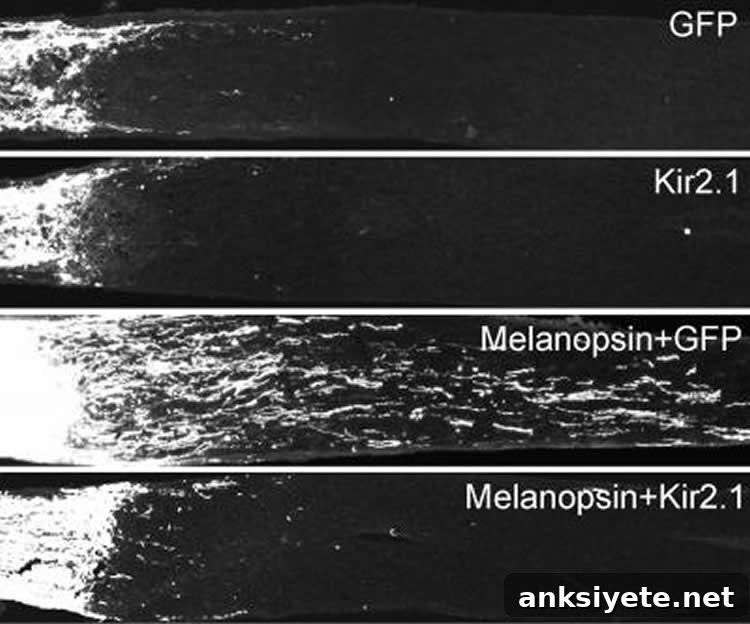
Damage to axons in the central nervous system (CNS) typically leads to lasting functional deficits. Enhancing the intrinsic growth capacity of neurons can markedly improve axon regeneration after injury. If injured neurons can regrow a sufficient number of axons, the CNS may recover and restore lost functions.
Researchers at the Hong Kong University of Science and Technology (HKUST) recently demonstrated that axon regenerative capacity can be increased by stimulating neuronal activity through optogenetic and chemogenetic strategies. Their work shows that overexpressing the photopigment melanopsin in the retina enhances the firing of retinal ganglion cells (RGCs) and promotes axon regeneration after optic nerve crush by activating the mammalian target of rapamycin (mTOR) signaling pathway. The team also achieved similar regenerative effects by activating Gq signaling in RGCs using Designer Receptors Exclusively Activated by Designer Drugs (DREADD), a chemogenetic tool commonly used to raise neuronal activity.
The study, led by Kai Liu, assistant professor in the Division of Life Science at HKUST, was published online in the early edition of PNAS on February 1, 2016. The researchers used adeno-associated virus (AAV) vectors to overexpress melanopsin in RGCs of adult mice and assessed axon growth after optic nerve injury. They observed clear axonal regeneration within two weeks. This regenerative response depended on light stimulation and increased neuronal firing, which together sustained mTOR signaling in the injured RGCs.
To probe the downstream pathway of melanopsin and test an alternative method to elevate neuronal activity, the authors used a chemogenetic approach. They injected AAVs expressing a Gq-coupled DREADD into the eyes of mice and administered the synthetic agonist clozapine-N-oxide (CNO) daily. Activation of Gq signaling through DREADD-Gq produced a significant increase in axonal growth comparable to the effect achieved with melanopsin overexpression.
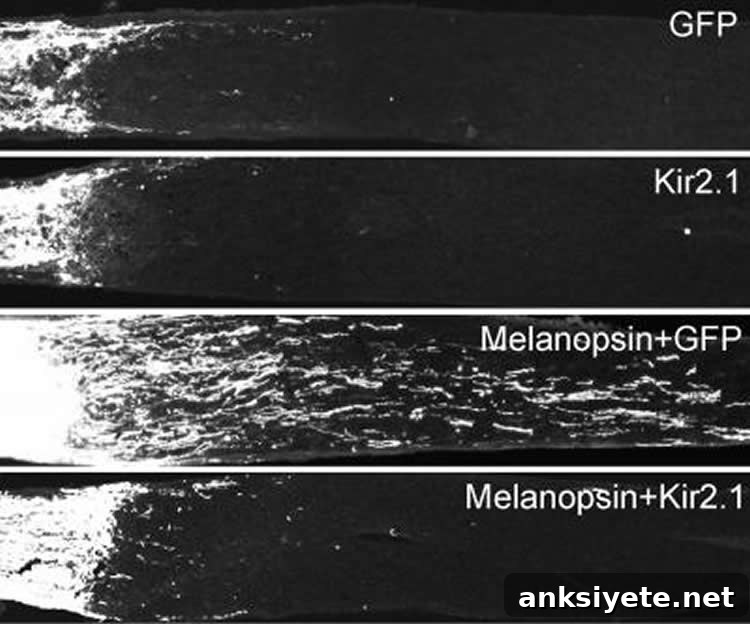
“Our results show that melanopsin boosts axon regeneration by enhancing mTORC1 in a neuronal activity–dependent manner,” Liu explained. Melanopsin activates Gq/11 signaling, which increases neuronal activity and calcium influx to levels likely required to sustain long-term mTOR activation in RGCs. In turn, elevated mTORC1 supports the cellular growth program necessary for axonal regrowth.
These findings build on earlier work from Liu’s group demonstrating that genetic inhibition of PTEN can activate mTOR and promote corticospinal tract regeneration after spinal cord injury. Together, these studies highlight mTOR as a central regulator of regenerative capacity in adult CNS neurons and identify neuronal activity—modulated through GPCR signaling—as a practical lever to enhance regeneration. The authors suggest that interventions which safely increase neuronal firing and engage mTOR signaling could provide a relatively simple and effective strategy to facilitate neural repair after injury.
Funding: This project was supported by the Hong Kong Research Grants Council and the Hong Kong Spinal Cord Injury Foundation.
Source: Sherry No, HKUST
Image credit: Division of Life Science, HKUST.
Original research: “Promoting axon regeneration in the adult CNS by modulation of the melanopsin/GPCR signaling,” published in PNAS, February 1, 2016. Authors: Songshan Li, Chao Yang, Li Zhang, Xin Gao, Xuejie Wang, Wen Liu, Yuqi Wang, Songshan Jiang, Yung Hou Wong, Yifeng Zhang, and Kai Liu.
Abstract
Promoting axon regeneration in the adult CNS by modulation of the melanopsin/GPCR signaling
Cell-type–specific G protein–coupled receptor (GPCR) signaling orchestrates neuronal responses and plays essential roles during development in axon guidance and targeting. Its role in axonal regeneration in the mature CNS is less well defined. The authors found that certain intrinsically photosensitive retinal ganglion cells (ipRGCs) in mice retain elevated mTOR levels after axotomy, and that the light-sensitive GPCR melanopsin mediates this sustained expression. Overexpressing melanopsin in RGCs stimulated axonal regeneration after optic nerve crush by up-regulating mTOR complex 1 (mTORC1), with an extent of regeneration comparable to that produced by Pten knockdown. Both melanopsin-enhanced axon regeneration and increased mTOR activity required light stimulation and Gq/11 signaling. Direct activation of Gq in RGCs elevated mTOR activation and promoted axonal regrowth. Melanopsin overexpression amplified both the amplitude and duration of RGC light responses, and silencing these neurons with Kir2.1 significantly reduced the melanopsin-induced increases in mTOR signaling and axon regeneration. These results support a strategy to promote axon regeneration after CNS injury by modulating neuronal activity through GPCR signaling.