
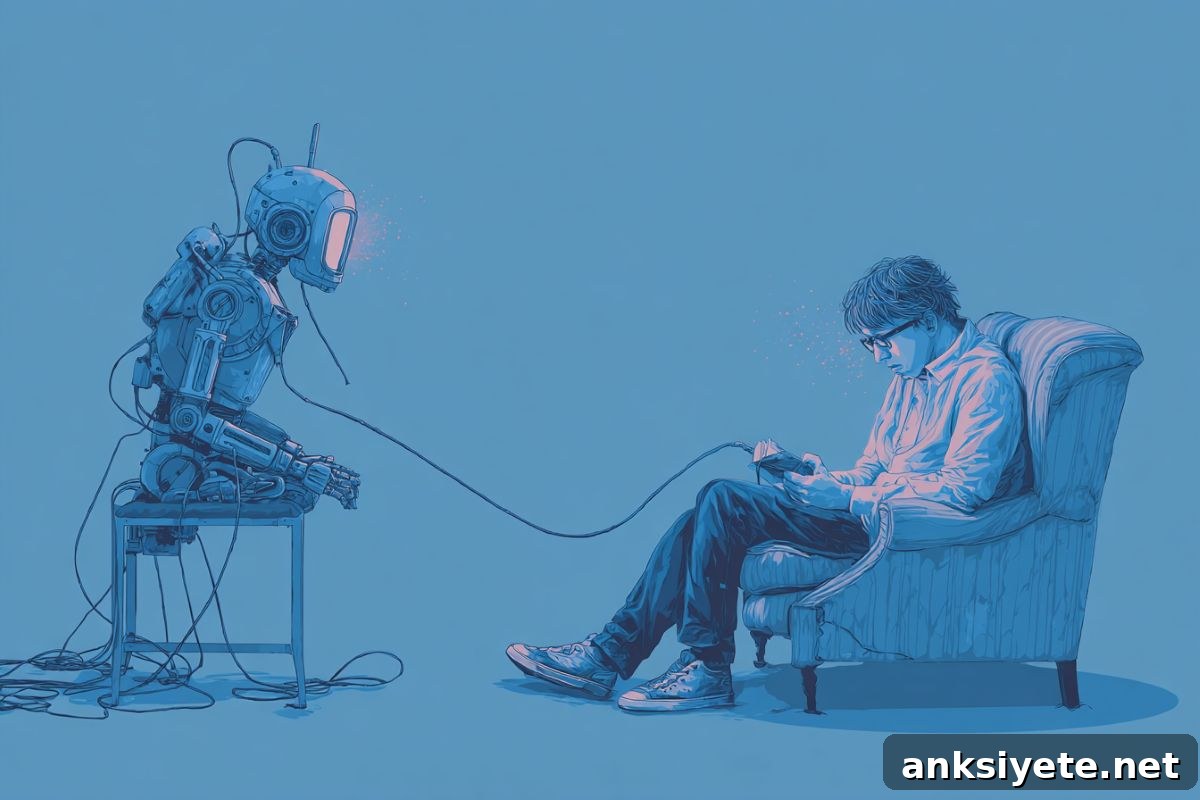
Summary: A new Drexel University study finds that while people increasingly turn to general-purpose AI chatbots for emotional and mental health support, most users treat these systems as supplements to — not replacements for — human therapy. The research analyzed more than 4 million Reddit posts to map how people interact with large language models for mental health needs and reveals a central “bond paradox”: AI can be highly effective for task-focused support but risks harmful emotional dependence when used primarily for companionship or repeated reassurance.
Key Facts
- Widespread adoption: Recent surveys and studies indicate a rapid rise in use of AI language models for mental-health purposes. A 2025 American Psychological Association survey reported that nearly half of U.S. adults aged 18–80 used AI tools for mental health in the past year. Separate research found that about one in eight young adults turn to AI programs for mental-health advice.
- Large-scale Reddit analysis: Led by Dr. Shadi Rezapour, the research team applied natural language processing to over 4 million posts across 47 mental-health subreddits, isolating a curated sample of 5,126 posts for detailed qualitative analysis.
- Two kinds of support: Users commonly seek AI for emotional reassurance, anxiety management, coping strategies and companionship. At the same time, many rely on these tools for practical, executive-function support—help with organization, planning and tasks often associated with ADHD and autism.
- The “bond paradox”: Interactions that are task-oriented—reflection, goal-setting, learning coping skills—generally produce positive outcomes. But interactions driven primarily by emotional bonding or endless reassurance-seeking often coincide with increased emotional dependence, worsening symptoms, and difficulty disengaging from the system.
- Users prefer AI as a supplement: Across the discussions, users expressed cautious attitudes: 51% of posts explicitly discussed the risks, limitations or potential harms of using AI as therapy. Most framed AI as complementary to human clinicians or as a short-term bridge when professional care is inaccessible.
- Design and safety implications: Because general-purpose chatbots are not clinically validated treatments, the study’s authors call for stricter engineering boundaries. AI systems meant to support mental health should include safeguards, evidence-based frameworks, and mechanisms that discourage dependency and enable safe disengagement.
Study overview
Researchers from Drexel’s College of Engineering and Computing examined how people use AI chatbots in everyday settings and how they view the responses they receive. The team applied sociological frameworks traditionally used to assess therapist-client bonds and technology adoption to better understand when AI helps and when it harms. Findings will be presented at the 2026 Annual Meeting of the Association for Computational Linguistics.
“People are increasingly turning to general-purpose AI chatbots for mental health support, but these programs were not designed or clinically validated for that purpose,” said Shadi Rezapour, PhD, assistant professor in the School of Computer and Information Sciences and lead investigator. “We wanted to understand real-world use: where AI adds value and where it introduces risks.”
The analysis revealed two distinct patterns. When users engaged AI for concrete tasks—organizing thoughts, practicing coping techniques, planning daily activities—the interactions were experienced as helpful and empowering. Conversely, when users sought limitless emotional comfort, companionship, or repeated reassurance without clear goals, the relationship often became harmful: reports described emotional dependence, worsening mental-health symptoms, shame, guilt and problems disengaging from the chatbot.
These findings point to the importance of designing mental-health AI with clear boundaries. “AI should not simply be engineered to feel warm or human-like,” said Elham Aghakhani, the study’s lead author. “Systems need safeguards and exit strategies, especially for use cases prone to dependency.”
Key Questions Answered:
A: Chatbots are instantly accessible, anonymous, and available 24/7. Users often seek immediate reassurance for anxiety, help mapping coping strategies, or support organizing tasks tied to attention differences. For many, a chatbot is a stopgap when professional care is unaffordable or unavailable.
A: The bond paradox describes a split in outcomes: task-oriented use of AI tends to be beneficial, while efforts to form deep emotional bonds or seek endless comfort from AI frequently lead to harmful dependency and worsening mental-health symptoms.
A: No. The study shows most users view AI as a supplement, not a substitute. Over half of discussions highlighted risks and limits; many people explicitly use AI alongside human care or only when clinicians are inaccessible.
Editorial Notes:
- This article was edited by a Neuroscience News editor.
- Journal paper reviewed in full.
- Additional context added by editorial staff.
About this AI and psychology research news
Author: Britt Faulstick
Source: Drexel University
Contact: Britt Faulstick – Drexel University
Image: Image credit: Neuroscience News
Original research: Findings to be presented at the 2026 Annual Meeting of the Association for Computational Linguistics.