
Summary: New research suggests a likely cause of vision problems experienced by astronauts on long-duration space missions.
Source: RSNA
Researchers report that vision problems observed in astronauts after extended missions are linked to changes in the volume of cerebrospinal fluid (CSF), the clear fluid that surrounds the brain and spinal cord. These findings were presented at the annual meeting of the Radiological Society of North America (RSNA).
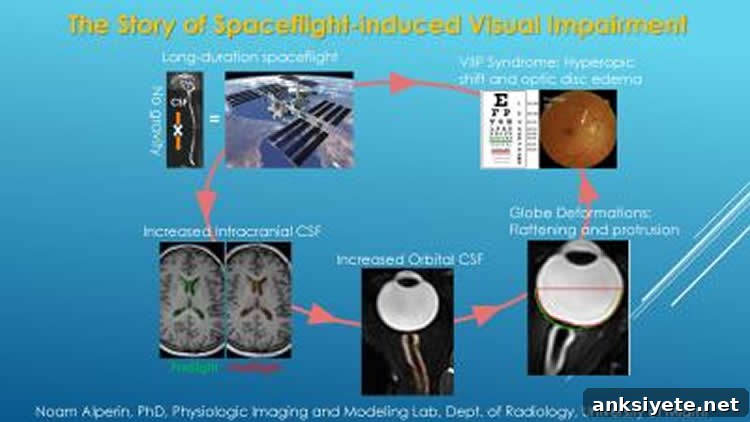
Over the past decade, NASA flight surgeons and scientists have identified a recurring pattern of visual impairment in astronauts who complete long-duration missions in microgravity. Affected crew members reported blurred vision, and medical imaging found several notable structural changes: the back of the eyeball (the globe) was flattened in some cases and the optic nerve head showed signs of swelling. This collection of signs and symptoms has been characterized as visual impairment intracranial pressure (VIIP) syndrome and has been observed in a substantial portion of astronauts returning from extended stays on the International Space Station (ISS).
“When these cases first appeared, clinicians and researchers were uncertain about the cause, but by 2010 it became clear that some astronauts had pronounced structural changes that did not fully reverse after returning to Earth,” said Noam Alperin, Ph.D., professor of radiology and biomedical engineering at the University of Miami Miller School of Medicine, who led the study.
Initial hypotheses focused on a shift of vascular fluid toward the head that occurs in microgravity, but Dr. Alperin and colleagues examined a different contributor: cerebrospinal fluid. CSF cushions the brain and spinal cord, distributes nutrients, and clears metabolic waste. On Earth the CSF system is adapted to handle posture-related hydrostatic pressure changes that occur when a person stands, sits or lies down. In microgravity, however, those normal pressure gradients are absent, and the CSF system may respond differently.
“The CSF system is designed around the gravity-related changes we experience on Earth. In space, without those posture-driven pressure differences, the system appears to behave in ways that can adversely affect the eye,” Dr. Alperin said.
To investigate the role of CSF in spaceflight-related ocular changes, the research team performed high-resolution MRI scans of the orbits and brains of seven astronauts before and shortly after long-duration ISS missions. They compared those results with MRI data from nine astronauts who flew shorter shuttle missions. Using advanced quantitative imaging algorithms, the investigators measured CSF volumes both around the optic nerves inside the orbit (intraorbital CSF) and within the brain’s ventricles (ventricular CSF), and they analyzed associations between CSF volume changes and structural alterations in the visual system.
The analysis showed that astronauts who completed long-duration missions experienced significantly greater post-flight flattening of the eye globe and increased protrusion of the optic nerve compared with short-duration crewmembers. Long-duration astronauts also exhibited larger post-flight increases in intraorbital CSF volume and in ventricular CSF volume. In other words, the more substantial ocular deformations seen in ISS crew members were associated with larger increases in CSF volume both around the optic nerves and within the brain.
“These results provide the first quantitative evidence, directly comparing short- and long-duration crewmembers, that implicates CSF volume changes as a primary driver of the globe deformations observed in astronauts with visual impairment syndrome,” Dr. Alperin said.
The researchers found no significant post-flight changes in overall brain gray or white matter volume in either the short- or long-duration groups. That indicates the observed ocular changes are more closely associated with alterations in CSF distribution than with generalized brain volume changes.
Understanding the origin of space-induced ocular changes is essential for developing effective countermeasures to protect astronauts on future long-duration missions, Dr. Alperin emphasized. If structural changes to the eye are not detected and addressed early, they may become permanent. As the eye globe flattens, astronauts can develop hyperopia (far-sightedness), which can impair performance during missions and affect quality of life after return to Earth.
NASA is actively investigating models to reproduce the conditions that lead to VIIP and is testing possible countermeasures. Identifying the specific mechanisms—such as how microgravity disrupts normal CSF dynamics—will guide the design of targeted interventions to prevent or reduce the risk of vision changes in space.
Co-authors on the study include Ahmet M. Bagci, Ph.D., Sang H. Lee, M.S., and Byron L. Lam, M.D.
Source: Linda Brooks – RSNA
Image credit: RSNA
This report summarizes findings presented at the RSNA annual meeting and reflects analyses comparing MRI measurements taken before and after spaceflight. The focus is on the association between increases in cerebrospinal fluid volume and structural changes in the eye and optic nerve seen after long-duration missions on the International Space Station.