
Summary: The stress hormone cortisol reduces altruistic choices and changes activity in the dorsolateral prefrontal cortex, especially in people with stronger capacity to infer others’ mental states.
Source: SfN
New research published in The Journal of Neuroscience shows that cortisol—the hormone released during stress—can reduce charitable giving and alter neural value representations in brain regions involved in social decision-making, but these effects are most pronounced in people with higher mentalizing ability (the skill of imagining others’ thoughts and feelings).
Researchers at Universität Hamburg measured how much participants donated to various charities before and after a psychosocial stress task that involved public speaking, while recording brain activity with functional magnetic resonance imaging (fMRI). To make donations personally costly, participants kept a portion of the money they did not give away.
Before the stress task, participants who scored higher on independent tests of mentalizing generally donated more than those with lower mentalizing ability. After the stress manipulation, increases in salivary cortisol predicted reduced donations, but only among these high mentalizers. Participants with lower mentalizing capacity showed no reliable change in generosity with cortisol increases.
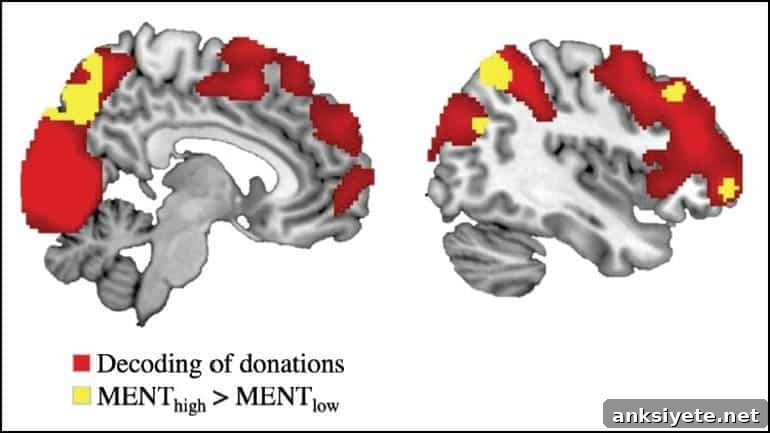
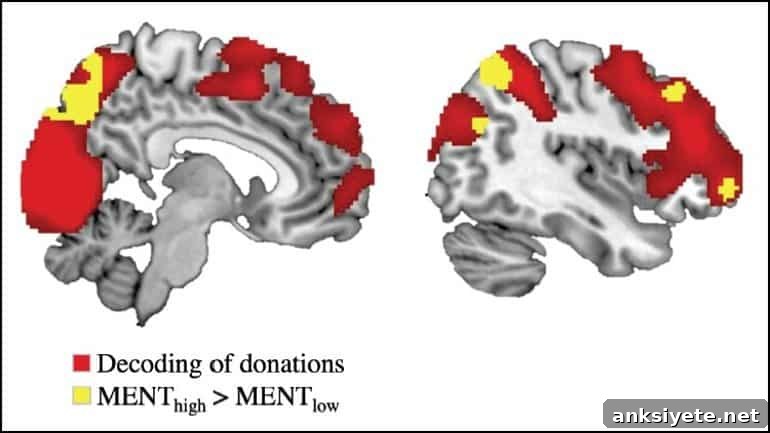
Multivariate analyses revealed that activity patterns in the right dorsolateral prefrontal cortex (rDLPFC)—a region implicated in social decision-making and value representation—predicted how high mentalizers would allocate money to charity. When cortisol levels rose, the predictive relationship between rDLPFC activity and donation choices weakened, suggesting that stress diminished the neural representation of charitable value in this region.
Taken together, the behavioral and neuroimaging data indicate that cortisol can selectively disrupt the neurocognitive processes high mentalizers use to make altruistic decisions. In other words, people who normally rely on mentalizing to guide prosocial behavior appear more vulnerable to stress-related reductions in generosity because cortisol interferes with value coding in the DLPFC.
About this neuroscience and altruism research news
Author: Press Office
Source: SfN
Contact: Press Office – SfN
Image: The image is credited to Schulreich et al
Original Research: Closed access.
“Altruism under stress: cortisol negatively predicts charitable giving and neural value representations depending on mentalizing capacity” by Schulreich et al. Journal of Neuroscience
Abstract
Altruism under stress: cortisol negatively predicts charitable giving and neural value representations depending on mentalizing capacity
Altruism—defined as costly behavior that benefits others—varies widely across individuals and situations. One common context for social choices is exposure to acute stress. This study examined how stress affects charitable decision-making and which neurocognitive mechanisms mediate any changes.
Participants of both sexes completed a donation task inside an fMRI scanner before and after either a psychosocial stressor or a control procedure. The study also assessed each participant’s capacity to infer others’ mental states (mentalizing) in an independent task, since mentalizing predicts prosocial behavior and may be sensitive to stress.
While the stress induction itself did not produce a uniform change in donations across the whole sample, individual increases in cortisol were associated with reduced donations among participants with high mentalizing capacity. No such cortisol-related decline in giving was observed in participants with low mentalizing ability.
Neurally, multivariate response patterns in the right dorsolateral prefrontal cortex were less predictive of post-manipulation donations in high mentalizers who experienced cortisol increases, indicating a reduction in value coding. This neural effect statistically mediated the relationship between cortisol rise and lower donations among high mentalizers.
These findings suggest that cortisol can modulate mentalizing-related neurocognitive processes and thereby reduce altruistic behavior. The DLPFC emerges as a key neural node mediating stress-related shifts in charitable decision-making.
Significance Statement
Altruism underpins social cohesion, and acute stress and its neuroendocrine consequences can alter social behavior. This study identifies cortisol as a hormonal factor linked to decreased generosity, with the effect dependent on individuals’ ability to mentalize and mediated by reduced value representations in the right DLPFC.
Understanding these mechanisms clarifies how stress may impair social cognition and prosocial conduct and points to neural targets for interventions aimed at preventing stress-related declines in altruism and social decision-making.