
Summary: Using advanced ultrasound techniques for brain imaging could be safer and more affordable than many current neuroimaging methods.
Source: ETH Zurich
Ultrasound imaging and seismology share a common principle: both infer internal structure by measuring how waves travel through material. When seismic waves meet changes in rock types underground, they are reflected and refracted at interfaces, altering their speed and direction.
By recording those waves at the surface, seismologists can reconstruct the three-dimensional architecture of the Earth and derive physical properties such as density, pressure and temperature. The same underlying wave physics can be applied at much smaller scales: to medical ultrasound, where waves probe soft tissue and bone.
Andreas Fichtner, professor at ETH Zurich’s Institute of Geophysics and head of the Seismology and Wave Physics Group, and his team have long used sophisticated algorithms and high-performance computers—such as the “Piz Daint” supercomputer at CSCS—to characterise complex wavefields. Their expertise in full-waveform modelling and image reconstruction motivated the group to explore how these tools might improve medical ultrasound, particularly for brain imaging.
Working with clinicians at the University Hospital of Zürich, the research team is adapting seismic imaging techniques to the challenges of transcranial ultrasound. If Patrick Marty, a PhD student in Fichtner’s group, succeeds in refining meshing and imaging workflows during his doctoral project, the same methods could be adapted to image other parts of the body—knees, elbows, and similar anatomical regions—paving the way for new diagnostic ultrasound devices.
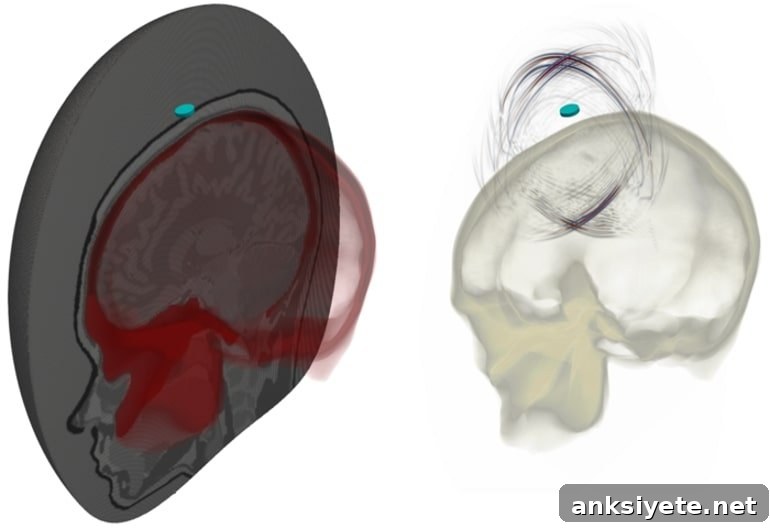
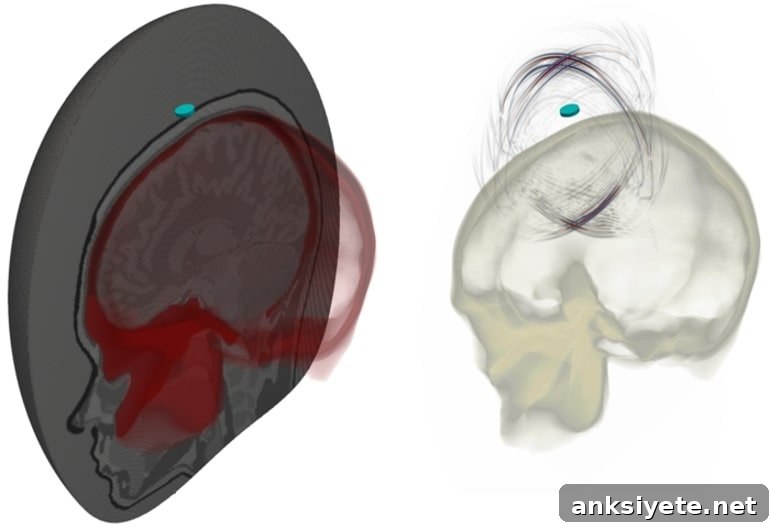
Marty, supported by senior scientist Christian Böhm, is developing a computational approach designed to deliver high-resolution ultrasound images of the brain. The method relies on detailed numerical simulations that model the entire ultrasound wavefield—shape, frequency, velocity and amplitude—rather than only tracking simple arrival times as in conventional ultrasound.
Central to their modelling workflow is the Salvus software package, developed at ETH Zurich with support from CSCS. Salvus implements full-waveform simulations across spatial scales from millimetres to thousands of kilometres and is already used by ETH seismologists to study seismic waves on Earth and Mars. For medical applications, Salvus employs the spectral-element method (SEM), which excels at handling strong contrasts between materials—such as the sharp boundary between soft brain tissue and dense skull bone.
Learning on a magnetic resonance imaging scanner
To build and validate their models, the researchers start from an MRI scan of a patient’s brain. They run repeated simulations on “Piz Daint,” adjusting material parameters until the simulated ultrasound response matches the MRI-derived reference. This inversion process yields quantitative maps rather than the conventional greyscale ultrasound images.
By exploiting the full-waveform data, the team can recover physical properties at each location in the brain—sound speed, attenuation (damping) and density. Because different tissue types and pathological tissues (for example, tumors) have distinct acoustic signatures established in laboratory studies, these quantitative maps can help distinguish healthy from diseased tissue.
The researchers envision integrating this inversion capability into a clinical ultrasound device: an onboard computer would process signals recorded by sensors and produce a 3D image of the brain in near real time. While the approach promises a non-invasive, safe and cost-effective alternative to CT or MRI—especially attractive for remote or resource-limited settings—the team stresses that clinical translation will require further development and validation.
A major technical hurdle is the skull’s complex geometry, which includes cavities around the eyes, nose and jaw. Accurately modelling these features is essential for realistic simulations but must be achieved without prohibitive computational cost. To address this, Marty is creating workflows that generate conforming hexahedral meshes—arrays of deformed cubic elements tailored to individual skull shapes.
“With these deformed little cubes, we are 100 to 1000 times faster than if we were working with tetrahedra,” says Böhm. The method benefits greatly from modern graphics processing units, such as those deployed in “Piz Daint” and planned for future systems like “Alps,” which are well suited to the parallel workloads of spectral-element simulations.
About six years ago, the group collaborated with clinicians to develop ultrasound methods for the early detection of breast cancer. Building on that success, they are now focused on enabling safe, reliable ultrasound examinations of the brain. Potential clinical applications include monitoring stroke patients and detecting brain tumours, among other neurological conditions.
Non-invasive and cost-effective examination
Compared with CT or X-rays, ultrasound is almost entirely harmless because it does not use ionising radiation. It is also generally more affordable than MRI and can be deployed in portable devices for use in field or remote clinical settings. The main technical limitation so far has been the skull: bone strongly reflects and attenuates ultrasound, making transcranial imaging difficult. The full-waveform approach combined with conforming hexahedral meshes and GPU-accelerated computation aims to overcome this limitation.
About this neuroimaging research news
Author: Simone Ulmer
Source: CSCS
Contact: Peter Rueegg – ETH Zurich
Image: Image is credited to Marty, P. et al
Original Research: Closed access.
“Full‑waveform ultrasound modeling of soft tissue‑bone interactions using conforming hexahedral meshes” by Marty, P. et al. Physics of Medical Imaging
Abstract
Full‑waveform ultrasound modeling of soft tissue‑bone interactions using conforming hexahedral meshes
Full-waveform modelling underpins many advanced inversion techniques in ultrasound computed tomography. Accurately resolving strong material interfaces—such as the transition between soft tissue and bone—is crucial to producing physically correct numerical results. The authors present a procedure to build digital twins of anatomical regions using conforming hexahedral meshes together with the spectral-element method. These meshes enable precise modelling of ultrasound wave interaction at sharp material boundaries. The approach is illustrated using in silico cranial and knee phantoms.