
Gene Linked to Human Speech Shapes Mouse Vocal Communication
Summary: Researchers examined how a FOXP2 gene mutation affects the ultrasonic vocalizations and vocal circuitry of adult male mice.
Source: Frontiers
Overview
New research published in Frontiers in Behavioral Neuroscience shows that a mutation in FOXP2 — a gene long associated with human speech production — also alters vocal communication in mice. The study, led by Jonathan Chabout with principal investigator Erich Jarvis, challenges the idea that the neural and genetic mechanisms supporting vocal sequencing are unique to humans. Instead, their results support a continuum in which FOXP2 contributes to vocal patterning across mammals.
Why FOXP2 Matters
FOXP2 is a transcription factor known to play a critical role in human speech. People with certain FOXP2 mutations struggle to form complex syllables and to sequence syllables into fluent speech. While mice do not speak like humans, they produce ultrasonic vocalizations (USVs) that function as social signals. The question addressed by this study was whether the same FOXP2 mutation implicated in human speech deficits would affect the sequencing and complexity of mice vocalizations.
Study Design and Methods
The investigators compared adult male mice carrying a heterozygous FOXP2 mutation — the same KE family missense mutation linked to speech apraxia in humans — to wildtype males with normal FOXP2 levels. The experimental group included 26 heterozygous males and 24 wildtype males. Recordings were made in several social contexts that prior work had shown influence mouse USV patterns: an active wildtype female present, exposure to female urine, and presence of a sleeping female or male.
Using detailed acoustic analysis and novel statistical tools, the team examined syllable acoustics, syllable length, sequence length, and the tendency to shift into more complex vocal syntax in different social contexts. After acoustic recordings, the researchers performed transsynaptic tracing from laryngeal muscles to map the cortical placement of vocal motor neurons and compare the vocal circuitry of heterozygotes and wildtype mice.
Key Findings
The main behavioral result was that FOXP2 heterozygous males produced less complex vocal sequences than wildtype males. Although the acoustic structure of individual syllables remained largely unchanged, heterozygotes produced shorter sequences and used fewer complex syllable types. The differences were most pronounced in the presence of active female mice: wildtype males were about three times more likely than heterozygotes to produce the most complex syllable types and sequences in that social context. These differences persisted after rigorous statistical analyses.
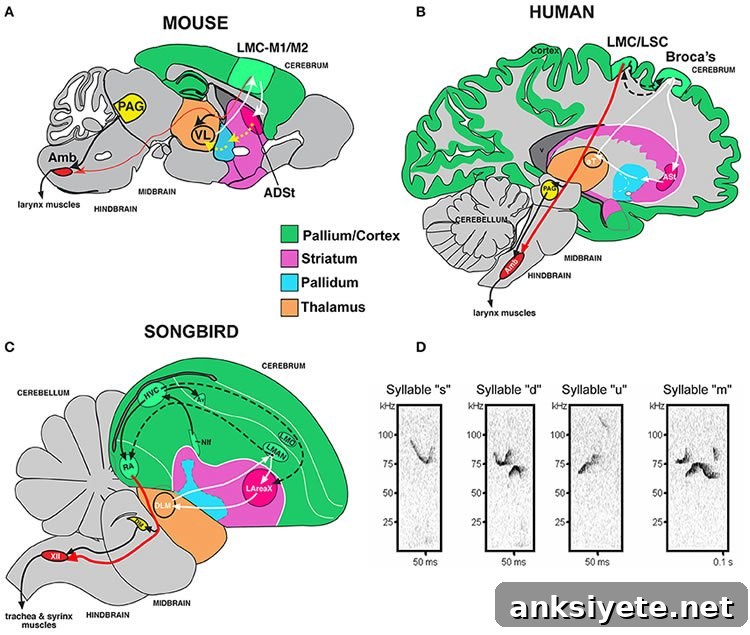
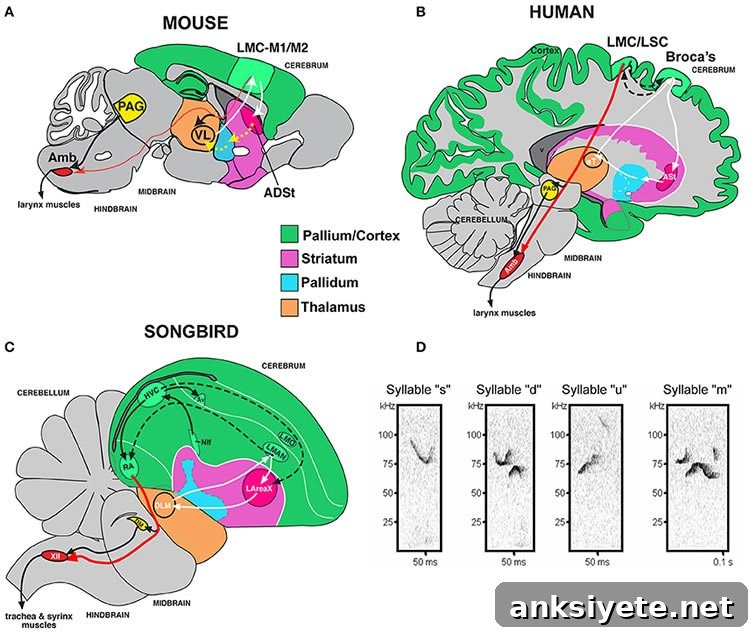
Neuroanatomical tracing revealed an associated change in cortical circuitry. Heterozygous mice showed a shifted and more widely distributed placement of laryngeal motor cortex (LMC) layer-5 neurons compared with wildtype animals. This altered distribution suggests that the FOXP2 mutation affects not only vocal behavior but also the organization of cortical motor neurons involved in vocal production.
Interpretation and Implications
These findings indicate that FOXP2 contributes to the sequencing of vocalizations across mammals, not solely to uniquely human speech. While mouse USVs are largely innate, the conserved role of FOXP2 in sequencing points to an evolutionary continuity: the gene likely had a pre-existing function in regulating patterned vocal output before the emergence of human language. The study strengthens the “continuum hypothesis,” proposing a shared genetic influence on vocal production across species.
By linking behavioral changes in vocal sequencing to measurable differences in cortical motor neuron placement, the work provides a more integrated view of how a single gene can affect both neural circuitry and social vocal behavior. These results expand the understanding of FOXP2 beyond a narrow human-specific role and highlight mouse models as informative for studying genetic contributions to vocal sequencing.
Funding and Source
Funding was provided by the Howard Hughes Medical Institute, the Max Planck Society, and the Office of Naval Research. The study and its full methods and results were reported in Frontiers in Behavioral Neuroscience by Jonathan Chabout, Abhra Sarkar, Sheel R. Patel, Taylor Radden, David B. Dunson, Simon E. Fisher, and Erich D. Jarvis, published online October 20, 2016.
Abstract (Condensed)
Mutations in the FOXP2 transcription factor disrupt the development of fluent spoken language in humans. Using adult male mice carrying a heterozygous KE family FOXP2 mutation, researchers found that while the acoustic structure of single ultrasonic syllables was not detectably altered, mutated mice produced shorter sequences and failed to shift into more complex vocal syntax in social contexts where wildtype males did. A corresponding shift in the cortical position of laryngeal motor cortex layer-5 neurons was observed. These results suggest that FOXP2’s contribution to vocal sequencing is conserved between mice and humans.