
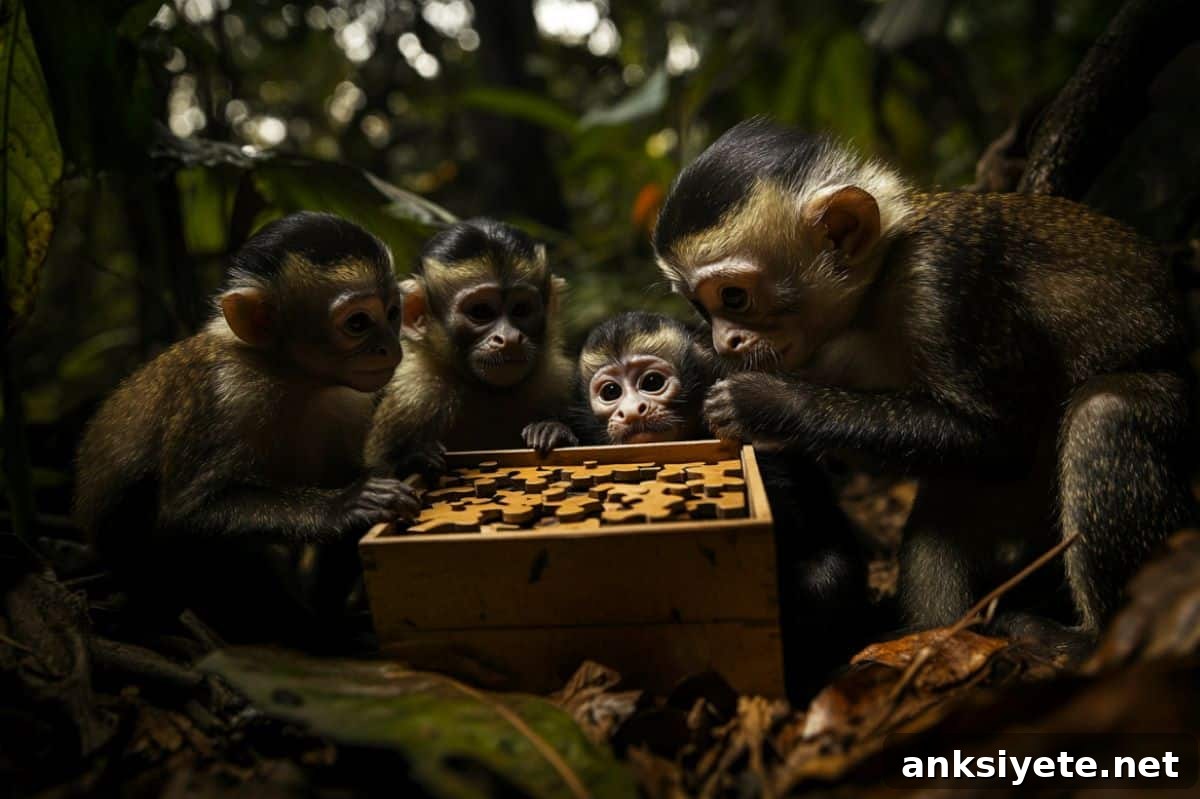
Summary: Wild bearded capuchin monkeys rely on social learning to solve problems, and the patterns of that learning are shaped by social tolerance and group dynamics. Researchers observed the monkeys using a puzzle box and found that grooming partners and socially tolerant individuals were more likely to learn from one another.
Naïve individuals frequently watched successful males, demonstrating how social hierarchy and tolerance influence who becomes a model for others. These observations help illuminate the evolutionary roots of cultural transmission in primates, including humans.
Key Facts:
- Social tolerance predicts who learns from whom among wild bearded capuchins.
- Monkeys preferentially learn by observing tolerant group members and high-status individuals.
- Social learning is a central mechanism for passing skills across generations in tool-using primates.
Source: Durham University
Study Overview: A team from Durham University’s Department of Anthropology conducted field research on two groups of wild bearded capuchin monkeys in Brazil’s Serra da Capivara National Park. To study social learning, researchers introduced a large puzzle box that concealed food. The box could be opened by either lifting a door or pulling a knob, creating two alternative extraction techniques.
Observers recorded which individuals discovered the methods to access the food and tracked how that information spread through each group. The analysis focused on how social tolerance—defined by who tolerates the close presence of others, shares space during feeding, and grooms together—influenced opportunities for observation and learning.
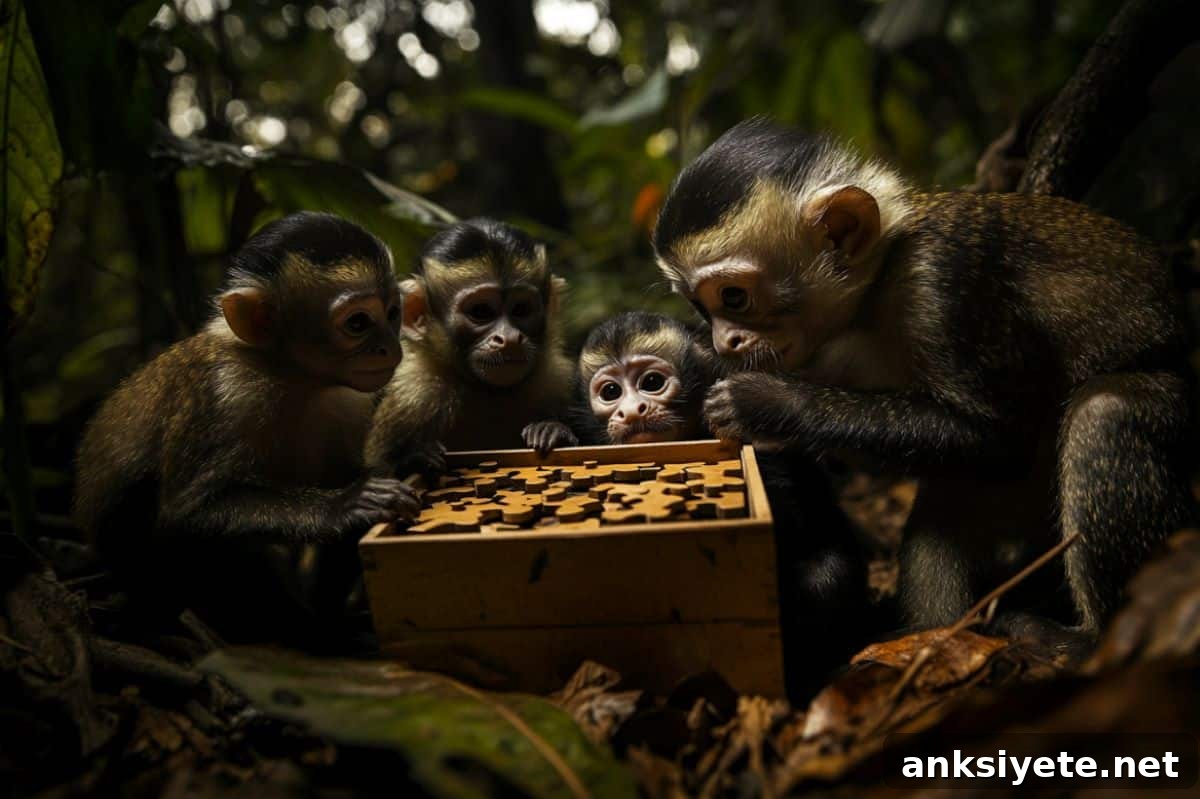
Social tolerance controls proximity and access to resources, including both food and the opportunity to observe others interacting with the environment. The study found that direct observation was the primary route for social learning, and that strong indicators of tolerance—such as frequent grooming or feeding close together—predicted who would watch and learn from whom at the puzzle box.
In addition to tolerance-based learning ties, naïve monkeys showed a tendency to watch and potentially copy successful males, indicating a success bias in social learning. In practical terms, this means that individuals who are both tolerant of others and demonstrably successful become important sources of knowledge for the group.
These findings were published in Proceedings of the National Academy of Sciences (PNAS). The study was co-supervised by Professor Rachel Kendal of Durham University’s Department of Anthropology and Eduardo B. Ottoni of the Institute of Psychology, University of São Paulo. The lead authors are Camila Galheigo Coelho and Ivan Garcia-Nisa, both former PhD researchers in Durham’s Anthropology Department.
Professor Rachel Kendal commented that bearded capuchins possess one of the most extensive tool-use repertoires among monkeys, a trait likely maintained and expanded through social learning that allows skills to be transmitted across generations. Once the team confirmed that social learning was taking place, they investigated the social factors that shaped which individuals were observed and copied.
She explained that individuals who regularly display social tolerance—by grooming together or feeding in close proximity—were significantly more likely to be observed by others interacting with the puzzle box. Social tolerance thus influenced not just who could be observed, but also the pathways by which problem-solving techniques spread across groups.
Kendal noted that some skills may fail to disseminate if the possessor lacks sufficient status to attract observers, or if that individual is intolerant of others’ proximity and therefore does not permit observation. Overall, the results suggest that social tolerance facilitates social learning, which can be further biased toward successful individuals. These dynamics shed light on evolutionary mechanisms shaping cultural abilities in primates and humans alike.
About this social neuroscience and learning research news
Author: Alexa Fox
Source: Durham University
Contact: Alexa Fox – Durham University
Image: Image credit: Neuroscience News
Original Research: Open access. “Social tolerance and success-biased social learning underlies the cultural transmission of an induced extractive foraging tradition in a wild tool-using primate” by Rachel Kendal et al., published in PNAS. DOI: 10.1073/pnas.2322888121
Abstract
Social tolerance and success-biased social learning underlies the cultural transmission of an induced extractive foraging tradition in a wild tool-using primate
Cultural evolutionary processes can create statistical associations between neutral and adaptive traits when populations move or when a beneficial technology is introduced into a new region. This paper examines such “cultural hitchhiking” through an individual-based model representing cultural interactions between migrant and incumbent populations. The model, inspired by interactions between farming and foraging groups during early agricultural adoption, assigns distinct neutral and adaptive trait variants to each population, with the adaptive trait providing a reproductive advantage to migrants.
The research explores how neutral traits carried by migrants spread, and how this spread depends on: (1) whether adaptive traits can be transmitted; (2) the magnitude of the reproductive advantage provided by adaptive variants; (3) postmarital residence rules; and (4) the timing and manner of neutral trait transmission. The results reveal a variety of possible outcomes and emphasize the importance of postmarital resocialization, combinations of residence rules, and sex-biased transmission in shaping cultural change.