
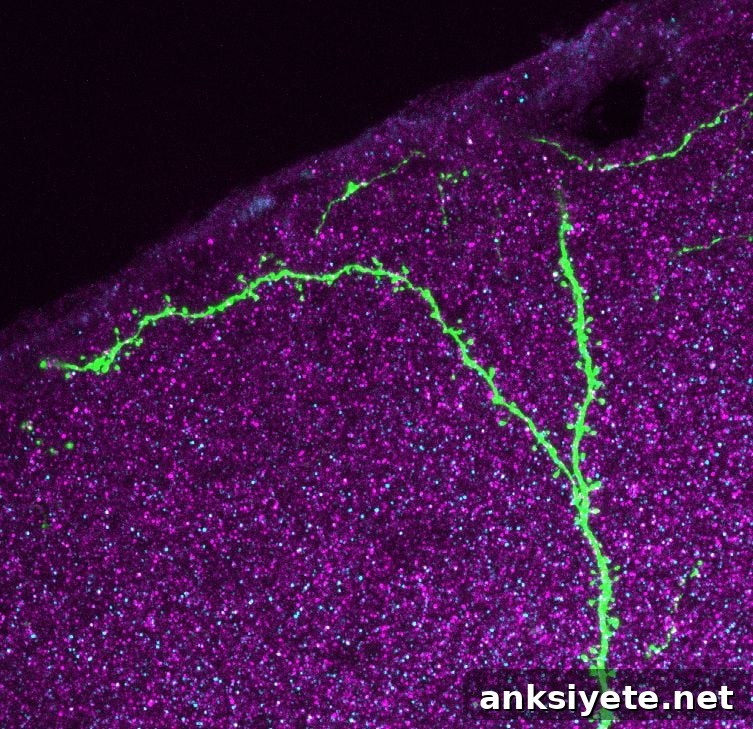
A team of neurobiologists led by Simon Rumpel at the Research Institute of Molecular Pathology (IMP) in Vienna has tracked single neurons in live mouse brains over several weeks, revealing how synaptic structures change during memory formation and what happens when memories are recalled. Their detailed observations were published in PNAS Early Edition.
Our behavior and personality are largely shaped by past experiences. Storing those experiences as memories and retrieving them when needed is a fundamental brain function. Current neuroscience holds that long-term memories are encoded by persistent changes at synapses—the specialized contact points where neurons communicate. Understanding how synaptic architecture changes as memories form and how those structures behave during recall is essential to explaining memory at the cellular level.
Using in vivo two-photon imaging, a high-resolution microscopy technique that permits repeated observation of microscopic structures within the living brain, the IMP team followed individual neurons in the auditory cortex of mice over time. Two-photon imaging allows researchers to visualize tiny features—on the order of a thousandth of a millimeter—through the intact skull or a cranial window, enabling longitudinal studies of the same cells and synapses during learning and later recall.
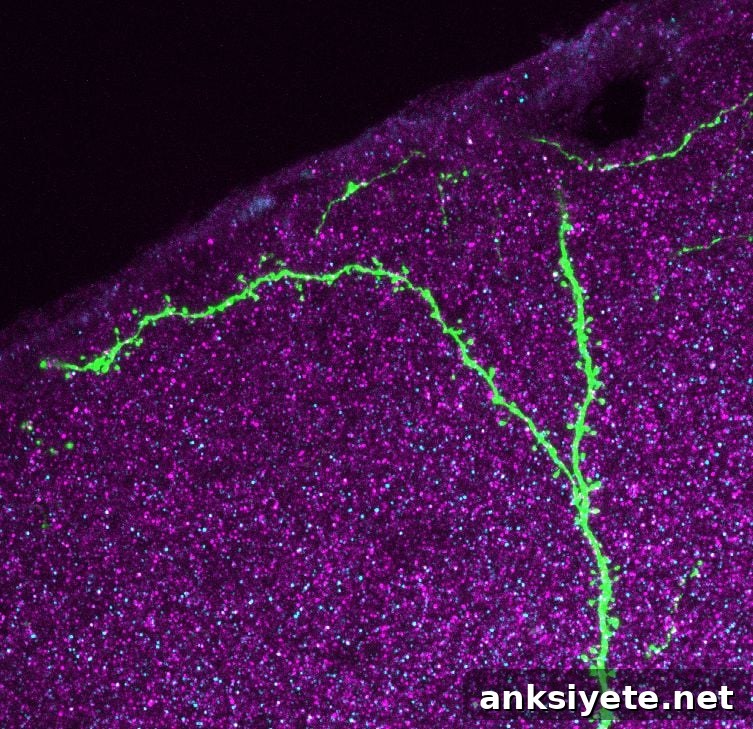
The researchers focused on dendritic spines, small protrusions along neuronal processes that correspond to excitatory synapses. By repeatedly imaging the same dendritic segments over days and weeks, they could detect the formation of new spines, the elimination of existing ones, and the stability of those changes over time. These structural dynamics were analyzed in conjunction with behavioral experiments using classical auditory conditioning, so the team could directly link synaptic changes in the auditory cortex to learning and memory performance.
After training, mice exposed to an auditory cue showed a clear increase in the formation of new dendritic spines in the auditory cortex. Importantly, several of these new spines remained stable well after training, providing an anatomical correlate of a long-lasting memory trace. The persistence of newly formed synaptic contacts supports the prevailing model that durable changes in synaptic connectivity underlie memory storage.
Beyond memory formation, the IMP team investigated what happens during memory recall. Earlier biochemical and molecular studies had indicated that recalling a memory can activate molecular cascades resembling those triggered during initial learning, raising the possibility that recall might remodel the underlying synaptic trace. To test that idea, previously trained mice were re-exposed to the conditioned auditory cue one week after training while the same dendritic spines in the auditory cortex were imaged.
The results showed that although recall activated molecular processes similar to those seen during learning, the anatomical structure of excitatory synapses—the dendritic spines—did not undergo substantial remodeling during recall. In other words, memory retrieval did not generally cause the large-scale structural rewiring of synaptic contacts observed during initial memory formation. Instead, the molecular activity associated with recall may serve to stabilize or re-engage synapses that were previously modified during learning, helping maintain the memory trace without changing its gross anatomy.
These findings refine our understanding of the cellular basis of memory by distinguishing the structural changes that encode new memories from the molecular events that accompany retrieval. The study shows that learning produces lasting synaptic modifications in the auditory cortex, while recall primarily triggers biochemical processes that support the stability and reactivation of those existing connections.
Clarifying the mechanisms of memory formation and recall advances basic neuroscience and has potential clinical relevance. A better mechanistic picture of synaptic dynamics in learning and memory may aid in understanding memory disorders and conditions in which recall processes are disrupted or maladaptive, such as post-traumatic stress disorder. Over the long term, insights into how synaptic connections are formed, stabilized, and reactivated could help inform therapeutic approaches aimed at restoring or modifying pathological memory traces.
Notes about this neuroscience, memory and learning research
Contact: Dr. Heidemarie Hurtl, IMP
Source: IMP press release
Image Source: Image credited to IMP and adapted from the press release.
Original Research: Abstract for “Dynamics of dendritic spines in the mouse auditory cortex during memory formation and memory recall” by Kaja Ewa Moczulska et al., published in PNAS (October 23, 2013).
#neuroscience, #neurons, #learning, #memory, #synaptic plasticity, #auditory cortex, #in vivo two-photon imaging