
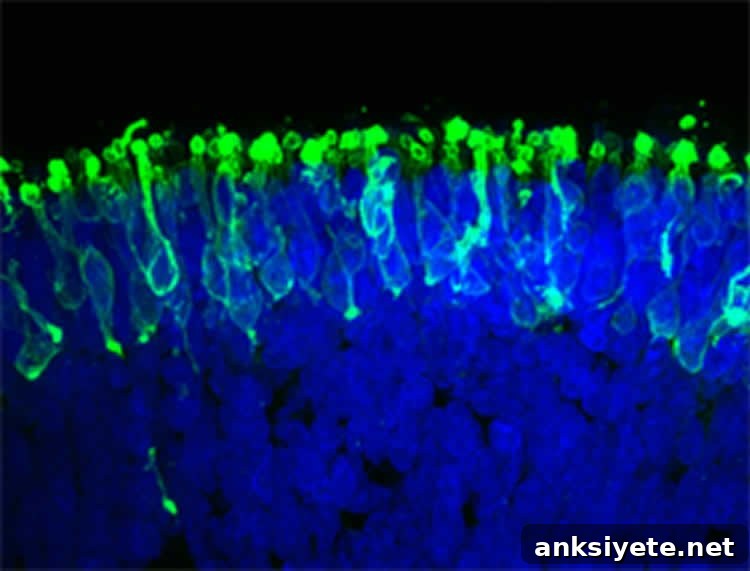
Johns Hopkins researchers have grown three-dimensional human retinal tissue from induced pluripotent stem cells that includes functioning photoreceptor cells able to respond to light — a crucial first step toward converting light into signals the brain can interpret as vision.
“We have essentially created a miniature human retina in a dish that not only mirrors the retina’s layered architecture but also senses light,” says study leader M. Valeria Canto-Soler, Ph.D., assistant professor of ophthalmology at Johns Hopkins University School of Medicine. The work, reported online June 10 in the journal Nature Communications, expands experimental options for vision research and offers a possible route to future therapies for retinal disease.
Vision depends on many specialized cell types working together to convert light into electrical signals that the brain interprets. Canto-Soler emphasizes that photoreceptors are only one component of the complex eye–brain system. Her team has not rebuilt all retinal functions nor reestablished connections to the brain’s visual cortex. “Can our lab-grown retina produce a visual signal that the brain would interpret as an image? Probably not yet. But this is an important early advance,” she says.
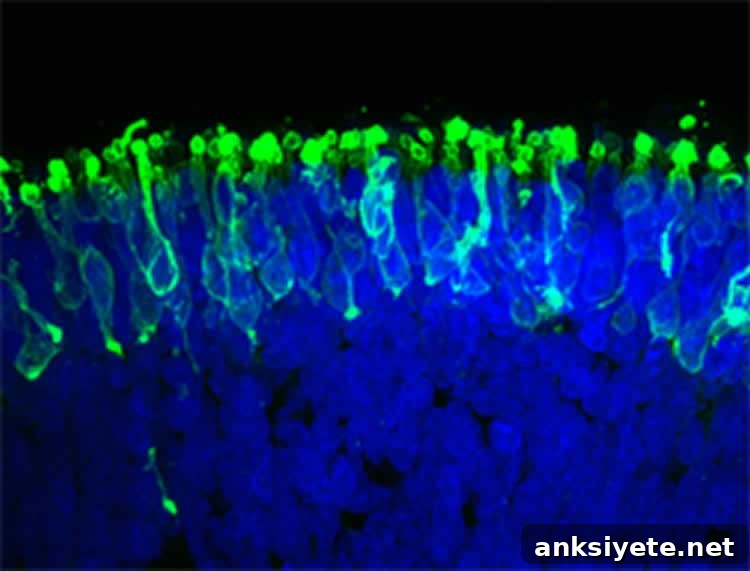
The team used human induced pluripotent stem (iPS) cells — adult cells reprogrammed back to a primitive, flexible state — and guided them to become retinal progenitor cells. Pluripotent cells can, under proper conditions, become most cell types in the body. In this study the researchers applied a straightforward, reproducible culture technique to promote retinal differentiation. Over time the progenitors self-organized into layered, three-dimensional retinal tissue within the dish, following a developmental timeline that resembled human fetal retinal growth.
Xiufeng Zhong, Ph.D., a postdoctoral researcher in Canto-Soler’s laboratory, notes that the photoreceptors matured sufficiently to form outer segments, the specialized structures essential for capturing light. Retinal tissue contains seven major cell types, including six neuronal types arranged into distinct layers that absorb, process and transmit visual information. The lab-grown tissue recreated the retina’s three-dimensional architecture, suggesting that the cells followed intrinsic developmental cues to assemble into a complex structure without extensive external patterning.
To test whether the photoreceptors could detect light, the researchers studied tissue at a stage equivalent to about 28 weeks of human gestation, when photoreceptors are relatively mature. Using an electrode inserted into single photoreceptor cells, they delivered brief pulses of light and recorded biochemical responses. The cells reacted in a pattern consistent with known phototransduction behavior.
Specifically, the lab-grown cells behaved like rod photoreceptors, which dominate the human retina and are specialized for low-light vision. The mini-retinas produced by the Johns Hopkins team were likewise dominated by rods. While rods and cones jointly enable daytime and color vision in humans, the presence of mature rod-like cells in these constructs is an important proof of concept for building functional retinal tissue from human iPS cells.
This system can be scaled to generate hundreds of mini-retinas from a single iPS cell source, including patient-derived cells that carry genetic forms of retinal disease such as retinitis pigmentosa. Creating disease-specific retinal tissue in vitro gives researchers a powerful human model to study disease mechanisms directly in human cells rather than relying solely on animal models. It also enables testing of candidate drugs and personalized therapeutic strategies on tissue that reflects an individual patient’s genetics.
In the longer term, lab-grown retinal tissue could serve as the basis for cell replacement therapies aimed at halting or reversing vision loss by replacing damaged or lost retinal cells. Many technical and safety challenges remain before such approaches reach the clinic, including ensuring proper integration with host tissue, restoring connections to the brain, and confirming long-term function and safety. Nonetheless, the ability to generate three-dimensional human retinal tissue with light-sensitive photoreceptors marks a notable step forward for regenerative ophthalmology and vision research.
Other Johns Hopkins contributors to the study include Christian Gutierrez, Tian Xue, Christopher Hampton, M. Natalia Vergara, Li-Hui Cao, Tea Soon Park, Elias T. Zambidis and King-Wai Yau. Jason S. Meyer of Purdue University and David M. Gamm of the University of Wisconsin also contributed.
Funding for the research came from the Maryland Stem Cell Research Fund; the William and Ella Owens Medical Research Foundation; the J. Willard and Alice S. Marriott Foundation; the William and Mary Greve Special Scholar Award from Research to Prevent Blindness; and the National Eye Institute of the National Institutes of Health (grant numbers R01EY022631, EY1765, R01EY021218 and R01EY06837).
Contact: Lauren Nelson – Johns Hopkins Medicine
Source: Johns Hopkins Medicine press release
Image Source: Image credited to Johns Hopkins Medicine and adapted from the press release
Original Research: “Generation of three-dimensional retinal tissue with functional photoreceptors from human iPSCs,” Zhong X., Gutierrez C., Xue T., Hampton C., Vergara M.N., Cao L.-H., Peters A., Park T.S., Zambidis E.T., Meyer J.S., Gamm D.M., Yau K.-W., Canto-Soler M.V. Published online June 10, 2014. doi:10.1038/ncomms5047