
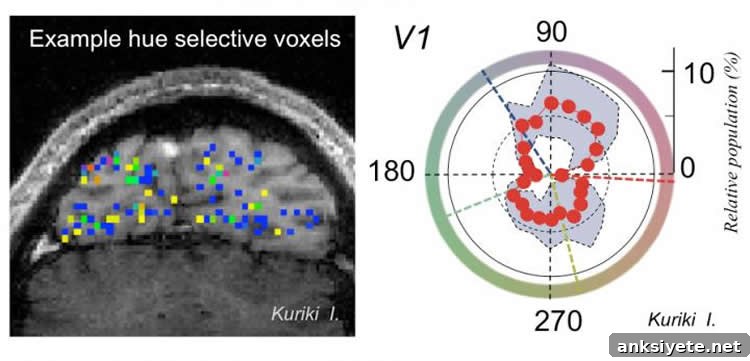
Researchers at Tohoku University’s Research Institute of Electrical Communication and RIKEN BSI have identified neurons in the human brain that respond selectively to intermediate colors—not only to the classic red, green, yellow and blue categories.
Traditional models of color encoding in the human visual system posited that color information is represented by combinations of four opponent channels—red versus green and yellow versus blue—along with luminance (dark/light) signals. Under that scheme, colors such as orange and purple would be interpreted as mixtures of the opponent signals (for example, orange as red plus yellow; purple as red plus blue).
More recent electrophysiological research in nonhuman primates challenged that simple view by demonstrating neurons in the visual cortex that are tuned to intermediate hues—specific color directions that fall between the classic opponent axes. Human studies using psychophysics and noninvasive brain imaging had provided indirect evidence for similar mechanisms, but direct measurements of hue-selective responses at the neuronal-population level in humans were lacking, and the variability and distribution of such neurons had not been clearly reported.
Using functional magnetic resonance imaging (fMRI), the research team recorded brain activity that reveals neuronal selectivity for intermediate hues in human visual cortex. During fMRI scanning, participants viewed a circular, checkered stimulus whose color continuously cycled around a perceptual hue circle. Stimulus luminance was equalized and individually calibrated for each participant so that the recordings reflected hue variation rather than brightness differences.
Brain activity was analyzed on a voxel-by-voxel basis across the measured visual areas. If a voxel’s signal was dominated by neurons tuned to a particular hue direction, that voxel would show maximal response when that hue appeared. The resulting hue preference for each voxel was summarized as a histogram of voxel counts by hue direction, allowing the researchers to visualize the relative population tuned to each color angle.
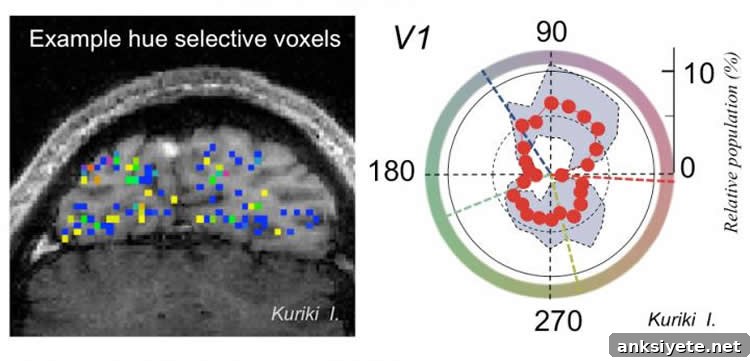
The researchers report averaged histograms from the primary visual cortex (V1) and other visual areas that reveal significant populations of voxels selective for intermediate directions such as purple, cyan and orange. The pattern of responses argues against a simple explanation in which intermediate hue responses emerge only from linear combinations of the four cone-opponent channels; instead, the data support the presence of neurons in human cortex that are tuned directly to intermediate hues.
This study provides the first quantitative histogram of hue-selective voxel populations—including those tuned to intermediate hues—in human subjects. The full results were published as an open-access article in the journal Cerebral Cortex on September 30. The article is titled “Hue Selectivity in Human Visual Cortex Revealed by Functional Magnetic Resonance Imaging” by Ichiro Kuriki, Pei Sun, Kenichi Ueno, Keiji Tanaka, and Kang Cheng.
Beyond the basic-science implications for how color is encoded in the brain, the findings may have practical applications for display technology. Most consumer displays rely on three primary colors (red, green and blue), but previous engineering work has shown that using more primaries—such as six—can improve color rendering precision. The histograms of hue-selective cortical populations suggest that selecting display primaries that align with hues having larger neural representation could yield more perceptually efficient and accurate color reproduction, which could be important for high-fidelity imaging in medical or professional contexts.
Funding: The study received funding from the Japan Society for the Promotion of Science.
Source: Ichiro Kuriki – Tohoku University
Image Credit: Research Institute of Electrical Communication, Tohoku University
Original Research: Full open-access research titled “Hue Selectivity in Human Visual Cortex Revealed by Functional Magnetic Resonance Imaging” by Ichiro Kuriki, Pei Sun, Kenichi Ueno, Keiji Tanaka, and Kang Cheng in Cerebral Cortex. Published online September 30, 2015. doi:10.1093/cercor/bhv198
Abstract
Hue Selectivity in Human Visual Cortex Revealed by Functional Magnetic Resonance Imaging
The variability of color-selective neurons in human visual cortex appears to be greater than would be predicted by cone-opponent mechanisms alone. To investigate this, the authors derived histograms of hue-selective voxels using fMRI with a novel stimulus paradigm in which hue varied continuously. Despite substantial between-subject differences in the hue-selective histograms, individual voxels demonstrated selectivity for intermediate hues such as purple, cyan and orange in addition to hues aligned with cone-opponent axes. To exclude the possibility that intermediate-hue selectivity emerged from spatial summation of neurons tuned only to cone-opponent signals, the researchers measured hue-selective adaptation: responses to four diagonal hues were recorded while subjects adapted to one of those hues. The selective, unidirectional reduction in response to the adapted hue supports the conclusion that cortical neurons respond selectively to intermediate hues.
“Hue Selectivity in Human Visual Cortex Revealed by Functional Magnetic Resonance Imaging” by Ichiro Kuriki, Pei Sun, Kenichi Ueno, Keiji Tanaka, and Kang Cheng in Cerebral Cortex. Published online September 30, 2015. doi:10.1093/cercor/bhv198