
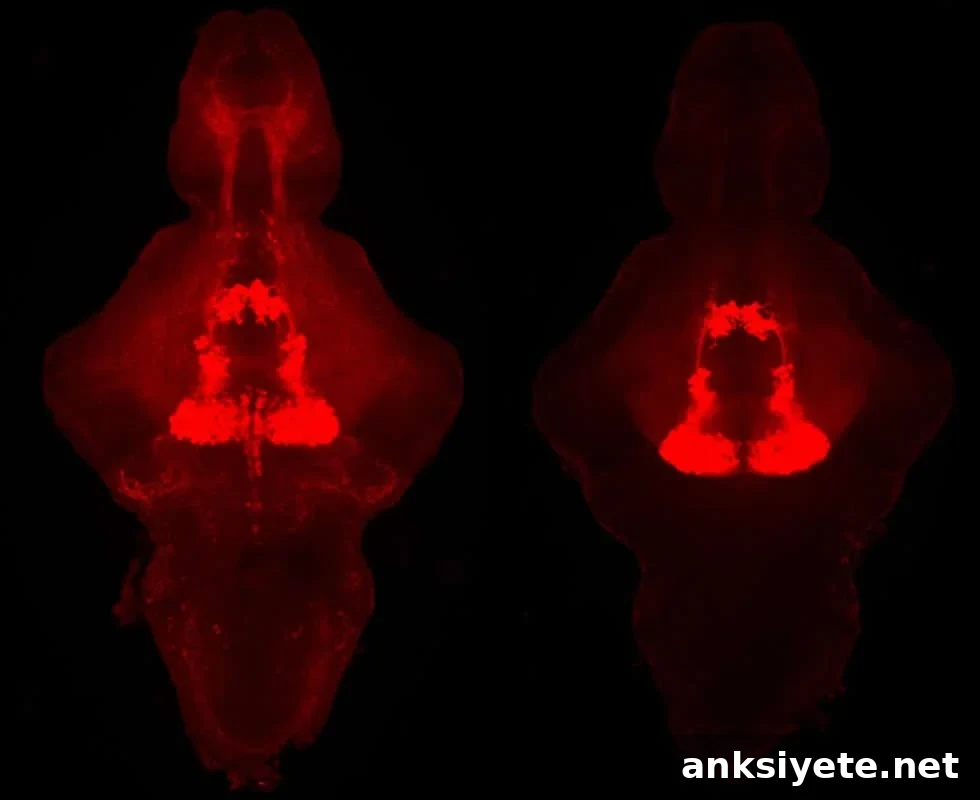
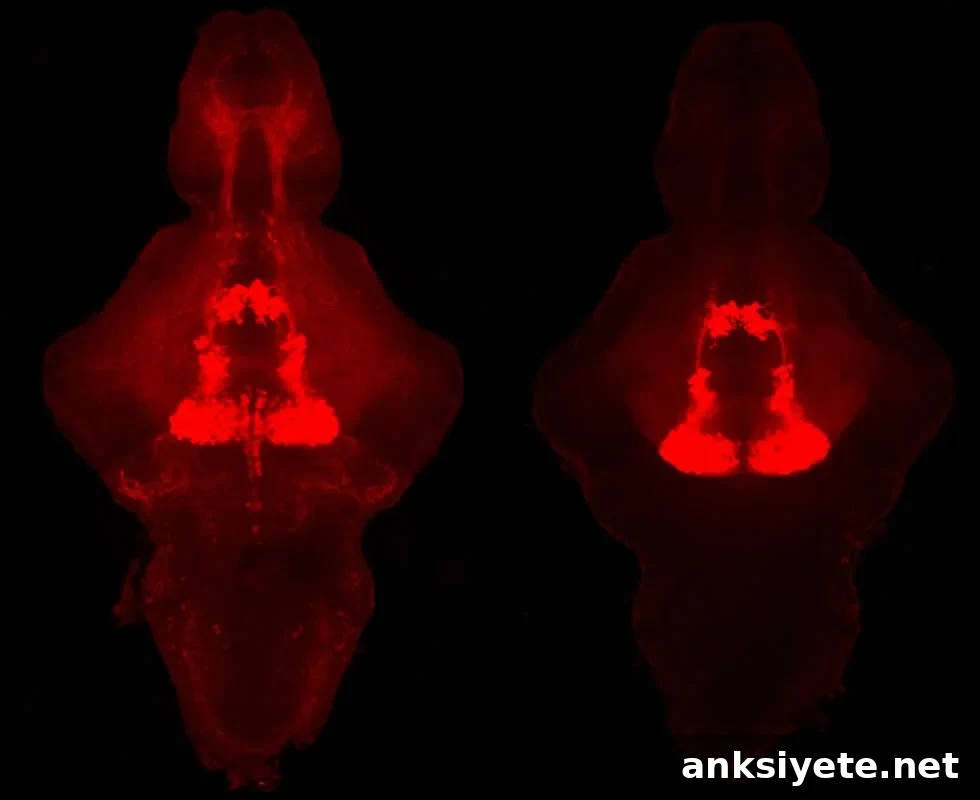
Summary: New Caltech research shows that serotonin produced by neurons in the raphe nuclei is essential for normal sleep in both zebrafish and mice. Raphe neuron activity and tonic serotonin release appear to build sleep pressure, clarifying why drugs that increase brain serotonin can alter sleep.
Source: CalTech
Serotonin is a versatile neurotransmitter found throughout the brain that influences mood, cognition, and memory. Its role in sleep has been debated for decades—some studies have linked serotonin to sleep promotion while others have associated serotonergic activity with wakefulness.
Scientists at Caltech have now produced evidence that serotonin from the raphe nuclei is required for normal sleep in animal models, using experiments in zebrafish and mice to resolve aspects of this long-standing paradox.
An article describing this work was published in Neuron on June 24. The study is a collaboration between the laboratories of David Prober, professor of biology and affiliated faculty of the Tianqiao and Chrissy Chen Institute for Neuroscience at Caltech, and Viviana Gradinaru, professor of neuroscience and biological engineering and director of the Chen Institute’s Center for Molecular and Cellular Neuroscience.
Past research reached conflicting conclusions: early reports suggested serotonin promotes sleep, while later studies emphasized raphe neurons’ activity during wakefulness. To clarify these contradictions, the Caltech teams focused on the raphe nuclei, evolutionarily conserved brainstem regions that synthesize and distribute serotonin across the brain.
Led by senior postdoctoral scholar Grigorios Oikonomou in the Prober lab, the study began with transparent zebrafish larvae, a diurnal model widely used to study sleep biology. The researchers created genetic mutants whose raphe neurons could not synthesize serotonin. These serotonin-deficient fish slept roughly half as much as normal siblings. Complete removal of the raphe produced a similar reduction in sleep.
In separate experiments, the team engineered fish in which raphe neurons could be activated by light (optogenetics). Light-driven activation of the raphe induced sleep in normal fish, but had no effect in animals that lacked serotonin synthesis, indicating that serotonin release is necessary for the sleep-promoting outcome.
The Prober lab then worked with the Gradinaru lab to test the phenomenon in mice. Graduate student Michael Altermatt led the mouse studies, which confirmed prior observations that many serotonergic raphe neurons are predominantly active during wakefulness and less active in sleep. Despite this baseline activity pattern, genetic ablation of raphe serotonergic neurons in mice reduced sleep time, mirroring the zebrafish findings.
Optogenetic stimulation of mouse raphe neurons also produced sleep, but only when stimulation parameters matched the neurons’ typical tonic firing rates observed during wakefulness. By contrast, burst-pattern stimulation—reflecting rapid, high-frequency discharges associated with arousal—produced wakefulness. These results reconcile earlier contradictions by showing that different activation patterns of the serotonergic system produce opposite behavioral outcomes.
To explain these results, the authors describe two interacting mechanisms that govern sleep: the circadian clock, which aligns sleep with day-night cycles, and homeostatic sleep pressure, which accumulates during waking hours and drives the need to sleep. The team proposes that tonic firing of raphe neurons and ongoing serotonin release during wakefulness contribute to building homeostatic sleep pressure. When sleep pressure becomes sufficiently high and the circadian system permits it, sleep is initiated and maintained.
“The theory is that, in order to sleep, you need to have high sleep pressure and the circadian clock needs to be aligned with the time of day—nighttime for diurnal species and daytime for nocturnal ones.”
Supporting this idea, zebrafish lacking raphe-derived serotonin and mice with ablated raphe showed diminished sleep pressure and an impaired homeostatic response to sleep deprivation. The conserved role of raphe serotonin in both diurnal zebrafish and nocturnal rodents suggests broad relevance across vertebrates.
Although these findings come from animal models, the raphe nuclei and serotonergic signaling are structurally and functionally similar in humans. The study helps explain why many antidepressants that raise brain serotonin can produce sleep-related side effects, and it clarifies how stimulation patterns of the serotonergic system can either promote sleep or provoke wakefulness.
Funding: Support for this research came from the National Institutes of Health; the Center for Molecular and Cellular Neuroscience of the Tianqiao and Chrissy Chen Institute for Neuroscience at Caltech; the CLARITY, Optogenetics and Vector Engineering Research Center at Caltech’s Beckman Institute; the National Science and Engineering Research Council of Canada; and the Heritage Medical Research Institute.
Source:
CalTech
Media Contacts:
Lori Dajose – CalTech
Image Source:
Image credit: Caltech.
Original Research: Closed access
“The Serotonergic Raphe Promote Sleep in Zebrafish and Mice.” Grigorios Oikonomou, Michael Altermatt, Rong-wei Zhang, Gerard M. Coughlin, Christin Montz, Viviana Gradinaru, David A. Prober. Neuron. DOI: 10.1016/j.neuron.2019.05.038
Abstract
The Serotonergic Raphe Promote Sleep in Zebrafish and Mice
Highlights
• The serotonergic system promotes sleep in zebrafish and mice.
• Disruption of serotonergic signaling reduces sleep and weakens the homeostatic response to sleep loss.
• Tonic stimulation of the serotonergic system induces sleep, while burst stimulation favors wakefulness.
• Baseline tonic activity of the serotonergic raphe during wake builds sleep pressure.
Summary
This study reconciles conflicting views on serotonin’s role in sleep by demonstrating that raphe-derived serotonin is critical for initiating and maintaining sleep. Genetic or pharmacological disruption of raphe serotonin reduces both total sleep and the depth of sleep, and it impairs recovery after sleep deprivation. Optogenetic experiments show that stimulation pattern matters: tonic activation at physiological rates promotes sleep, whereas burst activation triggers arousal. Together, the results indicate a conserved, sleep-promoting role of the serotonergic raphe across vertebrate species.