
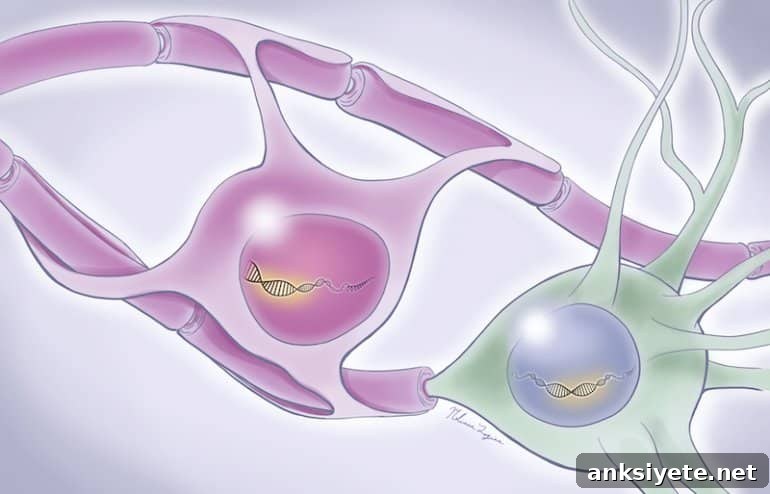
Summary: Researchers identified roughly 300 genes associated with brain oscillations tied to memory formation and narrowed these to a set of hub genes that coordinate distinct gene networks. The gene SMAD3 emerges as a likely master regulator influencing many of these hubs and their downstream targets.
Source: UT Southwestern Medical Center
UT Southwestern investigators have uncovered important genes linked to the brain rhythms that underlie memory encoding. Published in Nature Neuroscience, the study provides new molecular insight that could guide future treatments for memory loss related to Alzheimer’s disease and other dementias.
Memory formation depends on coordinated firing of populations of neurons across different frequency bands, a phenomenon known as neural oscillations. Yet, as study leaders Bradley C. Lega, M.D., and Genevieve Konopka, Ph.D., explain, how gene expression shapes these oscillatory patterns in humans has remained largely unknown.
“There’s a famous saying in neuroscience: neurons that fire together wire together,” says Lega. “We see that coordinated firing leads to new connections during learning, but the genetic mechanisms that regulate this process in people have not been defined.”
Lega and Konopka, both members of the Peter O’Donnell Jr. Brain Institute, previously compared neural oscillation recordings and gene activity from separate groups of subjects. That earlier work suggested candidate genes but was limited because the electrophysiology and gene-expression data came from different individuals.
To address that gap, the team seized an uncommon opportunity to collect both kinds of data from the same patients. They studied 16 volunteers who were undergoing invasive monitoring and subsequent surgery to treat drug-resistant epilepsy. Electrodes placed in these patients’ brains provided high-resolution recordings of neural activity while clinical teams identified seizure foci.
During monitoring, each volunteer performed memory tasks designed to engage episodic memory. In a typical trial, a participant read a list of 12 words, solved a short arithmetic problem as a distractor, then attempted to recall as many words as possible. The researchers recorded brain waves while participants encoded and retrieved the lists, producing individualized oscillation profiles across multiple frequency bands.
About six weeks after monitoring, each patient underwent a temporal lobectomy to remove seizure-generating tissue. The temporal lobe is both a common source of epileptic seizures and a critical region for memory. Surgically resected tissue was collected and processed within minutes to preserve RNA for molecular analysis.
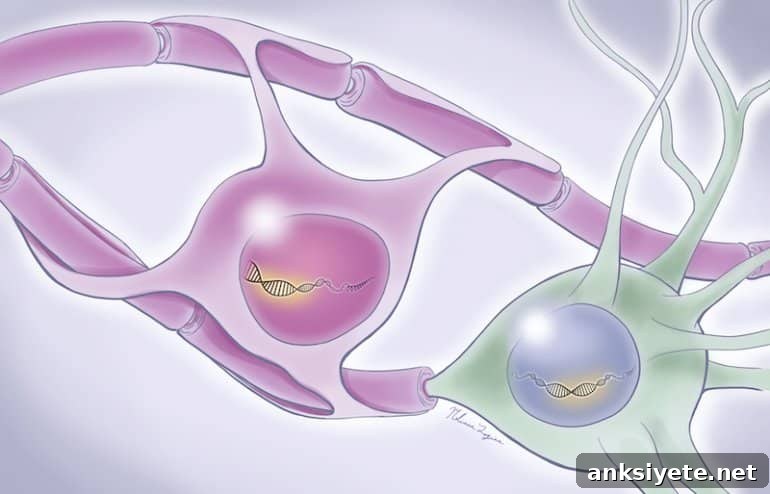
Credit: Melissa Logies
Konopka’s group performed whole-transcriptome RNA sequencing on these temporal lobe samples, capturing the active genes present across the tissue’s various cell types. By linking patient-specific oscillatory signatures from the memory task to gene-expression patterns in the matched tissue, the team identified approximately 300 genes whose activity correlated with oscillations associated with memory encoding.
Co-expression analyses of those genes revealed tightly connected modules and allowed the researchers to focus on a smaller subset of roughly a dozen hub genes that appear to coordinate distinct gene networks. Rather than being uniformly active in neurons, several of these hub genes showed their strongest expression in glial cell populations. Glia support neuronal function in many ways, including forming myelin that increases the speed and reliability of electrical signaling.
To explore regulatory mechanisms, the investigators applied ATAC-seq, a method that maps open regions of chromatin where regulatory proteins can bind and activate genes. This approach highlighted SMAD3 as a candidate master regulator: its regulatory footprint suggested it could control the activity of multiple hub genes and their downstream networks.
Many of the genes and networks the team identified overlap with pathways previously implicated in neurodevelopmental and neuropsychiatric conditions—such as autism spectrum disorder, attention deficit hyperactivity disorder, bipolar disorder, and schizophrenia—that can include cognitive and memory impairments. The authors propose that, with further validation, components of these gene networks might become targets for therapies aimed at improving memory in affected individuals.
“This dataset gives us a direct entry point into the molecular mechanisms that support human memory,” says Konopka, a Jon Heighten Scholar in Autism Research. “By connecting electrophysiology and genomics from the same people, we can begin to identify specific genes and regulatory pathways to study as potential therapeutic targets.”
Other UT Southwestern contributors to the study include Stefano Berto, Miles R. Fontenot, Sarah Seger, Fatma Ayhan, Emre Caglayan, Ashwinikumar Kulkarni, Connor Douglas, and Carol A. Tamminga. Tamminga holds the Stanton Sharp Distinguished Chair in Psychiatry.
Funding: This research was supported by grants and awards from the National Institute of Mental Health (F30MH105158 and MH103517), National Institute on Drug Abuse (5T32DA007290-25), National Heart, Lung, and Blood Institute (1T32HL139438-01A1), National Institute of Neurological Disorders and Stroke (NS106447 and NS107357), a UT BRAIN Initiative Seed Grant (366582), the Chilton Foundation, the National Center for Advancing Translational Sciences of the NIH under the Center for Translational Medicine’s award UL1TR001105, The Chan Zuckerberg Initiative (advised fund of Silicon Valley Community Foundation HCA-A-1704-01747), and the James S. McDonnell Foundation 21st Century Science Initiative in Understanding Human Cognition – Scholar Award.
About this genetics and memory research news
Source: UT Southwestern Medical Center
Contact: Press Office – UT Southwestern Medical Center
Image: The image is credited to Melissa Logies
Original Research: Closed access.
“Gene-expression correlates of the oscillatory signatures supporting human episodic memory encoding” by Stefano Berto, Miles R. Fontenot, Sarah Seger, Fatma Ayhan, Emre Caglayan, Ashwinikumar Kulkarni, Connor Douglas, Carol A. Tamminga, Bradley C. Lega & Genevieve Konopka. Nature Neuroscience
Abstract
Gene-expression correlates of the oscillatory signatures supporting human episodic memory encoding
Brain oscillations in humans are central to features of memory formation, yet the molecular drivers of these rhythms are poorly understood.
In this study, researchers recorded memory-sensitive oscillations via intracranial electroencephalography from the temporal cortex of patients performing episodic memory tasks. When those patients later underwent surgical resection, transcriptomic analysis of the temporal cortex was performed to link gene expression with the observed oscillatory signatures. The team identified genes correlated with memory-related oscillations across six frequency bands.
Co-expression analysis isolated modules specific to oscillatory signatures; these modules were associated with ion channel activity and neuropsychiatric disorder–related pathways, with highly correlated genes forming strong network connections.
Single-nucleus transcriptomics revealed that these expression modules are enriched in specific classes of excitatory and inhibitory neurons, and immunohistochemistry confirmed the expression of several highly correlated genes.
By coupling individualized brain oscillation measurements with genomics from the same patients, this dataset opens new avenues for understanding the genetic and regulatory architecture that supports human episodic memory encoding.