
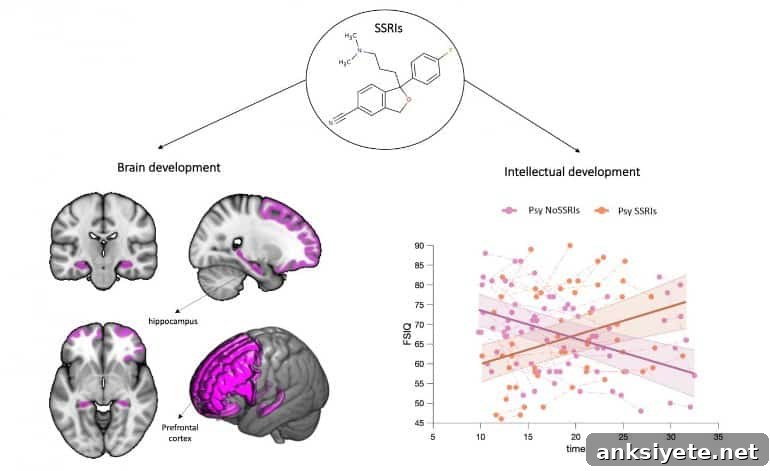
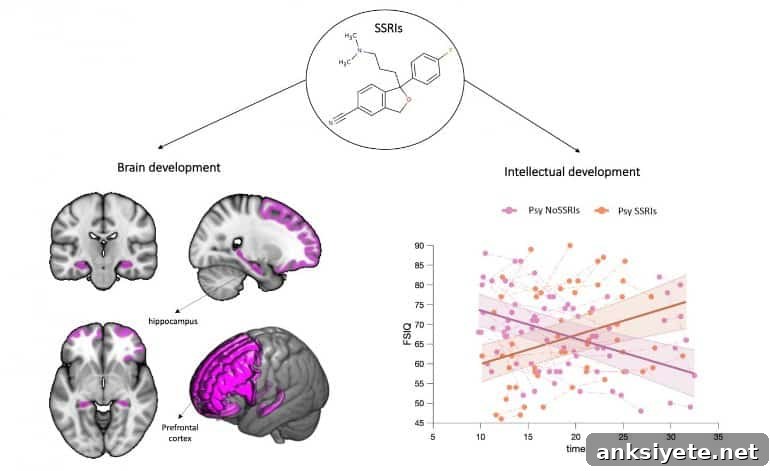
Summary: Early treatment with selective serotonin reuptake inhibitors (SSRIs) in late childhood and adolescence appears to reduce decline in intellectual functioning and protect key brain regions linked to psychosis in people with genetic risk. New evidence from University of Geneva researchers suggests SSRIs may have a neuroprotective effect when given before or during the critical developmental period for psychotic disorders.
Source: University of Geneva
About the condition: A microdeletion on chromosome 22 (22q11.2 deletion syndrome) affects roughly one in 2,000 people and carries a substantially elevated risk of developing psychotic disorders, including schizophrenia, typically emerging in adolescence. Beyond hallucinations and delusions, these disorders are associated with a progressive decline in cognitive abilities and intelligence quotient (IQ), often leading to reduced autonomy and the need for long-term support.
While current antipsychotic medications can alleviate many psychotic symptoms, no established treatment has reliably prevented the gradual loss of intellectual skills. Researchers at the University of Geneva (UNIGE) report that long-term, low-dose SSRI treatment begun in late childhood and continued through adolescence correlates with preservation — and in some cases improvement — of cognitive function and related brain structures in people with 22q11.2 deletion syndrome.
Average population IQ is about 100 points, but individuals with this microdeletion frequently score in the 70–80 range during childhood. When psychotic illness develops, frontal lobe and hippocampal changes can drive IQ further down to around 65–70 points, a decline that profoundly impairs independence. The Geneva team’s findings indicate that early SSRI exposure may limit that decline by supporting neurogenesis and synaptic plasticity during a vulnerable developmental window.
Long-term cohort monitoring revealed preliminary therapeutic clues
Over a 20-year period, the team led by Professor Stéphan Eliez followed roughly 200 individuals with 22q11.2 deletion syndrome. Of this cohort, 30–40% developed a schizophrenia spectrum psychotic disorder. On average, participants lost 7–8 IQ points from childhood to adulthood; among those who developed psychosis the decline reached approximately 15 IQ points.
However, clinicians observed a small subset of teenagers who did not follow that trajectory and in fact gained IQ points. A detailed review of their medical histories highlighted two consistent treatment patterns: early, sustained administration of low-dose SSRIs (typically started around ages 10–12) and, in some cases, the addition of low-dose antipsychotic (neuroleptic) medication during adolescence. The combination appeared most strongly associated with preserved frontal cortex thickness, larger hippocampal volume, and better cognitive outcomes.
Clinical and research implications
These results point to a potential preventive strategy that targets cognitive decline, not just psychotic symptoms. If confirmed in larger, controlled studies, early SSRI treatment could become part of a preventive approach for individuals at high genetic risk of psychosis, with the aim of preserving autonomy and reducing lifelong psychosocial dependence.
The Geneva team plans to validate their findings by comparing outcomes from their cohort with international datasets and exploring whether similar neuroprotective effects occur in other high-risk groups, such as people with Fragile X or Down syndrome, and children of parents with schizophrenia. They also intend to study whether a small proportion of adolescents in the general population who develop transient psychotic symptoms might benefit from early SSRI intervention.
About this psychosis research news
Source: University of Geneva
Contact: Valentina Mancini – University of Geneva
Image: The image is credited to Valentina Mancini
Original Research: Open access.
“Long-term effects of early treatment with SSRIs on cognition and brain development in individuals with 22q11.2 deletion syndrome” by Valentina Mancini, Johanna Maeder, Karin Bortolin, Maude Schneider, Marie Schaer & Stephan Eliez. Translational Psychiatry
Abstract
Long-term effects of early treatment with SSRIs on cognition and brain development in individuals with 22q11.2 deletion syndrome
Cognitive deficits among individuals at risk for psychosis present a major clinical challenge because symptomatic treatments rarely prevent decline. Abnormal brain development often precedes clinical psychosis, suggesting that early developmental stages may be optimal for interventions aimed at protecting cognition and brain maturation. The genetic condition 22q11.2 deletion syndrome provides a unique opportunity to study prospective risk and early intervention.
In this retrospective cohort analysis, researchers evaluated whether early SSRI treatment in children and adolescents with 22q11.2 deletion syndrome was associated with long-term cognitive and brain development outcomes. Ninety-eight participants (ages followed from 10 to 32 years) were included in detailed longitudinal analyses: 30 participants without psychiatric disorders received no psychotropic medications, 30 had psychotic symptoms but were not treated with SSRIs, and 38 received SSRI treatment.
Participants treated with SSRIs showed developmental trajectories characterized by increased IQ scores, including among those who experienced psychotic symptoms. Structural brain measures revealed relatively greater frontal cortical thickness and larger hippocampal volumes in the SSRI-treated group. Importantly, the beneficial effects were stronger when treatment began at younger ages.
These preliminary findings suggest that early, sustained SSRI treatment might attenuate the cognitive decline and developmental brain abnormalities associated with psychosis risk in 22q11.2 deletion syndrome, warranting further prospective, controlled research to confirm efficacy and safety.