
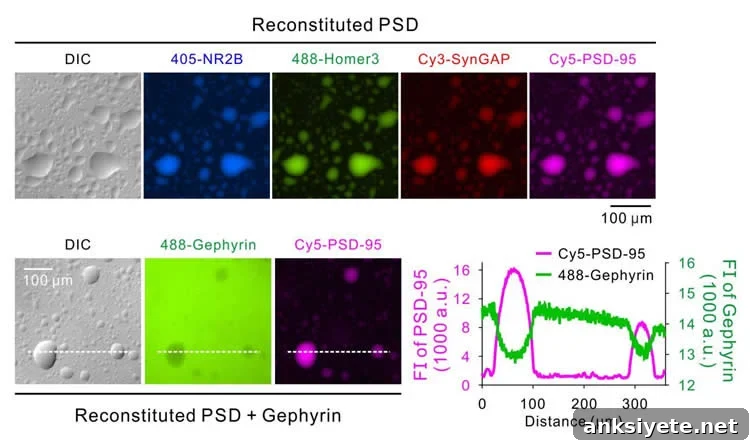
Summary: A new biochemical reconstitution study from HKUST shows that multivalent interaction networks formed by major excitatory postsynaptic density (PSD) scaffold proteins drive the assembly of PSD-like structures via liquid–liquid phase separation (LLPS), both in solution and on supported membrane bilayers.
Source: Hong Kong University of Science and Technology
Synapses are the fundamental sites where neurons communicate, and the postsynaptic density (PSD) is a protein-dense, semi-membraneless compartment critical for excitatory synaptic signaling. Although synapse formation and plasticity are essential to brain function, the molecular mechanisms that organize and dynamically regulate compartmentalized synaptic assemblies have remained unclear.
Researchers at the Hong Kong University of Science and Technology (HKUST) used a biochemical reconstitution approach to show that the principal scaffold proteins found in excitatory PSDs can form highly condensed, PSD-like assemblies through phase separation. These reconstituted condensates replicate several key features of neuronal PSDs: they cluster glutamate receptors on membranes, selectively concentrate synaptic enzymes, promote actin bundle formation, and exclude inhibitory postsynaptic proteins.
The study was published in the journal Cell on August 2, 2018.
Unlike static nodes in engineered circuits, synapses are dynamic structures that reorganize over multiple time scales. Their capacity to form concentrated molecular compartments at postsynaptic sites is central to how neural circuits develop, respond to stimulation, and encode plasticity. By reconstituting PSD components in vitro, the HKUST team created a simplified, controllable molecular platform to investigate how PSD architecture and dynamics emerge from the intrinsic properties of scaffold proteins.
“The condensed-phase PSD assemblies have properties that differ from homogeneous solutions and are well suited to synaptic functions,” said Professor Mingjie Zhang, the lead researcher on the project. “Our reconstitution system provides a molecular framework for understanding how excitatory synapses assemble and are regulated dynamically.”
Co-author Dr. Menglong Zeng added, “We wanted to understand how dense PSD protein assemblies, which are not enclosed by membranes, can autonomously form and persist. These condensates are dynamic, allowing components to exchange in response to synaptic signals.”
Key functional features demonstrated by the reconstituted PSD condensates include:
- Receptor clustering: On supported lipid bilayers, PSD condensates efficiently cluster glutamate receptor tails, while still permitting exchange with diffusing receptor molecules on the membrane.
- Selective enrichment of enzymes: Major PSD scaffold proteins drive condensate formation and recruit synaptic enzymes such as SynGAP and CaMKIIα into the condensed phase, concentrating biochemical activity at postsynaptic sites.
- Actin regulation: The condensates enrich actin-regulatory proteins and promote the formation of actin bundles, linking PSD assembly to cytoskeletal organization that supports synaptic shape and stability.
- Selective exclusion: Inhibitory postsynaptic proteins are driven out of the condensed PSD phase, supporting functional compartmentalization between excitatory and inhibitory signaling components.
The HKUST team emphasizes that, although the reconstituted system is simplified compared with an intact neuron, it is biochemically well defined and traceable. Combining data from this model system with experiments in living neurons yields mechanistic insight into how PSD scaffold proteins control synapse assembly, receptor organization, and activity-dependent remodeling.
“This platform establishes a new experimental paradigm for studying excitatory PSD formation and regulation,” Professor Zhang said. “It also offers a tractable foundation for investigating how mutations in synaptic genes may lead to brain disorders by disrupting PSD assembly or dynamics.”
Source: Johnny Tam, Hong Kong University of Science and Technology
Publisher: NeuroscienceNews (summary based on the HKUST study)
Image credit: HKUST
Original research: “Reconstituted Postsynaptic Density as a Molecular Platform for Understanding Synapse Formation and Plasticity” by Menglong Zeng, Xudong Chen, Dongshi Guan, Jia Xu, Haowei Wu, Penger Tong, Mingjie Zhang. Published in Cell, August 2, 2018. DOI: 10.1016/j.cell.2018.06.047
Suggested citation: Hong Kong University of Science and Technology. PSD as a molecular platform for understanding synapse formation and plasticity. NeuroscienceNews summary, August 2018.
Abstract
Reconstituted Postsynaptic Density as a Molecular Platform for Understanding Synapse Formation and Plasticity
Synapses form protein-dense, semi-membraneless reaction compartments that are central to neuronal signal processing. Proper synapse assembly and dynamic responses to stimuli throughout development and into adulthood are essential for mammalian brain function, but the molecular principles that organize compartmentalized synaptic assemblies are not fully understood. Using a biochemical reconstitution strategy, this study demonstrates that multivalent interaction networks formed by major excitatory PSD scaffold proteins drive phase separation to create PSD-like assemblies in solution and on supported membrane bilayers. These reconstituted PSD condensates cluster receptors, selectively concentrate enzymes, promote actin bundle formation, and exclude inhibitory postsynaptic proteins. The condensed-phase PSD assemblies show distinct physicochemical properties compared with homogeneous solutions and display features compatible with synaptic function. This work establishes a molecularly defined platform for probing how neuronal synapses form and are dynamically regulated.