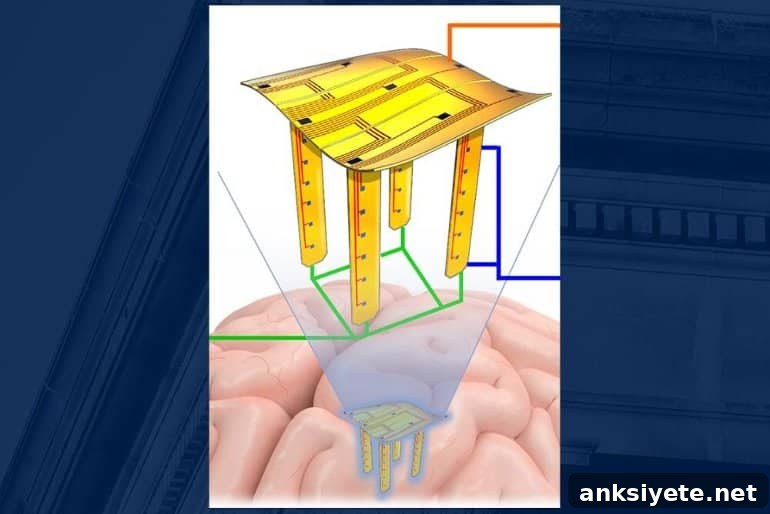
Summary: Researchers have developed a pop-up electrode device that can be deployed into three-dimensional form inside the brain to enable richer mapping of individual neurons and their connections while minimizing tissue damage.
Source: Penn State
Understanding how neurons connect and communicate across three dimensions is essential for studying aging, learning, neurological disease, and other brain processes. Current techniques for recording neural activity each have trade-offs: surface arrays are less invasive but capture limited depth information, while traditional penetrating probes provide depth but can be damaging and do not easily capture a full 3D picture.
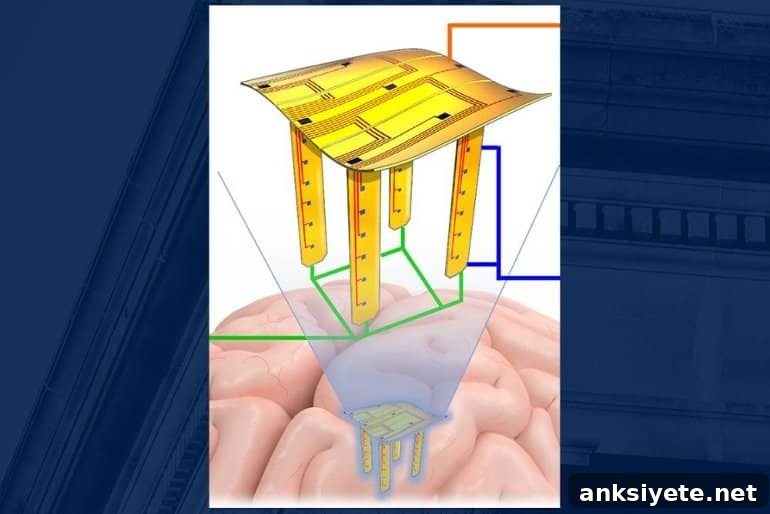
To bridge this gap, a multidisciplinary team has created a foldable, pop-up neural electrode array that can be inserted compactly and then expand into a three-dimensional geometry once positioned. This approach aims to collect detailed information from both the cortical surface and intracortical layers with the performance of standard microfabricated sensors while reducing the need for multiple, damaging insertions.
The work, led in part by Huanyu “Larry” Cheng, James L. Henderson, Jr. Memorial Associate Professor of Engineering Science and Mechanics at Penn State, was published in npj Flexible Electronics.
“Mapping the connectivity among the brain’s vast number of neurons in three dimensions is a major challenge,” Cheng said. Surface devices that rest on the cortex capture useful activity but miss much of the intracortical circuitry. Conversely, probe arrays that penetrate the brain can record depth information but are hard to deploy across a continuous, flexible surface and can cause significant tissue damage if multiple probes are used.
The pop-up design addresses these limitations by fabricating electrodes in a flat, high-resolution format that can transform into a three-dimensional structure just before or after insertion. “Think of a pop-up book: the device starts flat for fabrication and handling, and a controlled mechanical action converts it into a 3D shape,” Cheng explained. “This allows us to retain fabrication quality while providing the spatial coverage needed for 3D neural mapping.”
In addition to its unique geometry, the device employs a combination of materials arranged in a novel way. The team used polyethylene glycol (PEG) as a temporary, biocompatible stiffening coating. PEG has an established record of use in medicine, but here it serves a different role: it makes the flexible device rigid enough for insertion and then dissolves, restoring flexibility in situ.
“For insertion we need stiffness; for chronic recording we need flexibility,” said co-corresponding author Ki Jun Yu of Yonsei University. The biodegradable coating gives the device the necessary insertion stiffness and then dissolves, allowing the electrodes to flex with the surrounding tissue. This combination of material design and transformable geometry enables simultaneous recordings from surface and intracortical layers while reducing mechanical mismatch with brain tissue.
The integrated system contains multiple flexible penetrating shanks alongside surface electrode arrays, enabling continuous monitoring across cortical and intracortical regions. Early demonstrations show the platform can capture synchronized spike activity and correlations between layers, suggesting it can reveal previously inaccessible three-dimensional neural dynamics with high spatiotemporal fidelity.
Future work will iterate the device design for broader applications, including more complete mapping in animal models and potential clinical uses such as surgical guidance or targeted therapies. For clinical translation, long-term biocompatibility is a central focus: making the structure as small, soft, porous, and biocompatible as possible will help brain tissue integrate with the device, potentially allowing tissue to grow into a scaffold-like interface and improving outcomes.
Cheng noted the team is also exploring biodegradable device components that could dissolve after use, eliminating the need for removal in some therapeutic scenarios. These directions aim to combine precise, minimally damaging 3D neural interfacing with materials and forms that support tissue health and recovery.
About this neurotech research news
Author: Press Office
Source: Penn State
Contact: Press Office – Penn State
Image: The image is credited to Huanyu “Larry” Cheng
Original Research: Open access.
“Foldable three dimensional neural electrode arrays for simultaneous brain interfacing of cortical surface and intracortical multilayers” by Ju Young Lee et al. NPJ Flexible Electronics
Abstract
Foldable three dimensional neural electrode arrays for simultaneous brain interfacing of cortical surface and intracortical multilayers
Understanding three-dimensional brain networks requires recording both surface and intracortical signals, but mechanical design challenges and spatial limits of implant sites have hindered simultaneous mapping. The authors present a foldable, flexible 3D neural prosthetic designed to map complex neural circuits across intracortical and cortical regions with high spatiotemporal resolution.
The platform integrates four flexible penetrating shanks with surface electrode arrays in a single system to enable continuous electrophysiological monitoring from the intracortical region to the cortical surface. Using this device, the researchers demonstrate the ability to identify correlations of neural activity across layers and to record synchronized single-unit spikes evoked by sensory stimulation. This approach offers a next-generation neural interface capable of revealing unpredictable 3D neural pathways and advancing both basic neuroscience and translational neurotechnology.