
Summary: Three days of unconscious training with a brain–computer interface (BCI) reduced phantom limb pain. Participants reported an average 30% pain reduction after the first session, and the benefit persisted for several days after training ended.
Source: Osaka University
Phantom-limb pain is a common and often disabling condition experienced by many amputees. Although most people who lose a limb continue to sense the missing limb as part of their body, in 50% to 80% of cases those sensations are painful. Because the exact cause remains unclear and there are limited effective therapies, phantom-limb pain can substantially reduce quality of life and slow rehabilitation.
One leading theory proposes that phantom-limb pain arises when brain regions that formerly controlled the amputated limb remain strongly tied to the mental representation of that limb. To weaken that link, researchers have explored retraining the brain so areas controlling the intact limb also influence the phantom limb representation. Takufumi Yanagisawa and colleagues at Osaka University tested a novel approach: unconscious BCI training designed to alter cortical activity without asking patients to deliberately imagine moving the missing limb.
“It is difficult to deliberately activate the specific motor area for your right hand without consciously thinking about moving it,” Yanagisawa explains. “So we built a system that engages the relevant brain regions without telling patients which parts of the brain they are using.”
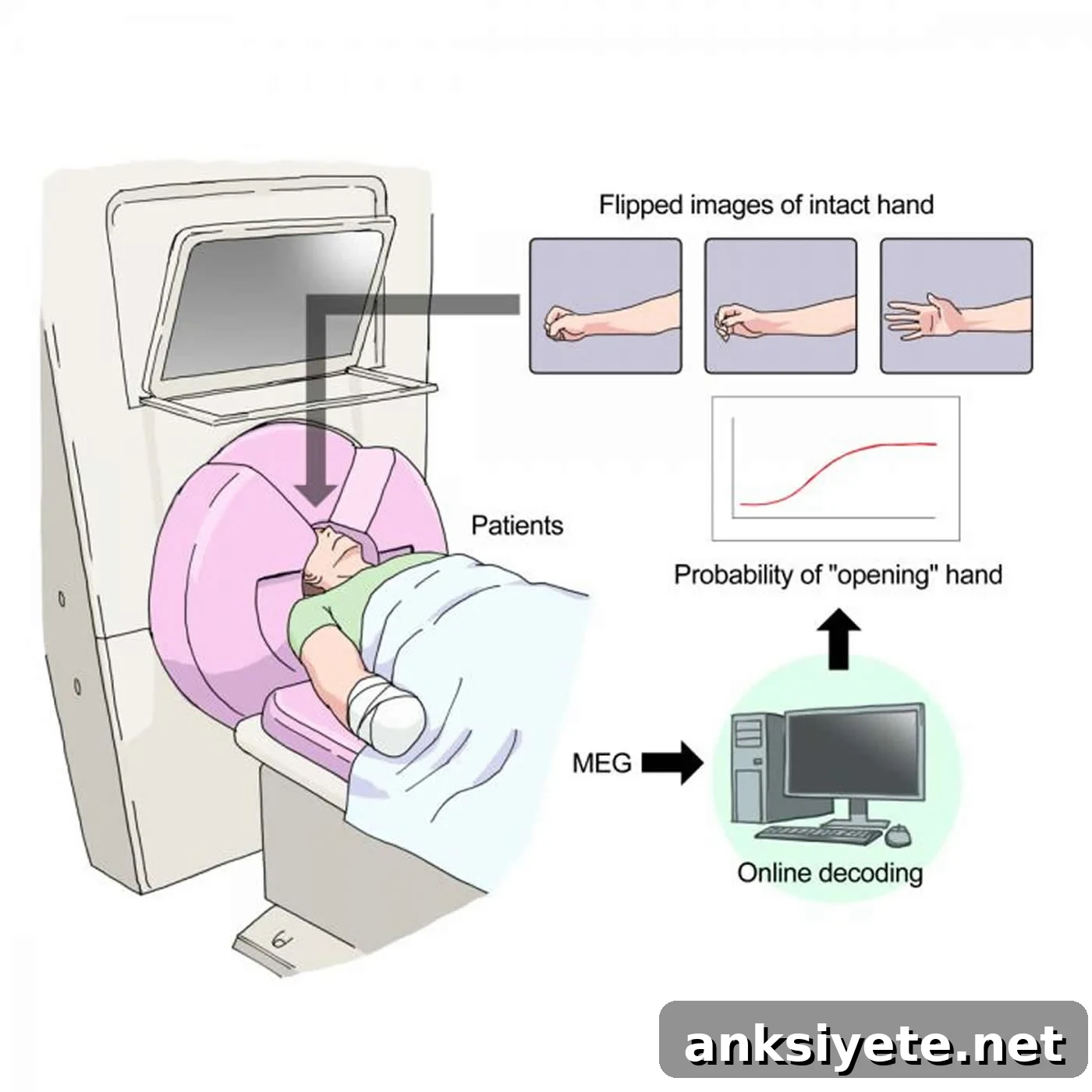
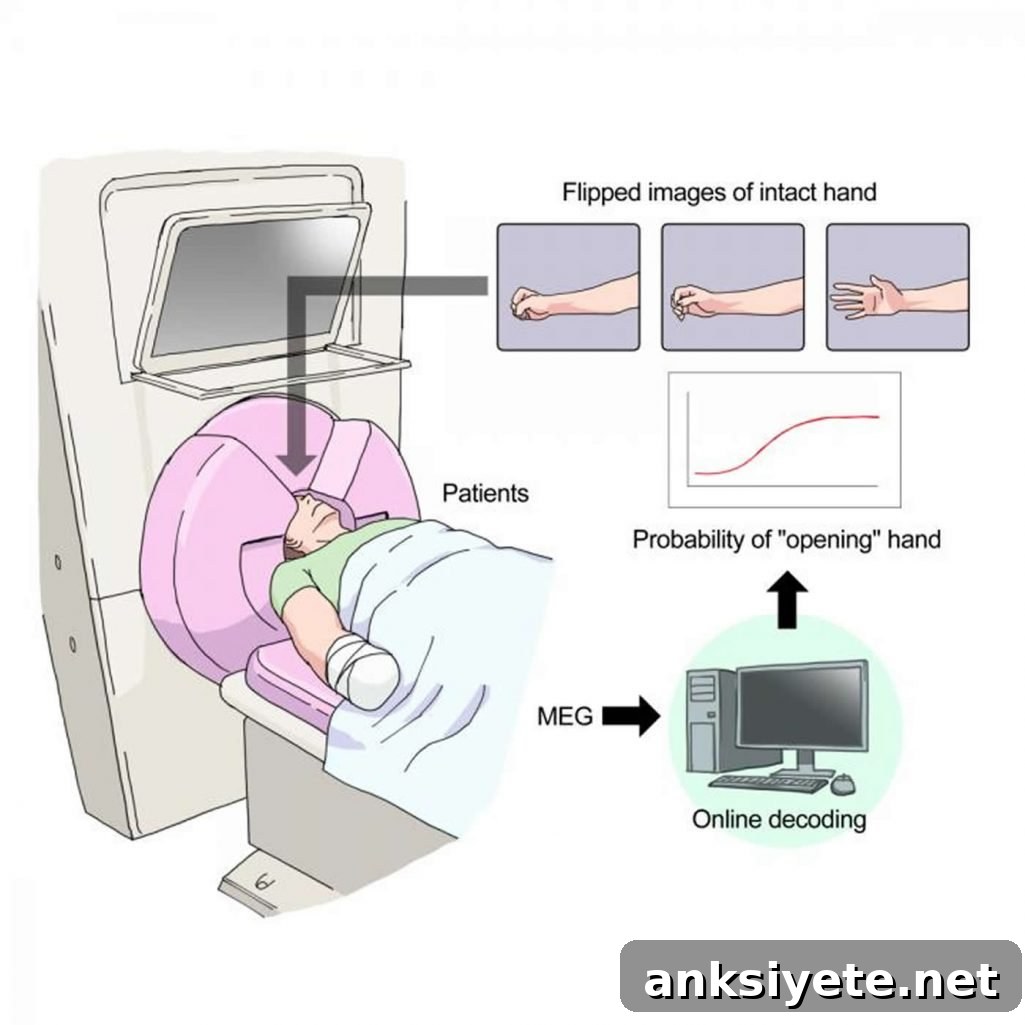
The team used magnetoencephalography (MEG) and a BCI to retrain brain activity. First, they recorded cortical activity while patients opened and closed their intact hand and created a decoding template from that pattern. During training, MEG signals from the intact-hand area were continuously monitored while participants attempted to control a virtual hand using their phantom hand. In the “real training” condition, decoded cortical currents were used to drive the virtual hand so its opening and closing matched the recorded brain activity. In the “random training” control, the virtual hand’s movements were unrelated to the patient’s brain signals. Patients were unaware of which training they received and believed they were controlling the virtual hand in all sessions. Training lasted roughly 30 minutes per day across three consecutive days, and patients rated their phantom-limb pain before and after each session.
Results showed a clinically meaningful pain reduction: after the first day of real BCI training, average pain fell by about 30%, and the reduction persisted for up to five days following the three-day program. Importantly, only participants who underwent real, decoder-driven training experienced significant pain relief; those in the random-training condition did not show the same decrease. Neurophysiological measures indicated that the representation of the phantom hand in motor cortex was weakened after real training, consistent with the hypothesis that modifying cortical activity reduces phantom-limb pain.
“These findings are encouraging,” says Yanagisawa, “particularly because other approaches like mirror therapy typically require weeks of practice to achieve similar gains. To translate this method into routine clinical care, however, the technology needs to become more affordable and accessible.”
About this neuroscience research article
Source:
Osaka University
Media Contacts:
Saori Obayashi – Osaka University
Image Source:
Image credited to Osaka University.
Original Research: “BCI training to move a virtual hand reduces phantom limb pain: A randomized crossover trial” by Takufumi Yanagisawa et al., published in Neurology. DOI: 10.1212/WNL.0000000000009858
Abstract
BCI training to move a virtual hand reduces phantom limb pain: A randomized crossover trial
Objective
To evaluate whether three days of BCI training that controls an image of a phantom hand—driven by cortical currents estimated from magnetoencephalographic signals—reduces phantom limb pain.
Methods
Twelve patients with chronic phantom-limb pain of the upper limb (amputation or brachial plexus root avulsion) participated in a randomized, single-blinded crossover trial. Participants trained for three days to move a virtual hand image driven by a real decoder constructed from motor cortical currents associated with intact-hand movements (“real training”). Pain was measured using a visual analogue scale (VAS) immediately before and after training and at follow-up visits for 16 additional days. As a control, the same hand image was driven by random values unrelated to brain activity (“random training”). The order of real and random training was randomized for each patient. This trial is registered at UMIN-CTR (UMIN000013608).
Results
VAS scores at day 4 were significantly lower than baseline after real training (mean [SD] 45.3 [24.2] to 30.9 [20.6]; p = 0.009), while random training did not produce a statistically significant change. Compared with day 1, VAS at days 4 and 8 decreased by 32% and 36% respectively after real training, and these reductions were significantly greater than those observed after random training (p < 0.01).
Conclusion
Three days of BCI-guided training to move virtual hand images significantly reduced phantom-limb pain for approximately one week, suggesting that targeted cortical retraining with BCI may be an effective short-term intervention for reducing phantom-limb pain.