Summary: Specific, identifiable neural pathways undergo functional changes at different progressive stages of Parkinson’s disease, linking distinct circuits to particular motor and cognitive symptoms.
Source: UCSD
Parkinson’s disease (PD) is a progressive neurological disorder that progressively impairs movement and, often early on, affects non-motor functions such as cognition. Although the hallmark of PD is loss of dopaminergic neurons and resulting motor deficits, the precise circuit-level changes that produce distinct motor and non-motor symptoms are not fully understood.
A new study led by neurobiologists at the University of California San Diego clarifies how discrete neural pathways within the basal ganglia contribute to different behavioral deficits that emerge across stages of Parkinson’s disease.
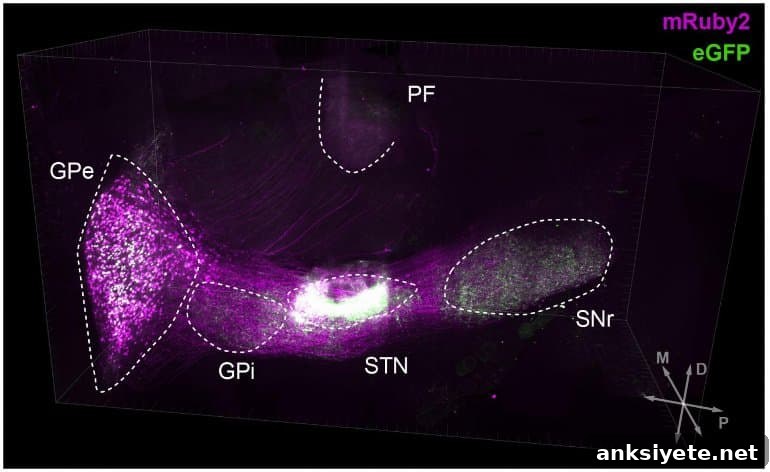
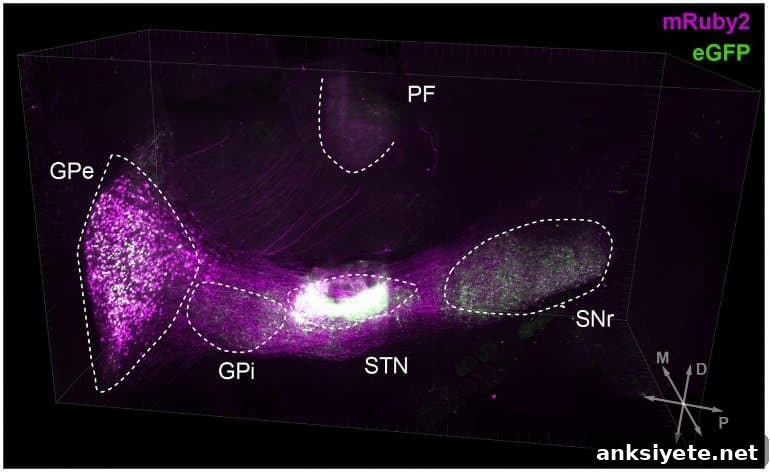
Published in Nature Neuroscience, the research identifies anatomically and functionally distinct populations of neurons in the external globus pallidus (GPe) and maps their projections and roles in Parkinsonian-like behaviors in mice. These findings offer a circuit-level framework that could guide more targeted therapeutic approaches for specific symptoms at defined stages of PD progression.
The basal ganglia are deep brain structures essential for motor control, learning, and cognitive flexibility, and they are strongly affected in PD. The research team focused on parvalbumin-expressing neurons in the GPe (GPe-PV), a key node with broad influence over downstream brain regions. Using a combination of electrophysiology, viral tracing of projections, and behavioral testing, the researchers dissected how different GPe-PV subpopulations connect to specific targets and drive distinct behaviors.
The investigators identified two major GPe-PV neuron populations with divergent projection patterns and behavioral associations. One population projects primarily to the substantia nigra pars reticulata (SNr) and is linked to locomotor control. The other population projects to the parafascicular thalamus (PF) and is associated with cognitive flexibility, specifically reversal learning. In a mouse model of Parkinson’s disease, selectively targeting the SNr-projecting GPe-PV neurons improved locomotor deficits, while manipulating the PF-projecting GPe-PV neurons rescued impaired reversal learning. These results demonstrate that different Parkinsonian symptoms arise from changes in distinct GPe circuits rather than from a single uniform dysfunction.
Byungkook Lim, an associate professor in the Neurobiology Section of the Division of Biological Sciences at UC San Diego and senior author of the study, emphasized the importance of assessing circuit-specific changes. “Our work demonstrates that distinct neural circuitries in the basal ganglia are differentially involved in the motor and non-motor symptoms of Parkinsonian-like behaviors that occur at different stages of the disease,” Lim said. He added that targeted evaluation of these circuits could lead to improved therapeutic strategies tailored to individual symptoms and stages of PD.
One striking insight from the study is how selectively the loss of dopaminergic neurons—central to Parkinson’s disease—can be linked to altered function in specific downstream brain areas. The authors show that manipulating discrete GPe pathways can alleviate one class of symptoms without affecting others, pointing to the feasibility of precision interventions that address either motor or cognitive deficits independently.
With this new framework, the research team plans to further probe how these and other basal ganglia circuits evolve over time in PD models, with a goal of identifying interventions that slow or prevent progression of particular symptoms. Understanding which circuits drive specific behaviors could enable therapies that are better matched to a patient’s symptom profile and disease stage.
The paper concludes that establishing the behavioral importance of distinct GPe-PV neuronal populations provides a novel circuit-based perspective on Parkinsonian deficits and creates a foundation for future translational work aimed at circuit-specific treatments.
Full author list: Varoth Lilascharoen (former graduate student), Eric Hou-Jen Wang (current graduate student), Nam Do, Stefan Carl Pate, Amanda Ngoc Tran, Christopher Dabin Yoon, Jun-Hyeok Choi, Xiao-Yun Wang, Horia Pribiag, Young-Gyun Park, Kwanghun Chung and Byungkook Lim.
About this Parkinson’s disease research news
Source: UCSD
Contact: Mario Aguilera – UCSD
Image: The image is credited to Lim Lab, UC San Diego
Original Research: Closed access. “Divergent pallidal pathways underlying distinct Parkinsonian behavioral deficits” by Varoth Lilascharoen, Eric Hou-Jen Wang, Nam Do, Stefan Carl Pate, Amanda Ngoc Tran, Christopher Dabin Yoon, Jun-Hyeok Choi, Xiao-Yun Wang, Horia Pribiag, Young-Gyun Park, Kwanghun Chung & Byung Kook Li. Nature Neuroscience
Abstract
Divergent pallidal pathways underlying distinct Parkinsonian behavioral deficits
The basal ganglia regulate a broad array of behaviors, including motor control and cognitive functions, and are greatly affected in Parkinson’s disease (PD). However, the circuit-level organization of distinct basal ganglia nuclei remains incompletely understood.
This study examines the functional roles of parvalbumin-expressing neuronal populations in the external globus pallidus (GPe-PV) and assesses how these distinct populations contribute to different PD-related behavioral deficits.
The authors demonstrate that SNr-projecting GPe-PV neurons are associated with locomotion, while PF-projecting GPe-PV neurons are linked to reversal learning. In a mouse model of PD, selective manipulation of SNr-projecting neurons alleviated locomotor deficits and manipulation of PF-projecting neurons rescued impaired reversal learning. These results establish the behavioral relevance of two distinct GPe-PV populations and offer a circuit-based framework for understanding divergent Parkinsonian symptoms.