
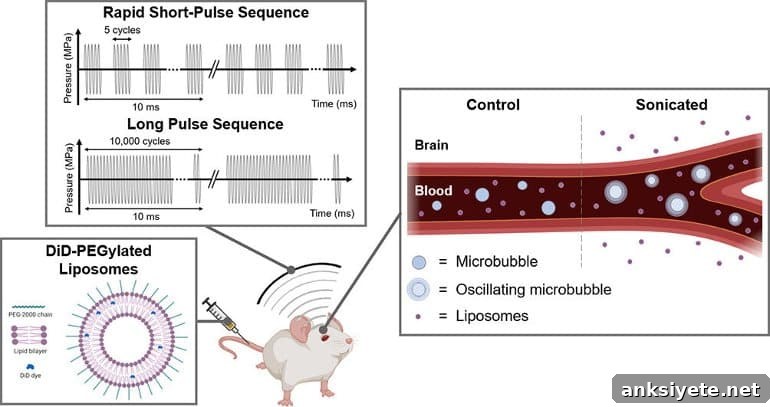
Summary: Applying rapid short pulses of ultrasound can non-invasively deliver liposomes directly to the brain by temporarily opening the blood-brain barrier.
Source: King’s College London
Researchers from the School of Biomedical Engineering & Imaging Sciences at King’s College London, working with the Noninvasive Surgery & Biopsy Laboratory led by Dr. James Choi at Imperial College London, report that rapid short pulses (RaSP) of focused ultrasound can non-invasively transport liposomes across the blood-brain barrier (BBB). The BBB is a specialized protective layer that limits the passage of most molecules into the brain, preventing more than 90 percent of drugs from entering this organ under normal conditions.
Their findings were published in the Journal of Controlled Release.
There is a growing clinical need for techniques that safely deliver large therapeutic molecules to the brain without causing lasting damage to the BBB. Liposomal nanomedicines are particularly promising in this context because they can carry high concentrations of drugs and be engineered to release their payload at sites of inflammation, infection, or tumor. This makes them a valuable option for treating neurodegenerative diseases, brain tumors, and other central nervous system disorders that current drugs cannot reach effectively.
Liposomes are spherical vesicles made from lipids that can encapsulate both hydrophilic and hydrophobic drugs, allowing delivery of a wide range of therapeutic agents. They can also be modified to enhance targeting and improve delivery efficiency. Clinically approved liposome-based products, including vaccine formulations, demonstrate the versatility and established safety profile of this delivery platform.
Focused ultrasound concentrates high-frequency sound waves on a precise location, delivering controlled energy that can temporarily perturb tissue or barriers depending on the pulse pattern and intensity. Prior approaches using long ultrasound pulses to open the BBB and deliver liposomes have sometimes caused damage to brain vasculature. The current study examines whether RaSP sequences—very brief pulses lasting only a few microseconds—offer safer and more effective delivery.
Using a mouse model, the research team targeted the left hemisphere of the brain with focused ultrasound. They administered microbubbles—gas-filled agents that oscillate in response to ultrasound—and liposomes intravenously. When ultrasound causes microbubbles to oscillate near the blood vessel walls, the mechanical interaction temporarily increases permeability of the BBB in that localized region, allowing liposomes to enter brain tissue.
The researchers observed that RaSP sequences produced a more diffuse and wider spread of liposome distribution within the targeted area compared with conventionally used long pulses. Importantly, microscopy-based assessments indicated that RaSP-induced delivery caused less observable vascular and tissue damage than long-pulse approaches. In some instances, liposomes were taken up by neuronal cells, suggesting that this technique can deliver cargo not only to the extracellular space but also into specific cell types relevant to disease.
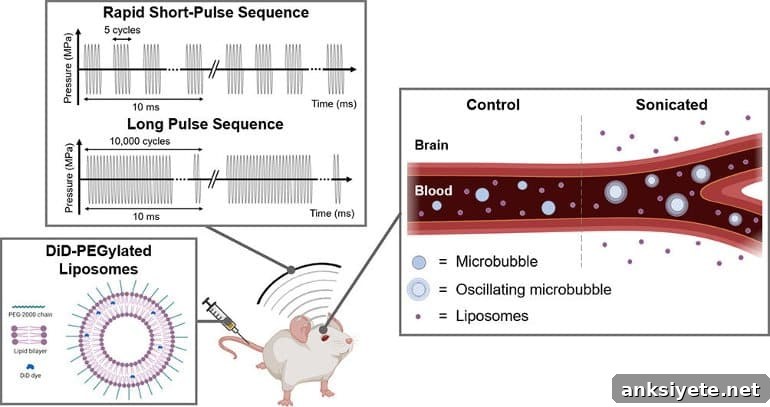
A key outcome of the study was the demonstration that liposomes delivered with RaSP were detectable within different neuronal populations, indicating potential for targeted treatment strategies. The combination of focused ultrasound, microbubbles and RaSP appears to be a controllable, localized, and less damaging approach to temporarily open the BBB and enable delivery of larger therapeutic nanoparticles.
About this neuroscience research news
Author: Press Office
Source: King’s College London
Contact: Press Office – King’s College London
Image: The image is credited to the researchers
Original Research: Open access.
“Liposome delivery to the brain with rapid short-pulses of focused ultrasound and microbubbles” by Sophie V. Morse et al., Journal of Controlled Release
Abstract
Liposome delivery to the brain with rapid short-pulses of focused ultrasound and microbubbles
Liposomes are clinically used drug carriers designed to improve delivery of therapeutic agents to target tissues while reducing systemic exposure. Due to their typical size (approximately 100 nm), liposomes do not readily cross the blood-brain barrier (BBB).
A localized, noninvasive strategy to transport liposomes across the BBB involves intravenous injection of microbubbles combined with focused ultrasound applied to a targeted brain region. Traditional approaches have used long ultrasound pulses (pulse length > 1 ms) to induce temporary BBB opening. Recent work demonstrates that very short, rapid pulses (RaSP; pulse length around 5 μs) can deliver drugs with improved safety and efficacy profiles. Previously, RaSP had been tested with smaller molecules; this study extends the investigation to larger nanoparticle carriers such as liposomes, evaluating distribution, cellular uptake, and tissue safety following delivery.