
Researchers have mapped the distinct genetic changes that childhood medulloblastoma follows at relapse, new findings published in Cancer Cell reveal.
Funded in part by Cancer Research UK and Action Medical Research, the study shows that taking an additional tumour sample when medulloblastoma returns can reveal newly acquired genetic alterations. Those changes can drive a more aggressive disease course and, in some cases, indicate existing targeted therapies that may be effective when standard treatments are no longer working.
Scientists from Newcastle University and The Institute of Cancer Research (ICR) analysed paired biopsy material from 29 patients, comparing samples taken at diagnosis with those taken at relapse. They identified a range of genetic events that appeared only at recurrence and that correlated with rapid progression. In particular, the investigators found that combined defects in the MYC family of oncogenes and the TP53 (P53) pathway often emerged at relapse and defined a subgroup of tumours with especially aggressive behaviour.
Follow-up laboratory work in mouse models supported the clinical observations. In a transgenic MYCN-driven medulloblastoma model, researchers observed the spontaneous development of Trp53-inactivating mutations. When p53 function was lost in that model, tumours became more aggressive and resembled the relapsed human tumours characterised by concurrent P53 and MYC dysfunction. Importantly, restoring p53 activity or genetically and pharmacologically suppressing MYCN reduced tumour growth and extended survival in the experimental systems. The team also showed that an experimental drug targeting one of the identified faults could slow tumour growth in mice, demonstrating a potentially actionable therapeutic avenue.
Professor Steve Clifford, joint lead researcher at Newcastle University, emphasised the clinical implications: “Our study shows that we need to understand and treat relapsed medulloblastoma in a completely new way. It’s clear that new biopsies need to be taken when the disease returns to give doctors a clearer picture of the best and most appropriate treatment.”
Dr Louis Chesler, Team Leader in Paediatric Solid Tumour Biology and Therapeutics at The Institute of Cancer Research, London, added: “We were very pleased to show in our study that some children with relapsed medulloblastoma could benefit from currently available targeted drugs, which usually have fewer and less severe side effects than traditional chemotherapy. It gives us a recipe to direct the use of targeted medicines in relapse where they are most needed. To personalise treatment to those who might benefit, doctors will need access to tumour samples as soon as children develop relapsed disease. Tumour biopsies are not routinely taken in these situations currently – and that will have to change before we can match the best treatments to the children who desperately need them.”
Professor Peter Johnson, Cancer Research UK’s chief clinician, commented on the urgency of new options: “We urgently need new treatments that are effective in relapsed medulloblastoma – there are too few effective options that doctors can use. We’re learning more all the time about how cancers evolve and change. In the short term this work will mean that doctors can decide on the most appropriate palliative care options for medulloblastoma but more importantly the research will lead to better treatments in the future.”
Medulloblastoma is the most common malignant childhood brain tumour. Around 60–70% of children survive the disease with current frontline therapies, but for those whose cancer relapses the prognosis is grave: historically, the chance of survival after relapse has been less than five per cent. Identifying molecular changes that emerge at relapse creates the opportunity to stratify patients and to prioritise targeted agents for those most likely to respond.
Open access funding was provided by Cancer Research UK. The study combined clinical sequencing of paired diagnostic and relapse biopsies with functional experiments in genetically engineered mouse models to define mechanisms that drive aggressive relapse and to test therapeutic strategies.
Contact: Press Office – Cancer Research UK
Source: Cancer Research UK press release
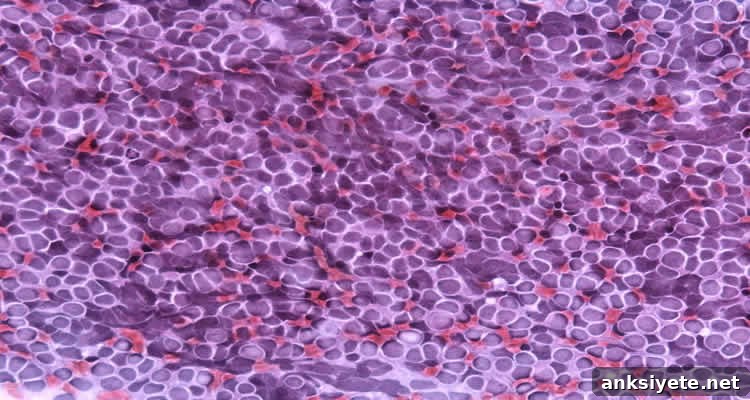
Image Source: The image is credited to Jensflorian and is licensed Creative Commons Attribution-ShareAlike 3.0 Unported.
Original Research: The full open access study, “Combined MYC and TP53 defects emerge at medulloblastoma relapse and define rapidly progressive, therapeutically targetable disease,” was published online in Cancer Cell (Hill RM et al., Dec 18, 2014, doi:10.1016/j.ccell.2014.11.002). The paper reports that combined MYC family amplifications and P53 pathway defects commonly arise at relapse, identify a group with rapid progression, and indicate potential molecular targets for therapy.
Combined MYC and P53 Defects Emerge at Medulloblastoma Relapse and Define Rapidly Progressive, Therapeutically Targetable Disease
The study performed a comprehensive clinical and biological analysis of serial medulloblastoma biopsies collected at diagnosis and relapse. Combined MYC family amplifications and P53 pathway defects commonly emerged at relapse, and all patients in this subgroup experienced rapidly progressive disease after relapse. In a MYCN-driven transgenic model, spontaneous Trp53-inactivating mutations developed and loss of p53 function produced aggressive tumours that resembled the relapsed human tumours with combined P53–MYC dysfunction. Restoring p53 activity and inhibiting MYCN genetically or therapeutically reduced tumour growth and prolonged survival. These findings identify P53–MYC interactions at relapse as biomarkers of clinically aggressive medulloblastoma that may be amenable to targeted treatment.