Groundbreaking study identifies hundreds of neurexin protein variants, strengthening links between neurexin diversity, synapse function, and neurological conditions such as autism.
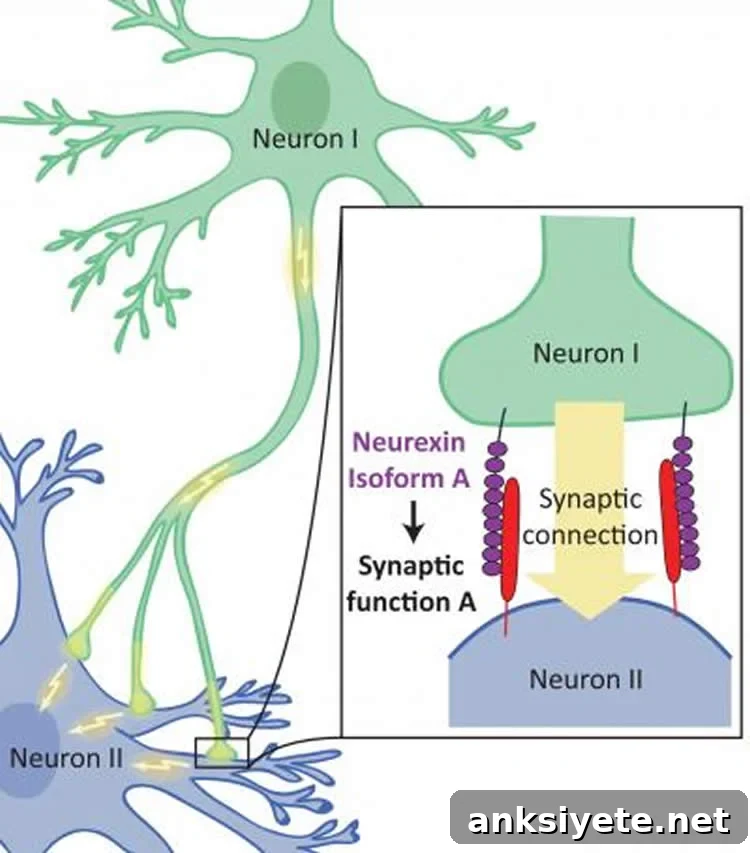
Researchers in neuroscience and bioengineering at Stanford University collaborated to map the diversity of the neurexin family of proteins and to explore how those variations contribute to the vast array of synaptic types in the brain. Neurexins are critical for forming and regulating synapses—the junctions where neurons communicate to control movement, perception, memory, and thought.
In a paper published in the Proceedings of the National Academy of Sciences, Thomas C. Südhof, M.D., professor of molecular and cellular physiology, and Stephen R. Quake, professor of bioengineering, report a detailed survey of neurexin isoforms. Past human genetics studies have associated neurexin genes with cognitive disorders including autism spectrum disorder and schizophrenia, but a comprehensive view of neurexin isoform diversity has been lacking until now.
Südhof, the Avram Goldstein Professor in the School of Medicine and a 2013 Nobel Prize in Medicine laureate, has long hypothesized that different neurexin isoforms provide molecular specificity that helps shape distinct synapse types and their functional properties. To test that idea directly, Südhof teamed up with Stephen Quake, who has developed advanced long-read sequencing technologies capable of reading very long RNA molecules end-to-end. Those technologies made it possible to catalog full-length messenger RNA (mRNA) sequences and reveal exactly which parts of the neurexin gene are included in each isoform.
The study combined expertise from Südhof’s and Quake’s labs to sequence and analyze neurexin mRNAs extracted from mouse prefrontal cortex. Inside cells, DNA instructions are transcribed into long precursor RNA molecules; cellular machinery then splices these transcripts, removing noncoding regions and assembling coding segments into mature mRNA. Different patterns of splicing create alternative isoforms—distinct versions of the same protein that can have different structural and functional properties. Neurexins are particularly prone to alternative splicing: the gene contains 25 modular regions that can be included or skipped in various combinations.
Postdoctoral researchers Ozgun Gokce (molecular and cellular physiology) and Barbara Treutlein (bioengineering) isolated total RNA from mouse prefrontal cortex, identified neurexin mRNAs, and used long-read sequencing instruments to read complete mRNA molecules. Long-read sequencing was essential because only by reading the entire mRNA sequence can researchers determine which of the 25 possible segments are present in a given isoform.
From more than 25,000 full-length neurexin mRNA molecules, the team detected roughly 450 distinct neurexin variants. Most of these variants were rare, while a smaller set of isoforms accounted for the majority of transcripts. Based on the observed diversity and the sampling depth, the researchers estimate the neurexin family may include at least 2,500 isoforms overall—suggesting an even greater level of molecular heterogeneity than previously appreciated.
The discovery of so many neurexin isoforms supports the idea that protein-level diversity contributes to the large variety of synaptic connections observed in the brain. Different isoforms could change how neurexins interact with partner proteins across the synaptic cleft, altering synapse formation, maintenance, and signaling dynamics. Such molecular differences therefore provide a plausible route by which genetic and splicing variation could influence neural circuit function and contribute to neurodevelopmental disorders.
The study raises important follow-up questions: which isoforms are functionally dominant, and which rare variants play specialized roles? How does the inclusion or exclusion of specific neurexin segments affect synapse type, strength, or plasticity? And how does isoform diversity interact with disease-associated mutations to influence risk for autism, schizophrenia, or other conditions?
“This experiment was like a flight over the terrain,” said Ozgun Gokce. “Now we need to land and examine the details.” The long-read sequencing map provides a roadmap for targeted functional studies that can link particular neurexin isoforms to synapse properties, neural circuits, and behavior.
Contact: Tom Abate – Stanford School of Engineering
Source: Stanford School of Engineering press release
Image Source: The image is credited to Barbara Treutlein, Quake Lab, Stanford, and is adapted from the press release.
Original Research: Cartography of neurexin alternative splicing mapped by single-molecule long-read mRNA sequencing by Barbara Treutlein, Ozgun Gokce, Stephen R. Quake, and Thomas C. Südhof in PNAS. Published online March 17, 2014. doi:10.1073/pnas.1403244111