
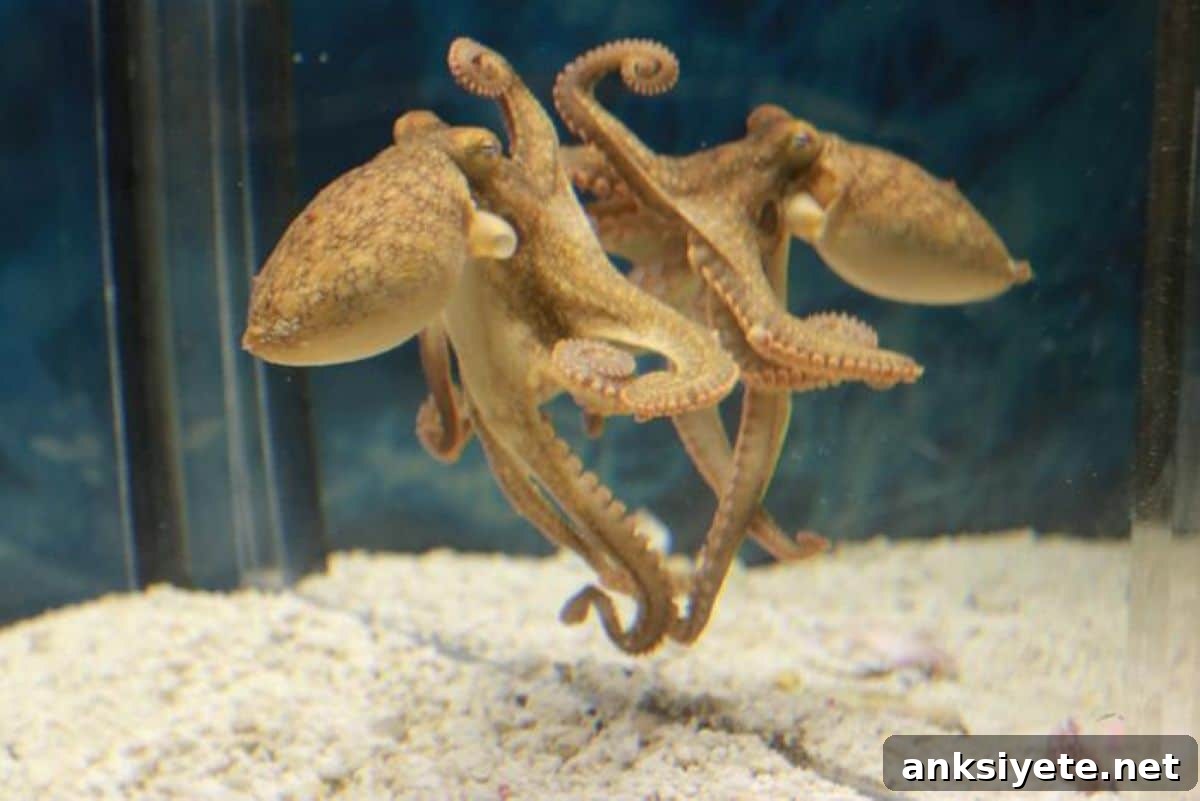
Summary: A Dartmouth study offers the first experimental evidence that an invertebrate can use a mirror as an abstract spatial tool to interpret its surroundings. The research shows that the California two-spot octopus (Octopus bimaculoides) can use mirror reflections to locate and intercept prey that is entirely out of its direct line of sight.
By demonstrating this ability in an animal so evolutionarily distant from humans, the study suggests that complex spatial cognition can arise independently in different branches of life, supporting the idea of convergent evolution where distinct species develop similar neural solutions to ecological challenges.
Key Facts
- First invertebrate evidence: Mirror use to decode spatial environments has been shown previously in some mammals and birds; this is the first documented case in an invertebrate.
- 73% success rate: In training trials at Dartmouth’s Octopus Lab, octopuses correctly navigated to the hidden reward location approximately 73% of the time using mirror information.
- Virtual prey protocol: To prevent chemosensory cues (octopuses can smell and taste by touch) from guiding behavior, researchers used a projected virtual crab so animals had to rely on visual inference alone.
- 180-degree navigation: Octopuses in a start chamber faced a mirror showing the virtual crab behind them. Rather than attacking the reflection, they turned 180 degrees or climbed over the enclosure wall to reach the actual projection site and obtain a live food reward.
- Improved spatial efficiency: Overhead tracking showed that while octopuses did not always take the absolute shortest path, they became faster and more efficient at reaching the hidden stimulus with practice.
- Evidence for convergent evolution: Lead author Mary Kieseler notes that humans and octopuses last shared a common ancestor 350–500 million years ago, so mirror-based spatial processing in octopuses implies independent evolution of similar cognitive strategies.
- Internal map hypothesis: Senior author Peter Tse suggests the results are consistent with octopuses forming internal spatial representations that integrate mirror information with knowledge of three-dimensional tank geometry.
Source: Dartmouth College
Octopuses are widely recognized for their intelligence; this study adds to that reputation by showing they can interpret mirror reflections to locate food outside their direct line of sight. The full findings appear in the journal Current Biology.
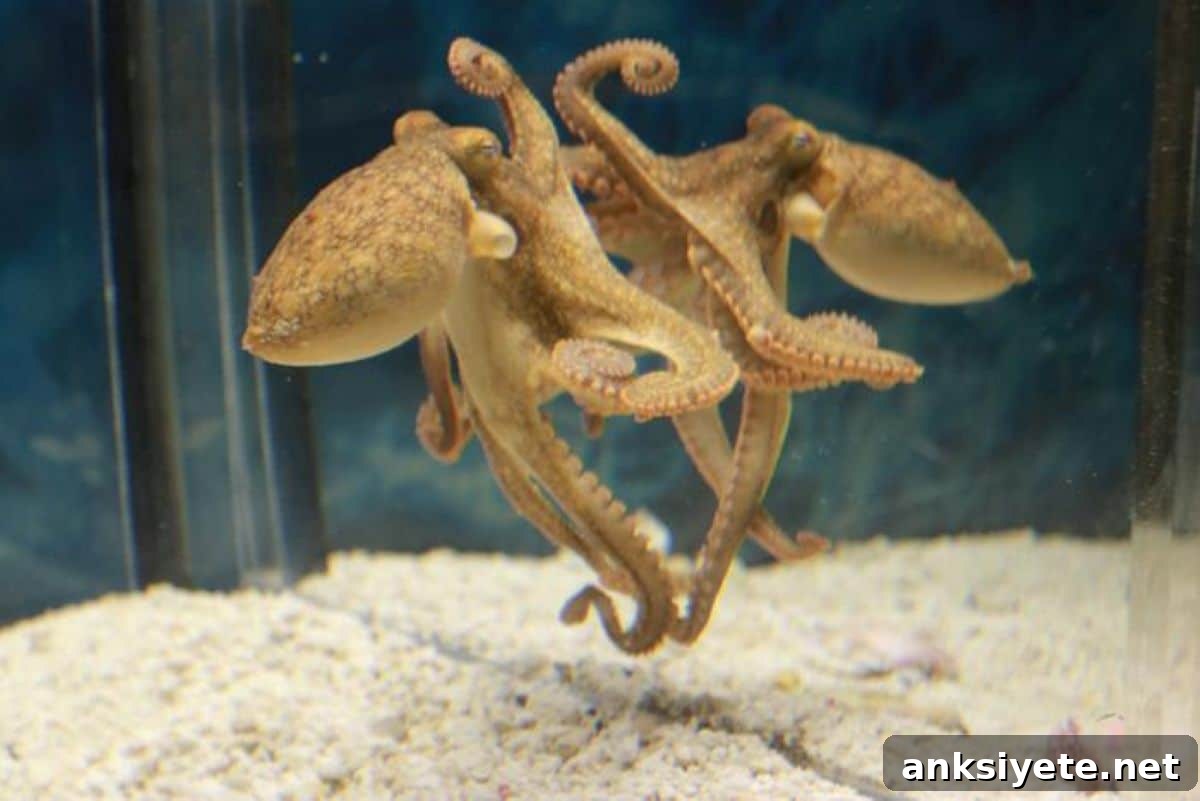
Lead author Mary Kieseler, who completed the work as a PhD student in Dartmouth’s Department of Psychological and Brain Sciences, explains: “Our findings are the first to demonstrate that invertebrates can use mirrors to understand their environment to find prey.” Senior author Peter Tse, a cognitive neuroscientist at Dartmouth, adds that mirror use is a learned skill: “Just as people learn to use a rearview mirror, octopuses can learn to use a mirror to infer where things are in the world.”
Three California two-spot octopuses (Octopus bimaculoides) were first given time to acclimate to mirrors in their tanks. Initial training involved showing a live crab in a jar visible in the mirror; to obtain the reward the octopus had to turn 90 degrees around a corner, demonstrating it could use the mirror to guide action. For the critical trials, the team removed olfactory and tactile cues by projecting a virtual crab that was visible only via mirror reflection.
During test trials, each octopus was placed in a start box open at the top and front. A virtual crab image appeared in the mirror in front of the animal but the real projected stimulus was positioned on either the left or right side behind the octopus. Rather than approaching the mirror, the animals turned 180 degrees or climbed over the side of the box to the correct projection site to receive a live crab reward. Across trials they chose the correct side about 73% of the time.
Researchers tracked a point between the octopus’s eyes from overhead to analyze movement and path length. While the animals did not always take the geometrically shortest route, they became faster and more decisive at reaching the target location, indicating learning and improved spatial calculation.
Kieseler highlights the evolutionary significance: “Octopuses and humans diverged from a worm-like ancestor hundreds of millions of years ago. That such a distant organism has evolved the ability to use a mirror as a spatial tool suggests similar cognitive solutions can evolve independently in different taxa.” Tse notes this behavior points to the presence of internal spatial maps that help octopuses hunt effectively in complex reef and seafloor habitats, though he and colleagues emphasize more research is needed to confirm the nature and limits of those internal representations.
Key Questions Answered:
A: Octopuses have powerful chemoreceptors on their skin that allow them to detect chemical cues by touch. A projected digital image removes olfactory and tactile information so subjects must rely solely on visual inference and mirror-based reasoning.
A: Instead of approaching the reflection in the glass, octopuses used the mirror image to infer the real prey’s location and then moved to that occluded spot—sometimes climbing over the enclosure—demonstrating inhibition of a direct approach and the ability to map reflected information to real-world coordinates.
A: These results support convergent evolution: distantly related species can independently develop similar cognitive abilities when faced with comparable ecological demands, suggesting common neural or computational solutions to spatial navigation challenges.
Editorial Notes:
- This article was edited by a Neuroscience News editor.
- The journal paper was reviewed in full.
- Additional context was added by the editorial staff.
About this neuroscience research news
Author: Amy Olson
Source: Dartmouth College
Contact: Amy Olson, Dartmouth College
Image credit: Mary Kieseler
Original Research: “Octopus bimaculoides can learn to utilize a mirror to localize a reward outside the line of sight” by Mary Kieseler et al., Current Biology. DOI: 10.1016/j.cub.2026.05.012. (Closed access)
Abstract
Octopus bimaculoides can learn to utilize a mirror to localize a reward outside the line of sight
Mirror-mediated localization of hidden objects is well established in vertebrates but has not previously been shown in invertebrates. Using a mirror to locate an occluded object links a visible reflection to an unseen location and can be regarded as a form of mediated perception. Cephalopods, which independently evolved complex perceptual and cognitive abilities, provide a compelling test case for such capacities.
In this study, researchers projected a virtual crab visible only via a mirror reflection onto a tank wall. Three Octopus bimaculoides were trained to navigate to the projection site rather than to the mirror itself. All three subjects learned the task and chose the correct side in 73% of trials. Notably, octopuses sometimes moved away from the visible reflection and climbed over the start chamber walls to reach the occluded location that aligned with the reflected prey. This behavior indicates both inhibition of a direct response to a salient visual stimulus and a spatial representation that integrates mirror information with knowledge of three-dimensional tank layout.
These results extend mirror-use capabilities to invertebrates and show that cephalopods can employ mirror reflections for spatial navigation. The independent emergence of these cognitive skills across distant taxa suggests common evolutionary solutions to the challenges of spatial foraging and navigation.