
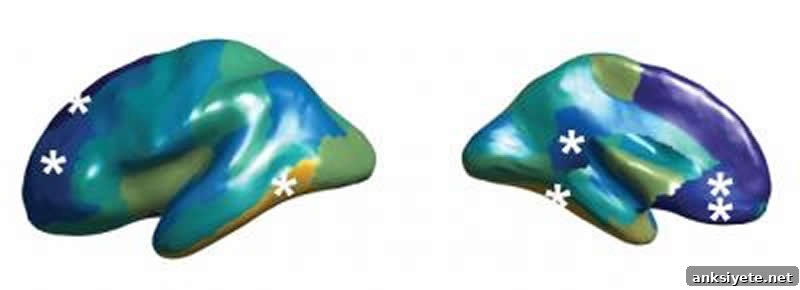
Summary: People with autism spectrum disorder (ASD) show reduced left-right brain asymmetry. A large international study found smaller differences in cortical thickness between the hemispheres across several brain regions in individuals with ASD.
Source: Max Planck Institute
Background
The two cerebral hemispheres normally develop with functional and structural specializations—for instance, language is typically lateralized to the left hemisphere in right-handed people. Previous research has suggested that people with autism spectrum disorder are less likely to show typical lateralized traits such as language dominance or hand preference. However, anatomical studies of brain asymmetry in autism have produced mixed results, in part because most studies used small samples.
Study and methods
To resolve inconsistent findings, researchers from the ENIGMA consortium carried out the largest study to date on structural brain asymmetry in autism. The team compiled brain-scan data collected across 54 independent datasets from multiple countries over more than two decades. The pooled sample included 1,774 individuals with ASD and 1,809 healthy controls, allowing the investigators to detect subtle but reliable anatomical differences.
Key findings
The main result was that individuals with ASD have generally reduced asymmetry between the left and right cerebral hemispheres, especially in cortical thickness. Reduced asymmetry appeared across multiple regions of the cortical surface—most prominently in medial frontal, orbitofrontal, cingulate, and inferior temporal areas. The orbitofrontal cortex also showed altered surface area asymmetry. In contrast, one subcortical measure—putamen volume asymmetry—was increased in ASD.
Notably, these anatomical differences were consistent across ages, sexes, IQ levels, symptom severity, and medication status: the effect patterns did not depend on those factors. Effect sizes were small; the largest case-control effect was Cohen’s d = −0.13 for asymmetry of superior frontal cortical thickness. Because group differences are subtle, brain asymmetry measures are unlikely to serve as clinical predictors for individual diagnosis. Still, they provide meaningful clues about atypical neurodevelopment in autism.
Interpretation and implications
Because most data in this study were from children, the findings support the idea that altered lateralized neurodevelopment—changes in the brain’s left-right axis—occurs early in ASD. Affected regions overlap with networks involved in diverse cognitive functions, including the default mode network (DMN). The DMN is active during internally focused states such as mind-wandering and self-referential thinking, and several altered regions in ASD are part of this network. How altered anatomical asymmetry relates to the cognitive and behavioral features of autism remains an open question for future research.
Study leader Clyde Francks noted that, although the detected differences in asymmetry are small and not clinically diagnostic, they contribute to a better biological understanding of autism spectrum disorder. PhD student Merel Postema emphasized that prior inconsistencies in the literature likely reflected limited sample sizes, and that the ENIGMA consortium’s large-scale approach made it possible to quantify the subtle structural changes reliably.
Conclusions
This large-scale analysis across 54 datasets demonstrates that ASD is associated with altered structural brain asymmetry, most consistently seen as reduced cortical thickness asymmetry in several frontal, cingulate and temporal regions. The results indicate that atypical lateralized neurodevelopment is a feature of ASD, affecting widespread cortical systems. Future studies can build on these findings to explore how altered asymmetry relates to cognitive function, behavior, and developmental trajectories in autism.
Source:
Max Planck Institute
Media Contacts:
Marjolein Scherphuis – Max Planck Institute
Image credit:
Clyde Francks, MPI Nijmegen.
Original research (open access):
“Altered structural brain asymmetry in autism spectrum disorder in a study of 54 datasets.” Postema, M.C., Van Rooij, D., Anagnostou, E., Arango, C., Auzias, G., Behrmann, M., … Francks, C. Nature Communications. DOI: 10.1038/s41467-019-13005-8