
Summary: Greater variability in reaction time is associated with reduced gray matter volume in the ventromedial prefrontal cortex, a new study reports.
Source: Larner College of Medicine.
Despite diagnoses of attention-deficit/hyperactivity disorder (ADHD) in roughly 11 percent of U.S. school-aged children, the biological roots of this condition remain incompletely understood. A new population-based imaging study of adolescents identifies a structural brain correlate linked to dimensional measures of ADHD symptoms—particularly inattention—pointing to a potential biomarker for attentional problems. The findings are reported in an Article in Press in Biological Psychiatry.
Researchers led by Matthew Albaugh, Ph.D., at the Larner College of Medicine, University of Vermont, analyzed structural MRI and behavioral data from the IMAGEN study to examine how continuous, multi-informant measures of ADHD symptoms relate to brain anatomy. Rather than using a categorical comparison of diagnosed ADHD versus control groups, the team used a dimensional approach that quantifies symptom severity across the population, integrating parent reports, adolescent self-reports, and symptom counts derived from clinical interviews.
“It’s not simply whether someone has attention problems, but the degree of inattention that matters,” says Albaugh. Taking a multi-informant, quantitative perspective allowed the researchers to detect anatomical patterns that align with graded differences in attention, hyperactivity, and impulsivity among adolescents in a large sample.
Data from 1,538 adolescents were included. Parent ratings came from the Strengths and Difficulties Questionnaire (SDQ) and the Development and Well-Being Assessment; adolescents completed the youth version of the SDQ; and interview-derived parent symptom counts provided an additional dimensional measure. Reaction time variability, an objective index of attentional lapses that prior research has linked to ADHD, was available for a subset of participants.
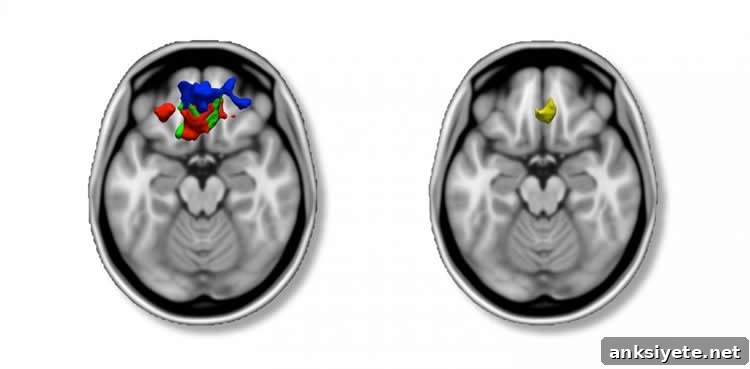
Across voxelwise whole-brain analyses, parent reports, adolescent self-reports, and parent-derived symptom counts converged on the same anatomical region: reduced gray matter volume in the ventromedial prefrontal cortex (vmPFC). This relationship was strongest for measures of inattention. When the imaging results from the behavioral questionnaires and symptom counts were overlaid, the vmPFC emerged consistently as the area of overlap.
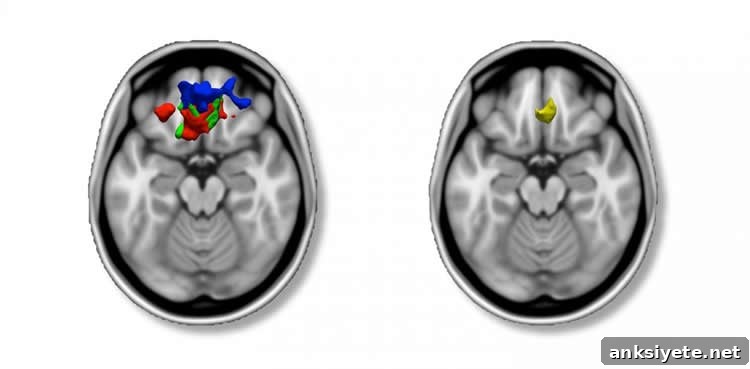
Importantly, the area of anatomical convergence in the vmPFC was also linked to reaction time variability. Adolescents who showed greater variability in response times—interpreted as more frequent lapses in attention—tended to have lower gray matter volume in this ventromedial prefrontal region. These converging results from subjective reports and an objective attentional measure strengthen the case for vmPFC structure as a marker related to inattentive symptoms.
Albaugh and colleagues note that vmPFC structural differences may reflect alterations in networks involved in attention and default mode processing, and their analyses found associations between the brain structural correlates of ADHD symptoms and maps of dopaminergic gene expression (DRD1 and DRD2). Such links are consistent with prior theories implicating dopaminergic dysfunction in ADHD.
The authors emphasize that this is the largest structural imaging study to date examining ADHD symptom dimensions in adolescents and that the multi-informant, dimensional approach increases sensitivity to detect clinically meaningful brain–behavior relationships. Reduced vmPFC volume predicted symptom change from adolescence toward adulthood in their sample, suggesting potential prognostic value, though further longitudinal work is needed to clarify clinical utility.
Funding: Support for the research came from multiple sources, including the European Union, Consortium on Vulnerability to Externalizing Disorders and Addictions, VR, FORTE, FORMAS, Medical Research Council, the Wellcome Trust Behavioural and Clinical Neuroscience Institute, and affiliated universities and institutions.
Source: Jennifer Nachbur – Larner College of Medicine
Image credit: Matthew Albaugh, Ph.D.
Original research: “Inattention and Reaction Time Variability Are Linked to Ventromedial Prefrontal Volume in Adolescents,” published in Biological Psychiatry. DOI: 10.1016/j.biopsych.2017.01.003.
Inattention and Reaction Time Variability Are Linked to Ventromedial Prefrontal Volume in Adolescents
Background
Neuroimaging studies of ADHD typically report volumetric differences in basal ganglia, cerebellum, and prefrontal cortices. Few large, population-based studies have examined how continuous measures of ADHD symptoms relate to brain structure. This study tested associations among dimensional ADHD symptom measures, gray matter volume across the brain, and reaction time variability as an index of attentional lapses. The authors also explored relationships between structural correlates and maps of dopaminergic gene expression.
Methods
Psychopathology and structural MRI data were available for 1,538 adolescents. ADHD symptom measures included parent ratings (Development and Well-Being Assessment, SDQ), youth self-report (SDQ), and parent interview-derived symptom counts. Reaction time variability was available for a subset. Whole-brain voxelwise regressions related each behavioral measure to gray matter volume, controlling for demographic and cognitive covariates.
Results
Parent and adolescent ratings, parent interview symptom counts, and reaction time variability were each negatively associated with gray matter volume in an overlapping region of the ventromedial prefrontal cortex. Brain structural correlates of ADHD symptomatology were associated with maps of DRD1 and DRD2 gene expression.
Conclusions
This large population-based study demonstrates that ventromedial prefrontal cortex structure is associated with multi-informant measures of ADHD symptoms—especially inattention—and with reaction time variability. The vmPFC may serve as a structural biomarker for ADHD symptomatology and links to dopaminergic systems and default mode network function warrant further investigation.
Feel free to share this Neuroscience News.