
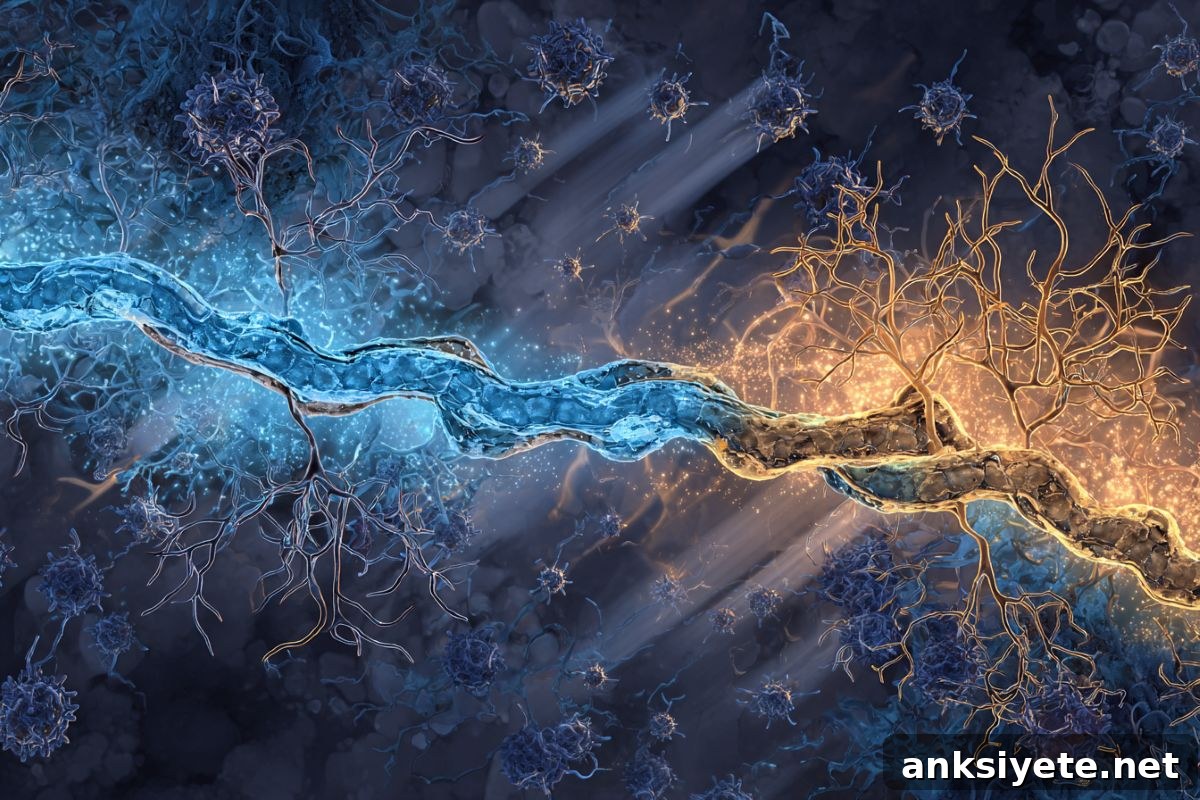
Summary: Researchers have identified two compounds that promote repair of the myelin sheath damaged in multiple sclerosis (MS), marking a major step toward therapies that regenerate nerve insulation rather than merely slowing damage. The lead compound, K102, not only encourages remyelination but also helps rebalance immune responses—an important combination for durable neurological recovery.
In preclinical studies using animal models and human cell cultures, these molecules restored myelin-producing cells and improved functional measures linked to nerve conduction. The program, now in development with Cadenza Bio, aims to translate these findings into the first therapy designed to regenerate, not only protect, nerve fibers affected by MS.
Key Facts:
- Restoring myelin: Both K102 and K110 promote remyelination, with K102 identified as the primary candidate for MS treatment.
- Dual mechanism: K102 supports remyelination and also modulates immune activity, addressing both neurodegeneration and inflammation.
- Path to trials: The compounds have progressed through preclinical testing and are advancing toward the studies required for first-in-human clinical trials under a biotech-led development program.
Source: UCR
About multiple sclerosis: Multiple sclerosis is a chronic autoimmune condition affecting more than 2.9 million people worldwide. It arises when the immune system attacks the myelin sheath—the insulating layer around nerve fibers—disrupting communication between the brain and the body. Symptoms range from numbness and tingling to vision loss and paralysis. Existing therapies reduce inflammation but do not reliably restore damaged myelin or protect neurons. The newly reported compounds aim to change that.
The study, published in Scientific Reports, was led by Seema Tiwari-Woodruff, professor of biomedical sciences at the University of California, Riverside School of Medicine, and John Katzenellenbogen, professor of chemistry at the University of Illinois Urbana-Champaign. Funding came from the National Multiple Sclerosis Society through both investigator-initiated grants and the Fast Forward commercial accelerator program, which helped move the research toward commercialization.
Over more than a decade of collaboration, the team screened and optimized chemical analogs to improve drug-like properties and patentability. Working with university chemists, they evaluated more than 60 derivatives of a parent compound called indazole chloride and identified two leads—K102 and K110—with superior safety, efficacy, and pharmacokinetics in preclinical evaluations.
Why K102 stands out
K102 emerged as the lead candidate because it demonstrated both remyelinating activity and immune modulation. In cultured human oligodendrocytes—cells responsible for producing myelin—derived from induced pluripotent stem cells, K102 promoted differentiation and supported the cellular processes needed to rebuild myelin. In mouse models of MS, including experimental autoimmune encephalomyelitis (EAE) and toxin-induced demyelination, K102 improved axonal remyelination and functional electrophysiological outcomes, suggesting measurable effects on nerve conduction and recovery.
By encouraging oligodendrocyte precursor cells to mature into myelin-producing oligodendrocytes, a compound like K102 could restore faster nerve signaling and help reduce long-term disability that results from failed natural repair in MS.
K110 remains an important candidate as well. It displayed slightly different central nervous system effects in preclinical testing and may be better suited for other types of neuronal injury—such as spinal cord or traumatic brain injury—so it remains in the development pipeline for potential future indications.
Translating discovery into development
The National MS Society’s Fast Forward program played a pivotal role by funding work that built the data package needed to license the technology. The intellectual property is jointly held by UCR and UIUC, and the universities granted an exclusive worldwide license to Cadenza Bio, which has since continued non-clinical development with investor support. Cadenza Bio is advancing K102 through the remaining preclinical studies required to support first-in-human trials.
University technology transfer offices and entrepreneurs-in-residence helped package the scientific and commercial case for investors, enabling the transition from academic research to biotech development. Cadenza Bio’s leadership highlighted the significance of moving beyond slowing axonal damage toward repairing it—a shift they describe as the future of MS treatment.
Broader potential and timeline
Although the immediate focus is on MS, the research team believes K102 and K110 may have broader applications for other disorders involving demyelination and neuronal injury, including stroke and certain neurodegenerative conditions. Cadenza Bio is conducting the necessary safety and pharmacology studies to support an initial clinical trial, and investigators express cautious optimism that human trials could begin once required regulatory and preclinical milestones are met.
Funding: The research received additional support from the National Institutes of Health and Cadenza Bio.
Contributors to the research include Seema Tiwari-Woodruff, John Katzenellenbogen, Sung Hoon Kim, Micah Feri, Flavio D. Cardenas, Alyssa M. Anderson, Brandon T. Poole, Devang Deshpande, Shane Desfor, Kelley C. Atkinson, Stephanie R. Peterson, Moyinoluwa T. Ajayi, Fernando Beltran, Julio Tapia, Martin I. Garcia-Castro (UCR), Kendall W. Nettles and Jerome C. Nwachukwu (The Scripps Research Institute, Florida), and David E. Martin and Curtis (Cadenza Bio, Oklahoma).
Key Questions Answered:
A: They identified two drug candidates, K102 and K110, that promote remyelination of damaged nerve fibers in preclinical models, offering a route toward therapies that restore lost myelin rather than only reducing inflammation.
A: Unlike many current therapies that primarily target inflammation, K102 has a dual action: it encourages oligodendrocyte differentiation and remyelination while also modulating immune responses through estrogen receptor β–related signaling pathways.
A: The compounds have advanced through preclinical efficacy and ADME testing and are undergoing the further non-clinical studies required to support first-in-human trials as part of a biotech development program.
About this multiple sclerosis and neuropharmacology research news
Author: Iqbal Pittalwala
Source: UCR
Contact: Iqbal Pittalwala – UCR
Image: The image is credited to Neuroscience News
Original Research: Open access. “Chloroindazole based estrogen receptor β ligands with favorable pharmacokinetics promote functional remyelination and visual recovery” by Seema Tiwari-Woodruff et al., Scientific Reports
Abstract
Chloroindazole based estrogen receptor β ligands with favorable pharmacokinetics promote functional remyelination and visual recovery
Multiple sclerosis is a chronic autoimmune, demyelinating, and neurodegenerative disease that produces motor, visual, and cognitive deficits. Current therapies can slow progression but seldom restore lost neurological function. Estrogen receptor β (ERβ) has emerged as a promising target because it activates signaling pathways linked to neuroprotection, immune regulation, and remyelination.
This study identifies two chloroindazole-derived ERβ-selective ligands, K102 and K110, which show favorable pharmacokinetics and strong performance in preclinical ADME screening. Both compounds promoted oligodendrocyte differentiation in primary mouse and human cell cultures and enhanced axonal remyelination and electrophysiological recovery in two mouse models of MS (EAE and cuprizone-induced demyelination).
In addition to supporting oligodendrocyte survival and maturation, K102 and K110 modulated immune responses in ways that contributed to motor and visual recovery in experimental models. These preclinical results support advancing K102 and K110 into further development, offering a novel approach that addresses both neurodegeneration and inflammation via ERβ-mediated mechanisms.