
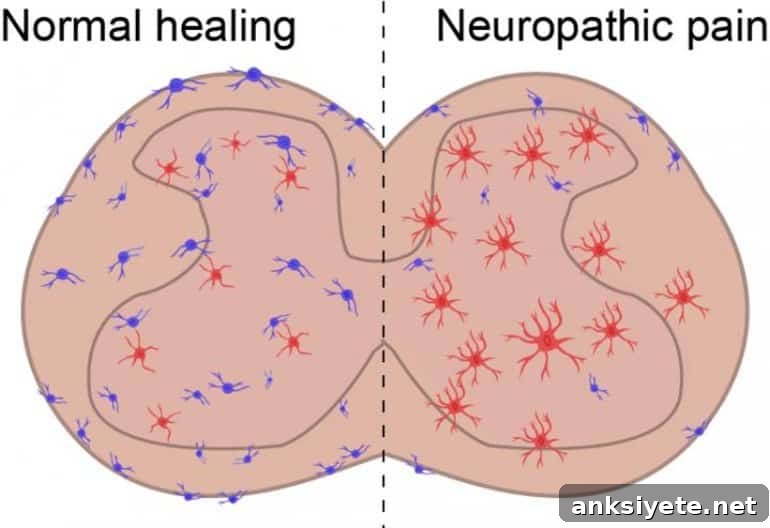
Summary: MRC1+ spinal macrophages become dysfunctional in animal models of neuropathic pain. Restoring their anti-inflammatory activity by driving expression of CD163 reduced neuroinflammation and improved pain-related behaviors in mice.
Source: UNC Health Care
Chronic pain frequently involves persistent inflammation in the nervous system. Researchers at the UNC School of Medicine report that a subset of anti-inflammatory immune cells—MRC1+ macrophages—are impaired in a mouse model of neuropathic pain. Reinstating their anti-inflammatory function may offer a targeted approach to treat neuropathic pain, which is driven by nerve injury or dysfunction of the nervous system.
Published in Neuron, the study shows that stimulating expression of the anti-inflammatory protein CD163 in spinal macrophages reduced markers of neuroinflammation in mice and produced lasting relief from pain-related behaviors.
“Macrophages circulate in blood and reside in tissues throughout the body. We identified a population of spinal macrophages that normally help resolve pain. In neuropathic pain, these cells appear to be disabled and fail to perform that protective role,” said senior author Mark Zylka, PhD, director of the UNC Neuroscience Center and Kenan Distinguished Professor of Cell Biology and Physiology.
“Importantly, the dysfunction is not irreversible. We were able to stimulate these macrophages to boost their anti-inflammatory program and reduce neuropathic pain. This opens the door to developing new, cell-targeted therapies that could treat pain more precisely and with fewer side effects than broad-acting drugs.”
Chronic pain affects an estimated one-fifth of the U.S. population, according to the Centers for Disease Control and Prevention. Causes are often unclear, and many patients require long-term relief to maintain quality of life. Opioids can be effective for short-term pain control but carry serious risks during prolonged use, including dependence, respiratory depression, and overdose.
One limitation of current pain treatments is a lack of cell-type specificity: pain arises from interactions among many cell types, so systemic drugs may help some cells while disrupting others, producing unwanted side effects. To overcome this, scientists are using single-cell RNA sequencing (scRNA-seq) to identify which cells change during chronic pain and how their gene programs are altered.
“Knowing the precise cells to target enables design of therapies that are far more selective and, in theory, have fewer adverse effects,” said Jesse Niehaus, a graduate student in the Zylka lab and the paper’s first author.
The team performed single-cell RNA-seq on spinal cord tissue from mice with neuropathic pain, a condition driven by peripheral nerve injury that triggers persistent changes in the spinal cord. Analysis revealed a population of anti-inflammatory MRC1+ macrophages that, under normal conditions, expand and express Cd163 to promote resolution of inflammation. In nerve-injured animals, however, this response was blunted.
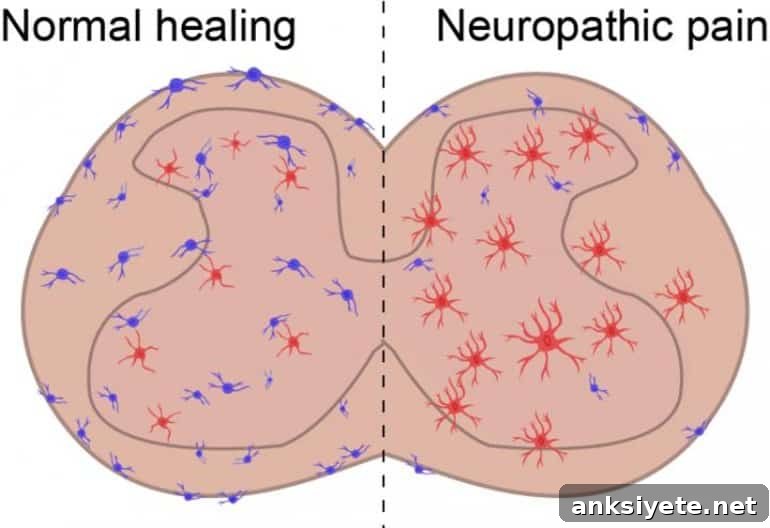
To test whether restoring macrophage anti-inflammatory signaling could reduce neuroinflammation and pain, the researchers used a gene therapy approach to increase CD163 expression specifically in MRC1+ spinal macrophages. A single treatment reduced spinal cord inflammation, decreased activation of glial cells, and relieved mechanical and thermal hypersensitivity for up to a month in injured mice.
Further experiments showed that removing spinal macrophages after a superficial injury prolonged microglial activation and pain behaviors, demonstrating that these macrophages actively restrain harmful glial responses and promote recovery. Conversely, expressing Cd163 in macrophages increased Interleukin-10 levels, limited microgliosis and astrogliosis, and produced lasting pain relief in nerve-injured animals.
“This discovery points to multiple therapeutic strategies to boost macrophage-mediated resolution of neuroinflammation,” Zylka said. “Each approach could offer a more precise and potentially safer means to treat neuropathic pain than current systemic treatments.”
Other contributors to the Neuron paper include Jeremy Simon, PhD, research assistant professor; Bonnie Taylor-Blake, research specialist; and Lipin Loo, PhD, a former postdoc in the Zylka lab who is now a research fellow at the University of Sydney.
Funding: Research funding was provided by the National Institute of Neurological Disorders and Stroke. Sequencing was conducted at the UNC High Throughput Sequencing Core, and microscopy was carried out at the UNC Neuroscience Center Microscopy Core.
About this pain and inflammation research news
Source: UNC Health Care
Contact: Mark Derewicz – UNC Health Care
Image: The image is credited to Zylka Lab, UNC School of Medicine
Original Research: Closed access.
“Spinal macrophages resolve nociceptive hypersensitivity after peripheral injury” by Mark Zylka et al., Neuron
Abstract
Spinal macrophages resolve nociceptive hypersensitivity after peripheral injury
Highlights
- • Single-cell RNA sequencing of the spinal cord in a mouse model of neuropathic pain identified cell-specific changes
- • The anti-inflammatory response of spinal MRC1+ macrophages is reduced after nerve injury
- • Spinal macrophages suppress microgliosis and pain hypersensitivity when functioning properly
- • CD163 expression promotes resolution of neuroinflammation and reverses hypersensitivity
Summary
Peripheral nerve injury triggers persistent pro-inflammatory responses in spinal glial cells that contribute to neuropathic pain. Using single-cell RNA sequencing, the investigators identified MRC1+ macrophages in the spinal cord that normally proliferate and upregulate the anti-inflammatory mediator Cd163 after a superficial injury. In contrast, nerve injury blunts this protective response.
Experimental depletion of spinal macrophages following superficial injury enhanced microgliosis and prolonged mechanical hypersensitivity, indicating that these macrophages actively limit harmful glial activation. Restoring Cd163 expression in spinal macrophages increased Interleukin-10, reduced micro- and astrogliosis, and produced sustained relief from mechanical and thermal hypersensitivity in nerve-injured animals.
These findings indicate that MRC1+ spinal macrophages play a critical role in restraining glial-mediated neuroinflammation and resolving pain after peripheral injury. Moreover, although spinal macrophages from nerve-injured animals show a dampened anti-inflammatory program, they can be therapeutically reactivated to promote long-lasting recovery from neuropathic pain.