
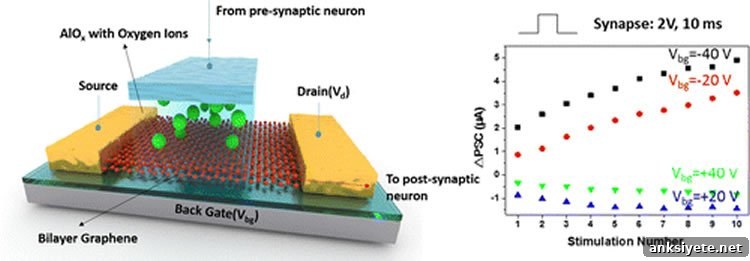
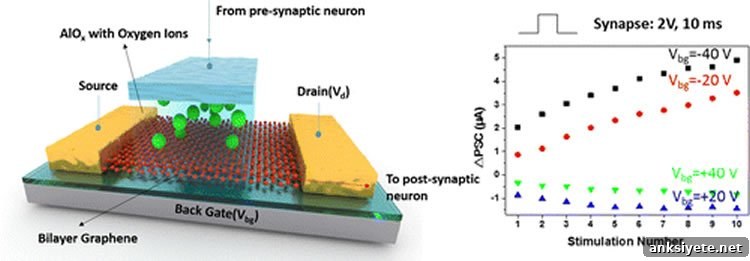
Creating a computer that can learn and remember like the human brain is a formidable task. The brain contains roughly 86 billion neurons and trillions of synaptic connections that strengthen or weaken over time. Researchers now report the development of a first-of-its-kind synthetic synapse that reproduces key aspects of biological synaptic plasticity, a step toward more brain-like artificial intelligence.
Biological synapses are highly dynamic: the amount and timing of signaling molecules released at a synapse can change, enabling learning, memory formation, adaptation, and recovery. Reproducing that adaptability in hardware has been a central aim of neuromorphic engineering. Although artificial neurons and synapses have been implemented using various electronic technologies, most devices to date have lacked the flexible, tunable plasticity needed for robust learning and self-repair. To address this limitation, a research team led by Tian-Ling Ren developed a novel artificial synapse that can be actively modulated to exhibit both excitatory and inhibitory behaviors.
The experimental device integrates aluminum oxide with twisted bilayer graphene. By changing applied voltages, the team could control the response amplitude of the receiving element—analogous to how a biological postsynaptic neuron adjusts its sensitivity. Thanks to graphene’s ambipolar conductance, a single device can function as either an excitatory or an inhibitory synapse depending on operating conditions. The researchers also demonstrated that the synaptic plasticity is tunable by varying the carrier density in the graphene layer and by adjusting the bottom gate voltage, enabling inversion and regulation of synaptic behavior. This ability to modulate and reverse synaptic characteristics allows the artificial synapse to mimic aspects of synapse development and adaptation seen in living nervous systems.
Funding: The research team acknowledges support from the National Natural Science Foundation of China, the National Basic Research Program of China, the National Key Project of Science and Technology, and the Special Fund for Agro-Scientific Research in the Public Interest of China.
Source: Michael Bernstein – American Chemical Society
Image credit: Reprinted with permission from Nano Letters 2015, American Chemical Society.
Original research: “Graphene Dynamic Synapse with Modulatable Plasticity” by He Tian, Wentian Mi, Xue-Feng Wang, Haiming Zhao, Qian-Yi Xie, Cheng Li, Yu-Xing Li, Yi Yang, and Tian-Ling Ren, published in Nano Letters. doi:10.1021/acs.nanolett.5b03283
Abstract (paraphrased)
Synaptic activity underlies memory and learning in nervous systems, and the concept of biological synapses has inspired neuromorphic device design. Prior hardware implementations of synaptic functions have used CMOS circuits, resistive switching memories, and field-effect transistors with ionic dielectrics. However, achieving an artificial synapse whose plasticity can be actively regulated at the device level has remained elusive. The present work demonstrates a dynamic artificial synapse based on twisted bilayer graphene that exhibits tunable plasticity. Owing to graphene’s ambipolar conductance, the same device can display both excitatory and inhibitory synaptic behaviors. Crucially, the degree of synaptic plasticity can be controlled by tuning graphene’s carrier density, and by changing the bottom gate voltage the device’s behavior can be modulated or inverted. These capabilities allow the device to imitate developmental and adaptive processes of synapses. The findings broaden opportunities for two-dimensional material electronics and offer a new direction for neuro-inspired electronic systems.
“Graphene Dynamic Synapse with Modulatable Plasticity” by He Tian, Wentian Mi, Xue-Feng Wang, Haiming Zhao, Qian-Yi Xie, Cheng Li, Yu-Xing Li, Yi Yang, and Tian-Ling Ren. Nano Letters. Published online October 26, 2015. doi:10.1021/acs.nanolett.5b03283