
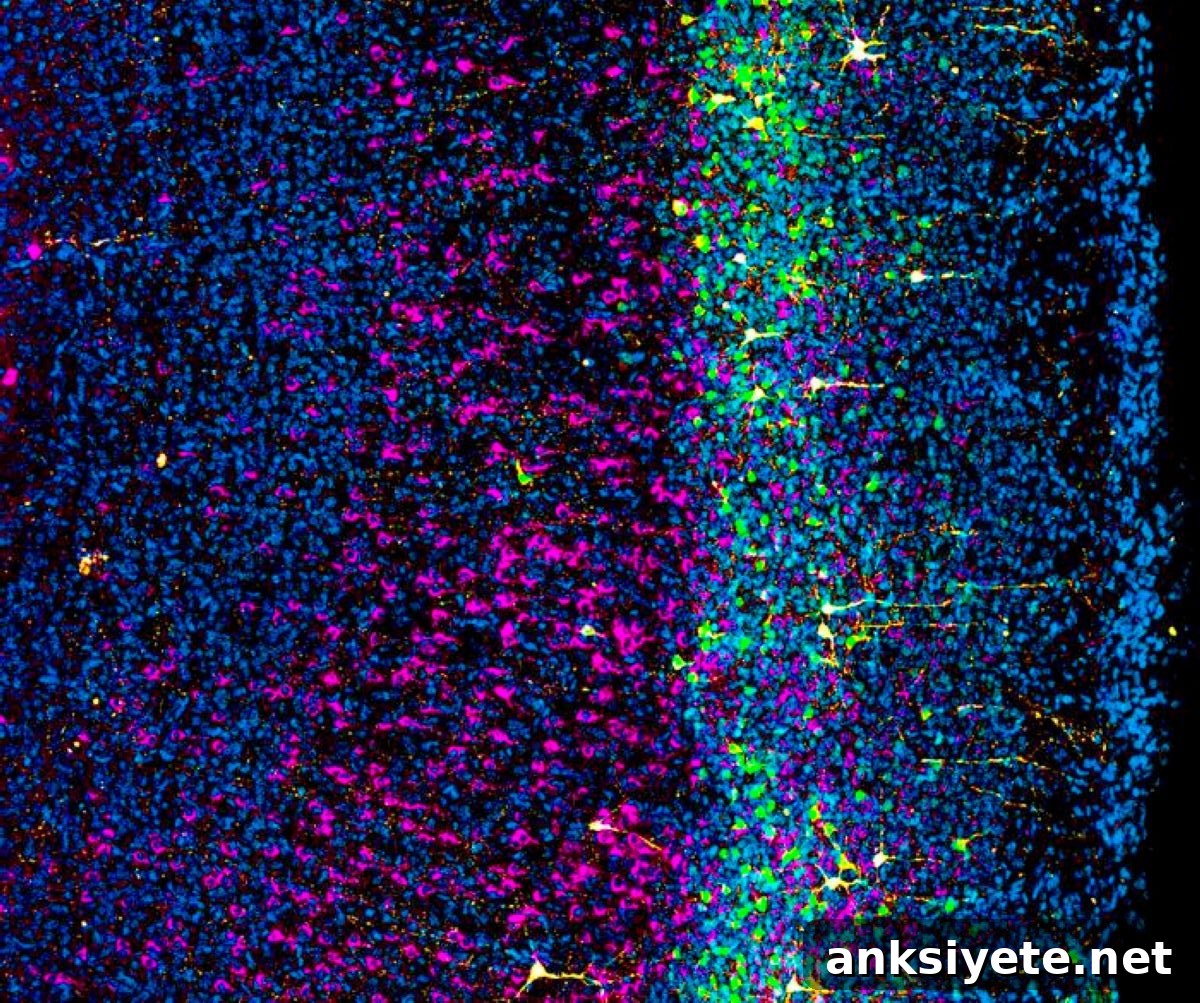
Summary: A new study overturns the long-standing “inside-out” model of cortical development by showing that radial glial progenitor cells branch early into parallel lineages. Using Mosaic Analysis with Double Markers (MADM) single-cell lineage tracing, researchers demonstrated that radial glial progenitors split at the onset of neurogenesis into distinct developmental trajectories that produce different populations of cortical projection neurons.
Instead of a single, homogeneous progenitor pool that sequentially produces deep-layer extra-telencephalic projection neurons (ET-PNs) first and then superficial-layer intra-telencephalic projection neurons (IT-PNs), cortical neurogenesis involves an early bifurcation. One progenitor branch exclusively generates IT-PNs across cortical layers, while a parallel branch produces both ET-PNs and IT-PNs. These findings revise fundamental assumptions about neural stem cell fate determination, timing of neurogenesis, and how cortical layers are assembled.
Key Facts
- Early lineage divergence: Radial glial cells, the neural stem cells of the cortex, split into at least two distinct lineage branches much earlier in development than previously appreciated.
- Not a strict sequential switch: Projection neurons do not arise from a single progenitor pool that undergoes a simple temporal switch from producing one subtype to another.
- Lineage-specific outputs: One branch produces only intra-telencephalic projection neurons (IT-PNs), while a parallel branch yields both extra-telencephalic projection neurons (ET-PNs) and IT-PNs.
- Distinct neurogenic dynamics: ET-PN–producing lineages generate small, self‑consuming clones that exhaust neurogenic potential early; IT-PN lineages give rise to larger, translaminar clones spanning multiple cortical layers.
- Explains temporal distribution: Early exhaustion of ET-PN progenitor clones accounts for their predominance in deep layers, while ongoing IT-PN production explains the enrichment of IT-PNs in upper cortical layers.
Source: ISTA
Collaborative research and training
Researcher Irene Varela-Martínez carried out the work during her PhD at the Centro Nacional de Biotecnología (CNB-CSIC) in Madrid in Marta Nieto’s lab. Supported by an EMBO short-term fellowship, she spent time at the Institute of Science and Technology Austria (ISTA) in Simon Hippenmeyer’s group, where she applied the MADM single-cell lineage-tracing technique. Varela-Martínez continued this line of work as a postdoctoral researcher at ISTA.
The study, published in Science Advances, reveals that radial glial progenitors are not following a single, time-driven program but rather diverge early into parallel developmental branches that determine neuronal subtype output.
Why the cerebral cortex and its layers matter
The cerebral cortex, the outermost layer of the brain, contains densely packed neurons and glia that underlie perception, attention, memory, language, and conscious thought. Projection neurons in the cortex are broadly categorized into two functional classes: intra-telencephalic projection neurons (IT-PNs), which connect cortical regions including the contralateral hemisphere via the corpus callosum, and extra-telencephalic projection neurons (ET-PNs), which send long-range projections to subcortical targets such as the brainstem, thalamus, and spinal cord.
During neurogenesis, projection neurons are born and migrate to settle in the cortex’s six layers. The classical “inside-out” model describes how deeper layers form earlier and upper layers later. Historically, this model led to the assumption that radial glial progenitors initially produce deep-layer ET-PNs and only later switch to producing upper-layer IT-PNs. The new lineage-level data challenge this simple temporal switch and indicate that subtype identity is influenced by early lineage commitment.
Lineage tracing with MADM reveals branching
The Hippenmeyer lab’s expertise in Mosaic Analysis with Double Markers (MADM) was essential to the discovery. MADM is a genetic single-cell labeling method that marks daughter cells following a progenitor division, enabling precise reconstruction of lineage trees and quantification of individual clones. By applying MADM at embryonic stages and combining it with callosal tracing in early postnatal mice, the team dissected radial glial progenitor (RGP) lineage progression with single-cell resolution.
Lineage analysis showed two parallel sublineages emerge at the onset of neurogenesis. One branch produces IT-PNs exclusively and yields large translaminar clones that span multiple cortical layers. The other branch produces both ET-PNs and IT-PNs but does so via small, self-limiting clones that quickly exhaust their neurogenic potential. These distinct dynamics explain why ET-PNs are concentrated in early-forming deep layers while IT-PNs continue to be generated across later stages and populate upper layers.
Research implications
This evidence supports a model in which IT- and ET-PNs arise from an early bifurcation within multipotent radial glial progenitors rather than from a unitary progenitor pool shifting production over time. The identification of POU3F transcription factors as candidate regulators of IT-PN fate through noncanonical mitotic chromatin interactions further suggests molecular mechanisms that could drive lineage specification.
Key Questions Answered
Q: How does this new model differ from the classical inside-out view?
A: The classical view proposed that a homogeneous pool of radial glial progenitors sequentially produced deep-layer neurons first and upper-layer neurons later. The new model shows an early bifurcation where parallel progenitor branches with distinct fates and clone sizes produce projection neuron subtypes in overlapping temporal windows.
Q: What is MADM and why was it crucial?
A: Mosaic Analysis with Double Markers (MADM) is a single-cell genetic labeling technique that allows precise visualization of individual progenitor divisions and the reconstruction of complete lineage clones. MADM provides the single-cell resolution necessary to detect parallel lineage branches that are hidden in population-level assays.
Q: What functional roles do IT-PNs and ET-PNs serve?
A: IT-PNs form cortical-cortical connections within and between hemispheres. ET-PNs project outside the telencephalon to subcortical structures, contributing to motor control and autonomic functions by relaying cortical output to downstream targets.
Next steps and evolutionary questions
Now a postdoctoral researcher at ISTA, Varela-Martínez is exploring how developmental programs of neural stem cells evolved to produce larger, more complex cerebral cortices. Her current work asks how neural stem cell lineages were modified across evolution to generate greater neuron numbers and increased cellular diversity, and how those changes are implemented at the lineage and molecular levels.
Editorial Notes
- Edited by a Neuroscience News editor.
- Original journal paper reviewed in full.
- Additional context provided by staff.
About this genetics and neurodevelopment research news
Author: Andreas Rothe – ISTA
Source: ISTA
Contact: Andreas Rothe, ISTA
Image credit: Irene Varela-Martínez / CNB-CSIC
Abstract
Early Fate Diversification of Radial Glial Progenitors During Corticogenesis
Radial glial progenitors (RGPs) generate all projection neurons (PNs) in the cerebral cortex through incompletely understood processes. The authors combined Mosaic Analysis with Double Markers at embryonic stages E12.5 and E13.5 with early postnatal callosal tracing to dissect RGP lineage progression. They find that multipotent RGPs generate all extra-telencephalic (ET) and intra-telencephalic (IT) PNs via parallel sublineages that emerge simultaneously at neurogenesis onset. ET-PN production progresses exclusively via small, self-consuming lineages, while IT-PN lineages feature RGPs generating large translaminar outputs. The early emergence of IT-PN–fated RGPs, coinciding with a switch to direct neurogenesis, contributes to the stereotyped population-level progression of the multipotent lineage. The authors also identify POU3F transcription factors as candidate regulators of IT-PN fate via noncanonical mitotic chromatin binding. These results support a model whereby IT- and ET-PNs arise from an early bifurcation and parallel specification within the multipotent RGP lineage.
Original research: Early Fate Diversification of Radial Glial Progenitors During Corticogenesis. Authors: Irene Varela-Martínez, Ana Villalba, Jorge García-Marqués, Alfonso Aguilera, Diogo S. Castro, Simon Hippenmeyer, Marta Nieto. Published in Science Advances. DOI: 10.1126/sciadv.adw5487