
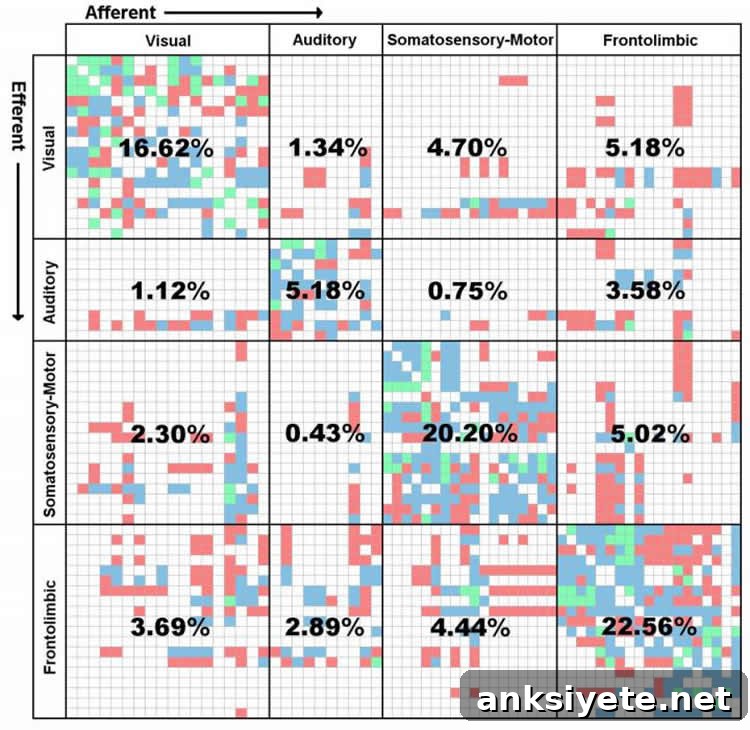
An international research team from Brazil, Scotland and Germany has advanced our understanding of the brain’s complex neural networks by using computer simulations combined with cluster analysis. The investigators built a computational model of the cat cerebral cortex, dividing it into 65 cortical areas linked by fibers with varying connection densities. Those cortical areas were grouped into four functional clusters—visual, auditory, somatosensory-motor, and frontolimbic—to reflect major cognitive regions of the brain.
The study simulated seizure-like electrical activity in the model and evaluated three interventions aimed at preventing or suppressing synchronized pathological rhythms. The researchers compared delayed feedback control, external time-periodic driving, and targeted activation of selected neurons to assess each method’s effectiveness at suppressing phase synchronization that can underlie seizure activity. Their findings were reported in the journal Chaos.
Among the three evaluated strategies, delayed feedback control proved the most effective for suppressing synchronization. External time-periodic driving and activation of selected neurons also produced suppression in certain conditions, but neither matched the efficiency of delayed feedback control across the simulations. Importantly, the delayed feedback intervention does not rely on damaging neural tissue, making it an attractive candidate for further experimental and clinical research.
“We studied how to disrupt synchronization in a biologically realistic neural network whose architecture is organized into clustered subnetworks, and we verified that delayed feedback control outperforms external periodic driving and selective neuron activation for suppression of synchronized rhythms,” said Antonio M. Batista, Ph.D., lead author and professor in the Department of Mathematics and Statistics at the State University of Ponta Grossa, Brazil. He emphasized that this method’s noninvasive nature is a significant advantage for potential therapeutic use.
Cluster analysis is the algorithmic technique the team used to define and evaluate the cortical subnetworks. Cluster analysis classifies and groups elements that share similar features; in this study it was applied to the brain’s connectivity matrix to reveal functional clusters and to relate network structure to dynamical behavior. Cluster-based approaches are widely used in many fields—pattern recognition, data science, and biology—for identifying meaningful groups and simplifying complex datasets.
The mammalian cerebral cortex is known for its intricate network structure and its essential role in perception, cognition and motor control. Detailed mapping studies of the cat cortex have repeatedly revealed clustered connectivity patterns that support distinct sensory and integrative functions. Clinically, abnormal synchronization among neuronal populations has been implicated in disorders such as epilepsy, Parkinson’s disease, and tremor. Excessive phase synchronization of neuronal firing can produce pathological rhythms that interfere with normal brain function.
Given this clinical relevance, the authors focused on suppression of phase-synchronized bursting as a potential route to restore normal spiking-bursting dynamics. The simulations aimed to identify control strategies that reduce or eliminate unwanted synchronized rhythms without resorting to destructive interventions. Delayed feedback control, which adjusts stimulation based on the ongoing network state with a time delay, consistently reduced synchronization more effectively than the other two methods when applied with comparable coupling strengths.
The research highlights two key points useful for future studies and therapy development: first, that network structure—particularly clustered architectures—strongly influences how pathological synchronization emerges and spreads; and second, that targeted dynamical interventions like delayed feedback control can exploit that structure to desynchronize activity efficiently and safely. The authors suggest that combining realistic connectivity maps with dynamical control techniques may guide the design of neuromodulatory treatments for synchronization-linked disorders.
Source: American Institute of Physics
Image credit: Kelly C. Iarosz, based on experimental connectivity data from Scannell et al. (1995).
Original research: Article titled “Suppression of phase synchronisation in network based on cat’s brain” by Ewandson L. Lameu et al., published in Chaos. Published online April 19, 2016. DOI: 10.1063/1.4945796
Abstract
Suppression of phase synchronisation in network based on cat’s brain
The study modeled perturbations of the cat’s cerebral cortex using a clustered network built from the same number of cortical areas as the empirical cat matrix, with each area represented as a small-world subnetwork. The focus was on suppressing neuronal phase synchronization using three control methods: delayed feedback control, external time-periodic driving, and activation of selected neurons. Simulations showed that delayed feedback control achieved higher efficiency in suppressing undesired synchronized rhythms than the other two interventions when applied with equivalent coupling strengths. These results offer a computational framework for developing interventions to counteract pathological synchronization associated with neurological disorders.