
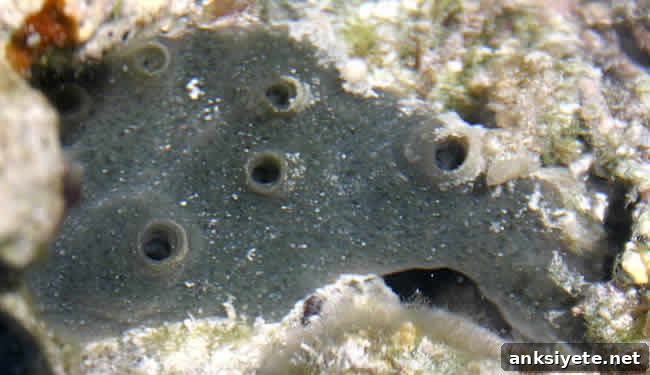
UC Santa Barbara researchers have looked to a humble sponge to uncover clues about how complex nervous systems evolved, finding that sponges possess many synapse-related genes but lack the regulatory coordination that assembles those genes into functioning neural connections. The results, reported in the paper “Functionalization of a protosynaptic gene expression network,” appear in the Proceedings of the National Academy of Sciences.
“If you want to trace the ancient roots of the nervous system, this is the place to look,” said Kenneth Kosik, Harriman Professor of Neuroscience Research in the Department of Molecular, Cellular and Developmental Biology and co-director of UCSB’s Neuroscience Research Institute. Kosik and colleagues focused on a key evolutionary window: the time when most animal lineages diverged from a common ancestor shared with sponges, an animal group that represents some of the earliest branches of animal life still extant today.
Earlier sequencing of the genome of Amphimedon queenslandica, a marine sponge native to Australia’s Great Barrier Reef, revealed that this sponge carries many of the same genes that in other animals produce the proteins that form synapses—the specialized structures that allow neurons to exchange chemical and electrical signals. Synapses function like biological microprocessors: they transmit and receive signals, and they adapt through experience in a process known as synaptic plasticity.
“The puzzle was to understand why Amphimedon retains almost all of the molecular components used to build a synapse in other animals, yet it lacks neurons entirely,” said Cecilia Conaco, first author of the paper and a UCSB postdoctoral researcher in MCDB and the Neuroscience Research Institute. “By studying how those genes are regulated, we sought insight into the evolutionary steps that gave rise to neuronal machinery.”
To explore that question, the research team—including scientists from UCSB’s Department of Physics and the Sage Center for the Study of the Mind—focused on RNA, the molecule that directs when and how genes are expressed. Tracking RNA across developmental stages of the sponge allowed the team to follow the activity patterns of genes encoding synaptic proteins.
“Many synapse-related genes did switch on and off during sponge development, suggesting activity,” Kosik explained. But unlike in animals that possess nervous systems, where synaptic genes are often co-expressed in coordinated programs that build synaptic structures, the sponge’s synaptic genes lacked that coordinated timing and integration. In other words, the components were present but not wired together in a unified expression network.
That observation led the authors to propose that a critical evolutionary innovation was not the invention of entirely new synapse-specific genes, but rather the evolution of regulatory mechanisms that synchronized preexisting genes into a functional network. Once those regulatory linkages emerged in the lineage leading to animals with nervous systems, the parts could be assembled into synapses and, over time, into more complex neural circuits.
“It appears that what was missing in sponges was not the molecular parts themselves, but the regulatory wiring that coordinates their expression,” Conaco said. This regulatory functionalization—transforming dispersed gene activity into an integrated protosynaptic gene expression network—may have been a decisive step toward the first nervous systems in early animals.
The team plans follow-up studies to explore the intermediate steps that convert gene expression programs into fully formed synapses, and to track how nervous systems diversified once regulatory coordination had evolved. “One open question is whether the human brain represents a quantitative increase in the same basic components or whether it introduced qualitatively new innovations,” Kosik said.
Notes about this evolutionary neuroscience research and article
Contacts: Sonia Fernandez, George Foulsham & Kenneth Kosik – UCSB
Source: University of California Santa Barbara press release
Image credit: Neuroscience image adapted from Wikimedia Commons image attributed to Maja Adamska, Sandie M. Degnan, Kathryn M. Green, Marcin Adamski, Alina Craigie, Claire Larroux and Bernard M. Degnan.
Original research: “Functionalization of a protosynaptic gene expression network,” Proceedings of the National Academy of Sciences. (At the time of the press release, the research paper abstract or full text was not immediately available online.)