
Summary: Decoding the first hours of human development has long been a central challenge in developmental biology. While decades of work in animal models—especially mice—have provided structural and conceptual guidance, investigating gene function directly in human embryos has been limited by the DNA damage caused by conventional genome-editing tools. Standard CRISPR/Cas9 approaches frequently introduce double-stranded breaks and large chromosomal rearrangements, preventing precise functional studies in delicate human embryos.
A new study from the University of Cambridge Loke Centre for Trophoblast Research reports the first functional use of an ultra-precise genome-editing method — called base editing — to probe gene activity in human embryos. This technique chemically converts a single nucleotide base pair within the roughly three-billion–base human genome, allowing researchers to inactivate the master regulator gene NANOG without inducing the widespread DNA damage typical of nuclease-based editing.
Key Findings
- Base editing offers a safer, more precise alternative: Unlike standard CRISPR/Cas9, which cuts both DNA strands, base editing rewrites a single nucleotide without breaking the DNA backbone, greatly reducing the risk of unintended chromosomal errors.
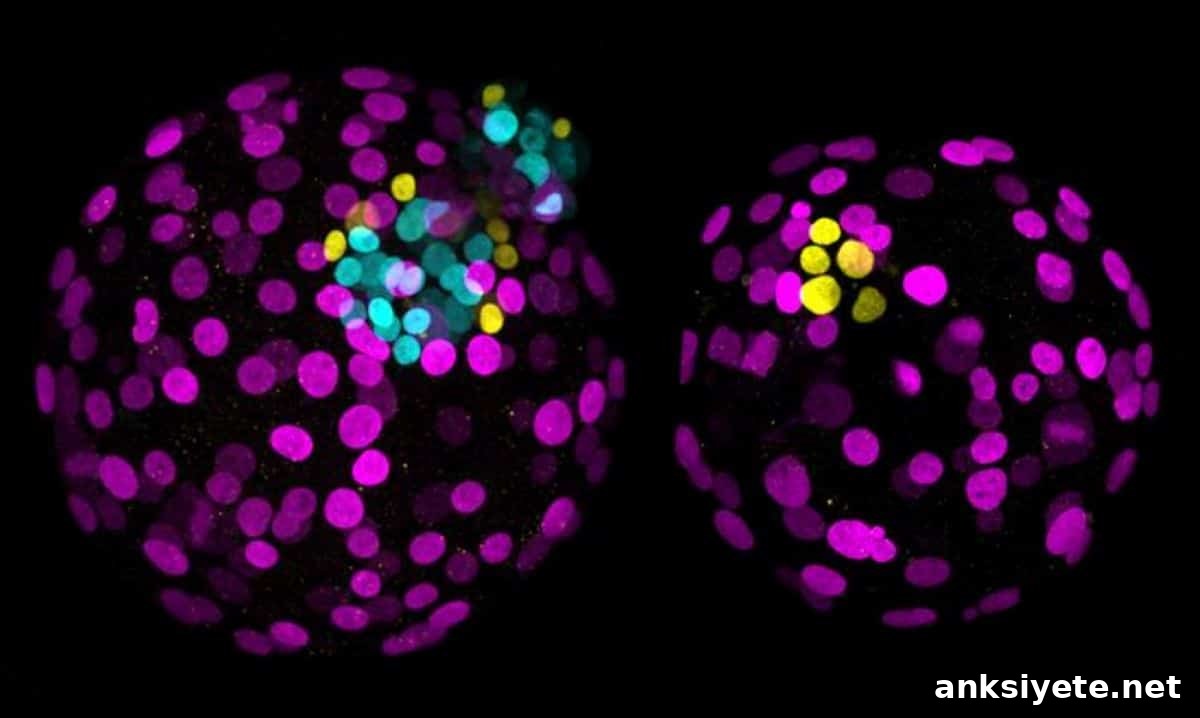
- NANOG is essential for the human epiblast: Using base editing to disrupt NANOG demonstrated that this gene is indispensable for the formation of the epiblast, the group of pluripotent cells that later give rise to the entire body.
- Supporting tissues remain intact: Even without NANOG, cells destined to become the placenta (trophectoderm) and yolk sac (primitive endoderm) were still able to form and differentiate, indicating that these supporting lineages can develop independently of NANOG activity.
- Human and mouse development differ: In mice, NANOG loss disrupts both the epiblast and extraembryonic lineages. In these human embryos, NANOG loss selectively abolished epiblast formation while sparing yolk sac–like differentiation, revealing species-specific differences in early lineage regulation.
- Clinical implications for IVF and early pregnancy research: Mapping how NANOG and its downstream networks guide cell fate decisions in the first days after fertilization provides a framework for studying early pregnancy loss and designing targeted approaches to improve IVF outcomes.
- Ethical oversight and safety limits: All embryos used were donated surplus from IVF with informed consent, experiments were performed under strict regulatory oversight, embryos were cultured only up to a 6.5‑day limit, and no embryos were transferred to a uterus.
Source: University of Cambridge
Research led by the Loke Centre for Trophoblast Research at the University of Cambridge shows that base editing can be used to alter a single gene in human embryonic cells, enabling detailed investigation of the earliest stages of human development.
Base editing is a refined form of genome editing derived from CRISPR technology. Instead of making double-strand DNA breaks, it converts one nucleotide base to another at a precise location. In this study, researchers used an adenine base editor (ABE8e) to introduce a splicing defect that functionally knocked out the NANOG gene in very early human embryos.
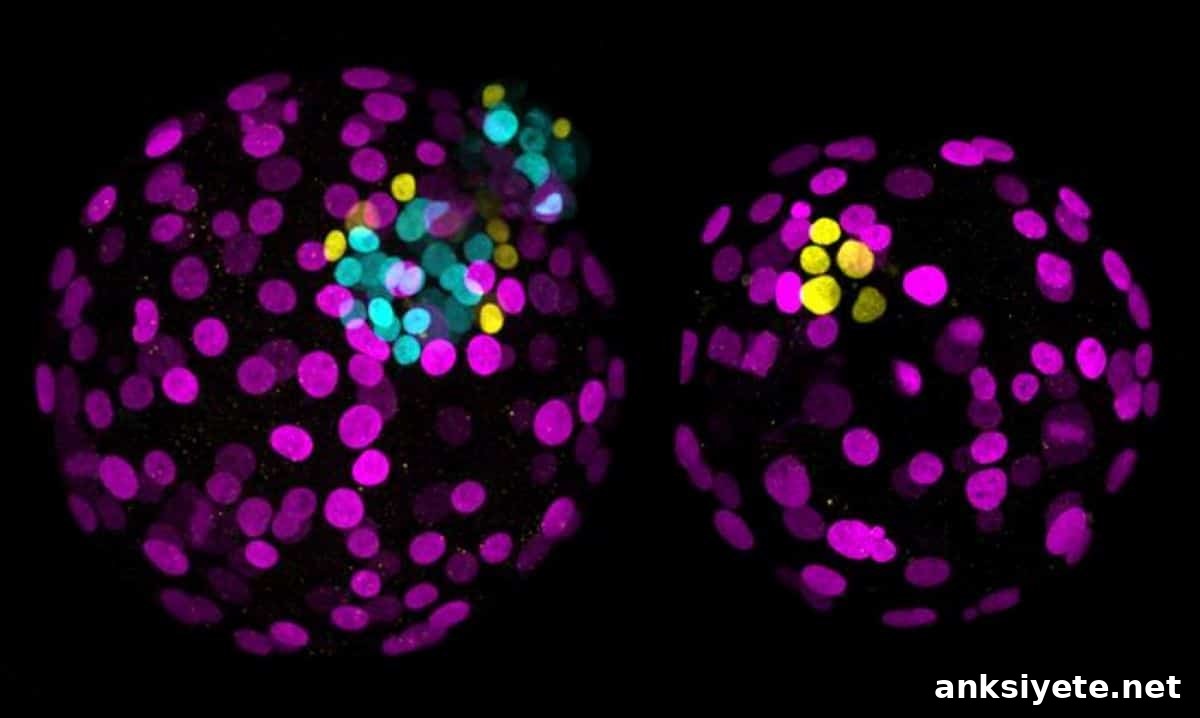
The edited embryos failed to specify a pluripotent epiblast, instead skewing cells toward primitive endoderm or trophectoderm transcriptional programs. Importantly, the base-editing strategy did not produce detectable genotoxicity and showed limited off-target editing in these experiments, addressing a central limitation of nuclease-based approaches for functional studies in human embryos.
These results clarify the centrality of NANOG to human pluripotency and early epiblast specification. They also reveal that direct study of human embryos is necessary because animal models do not always predict human-specific developmental pathways.
The research team notes potential future applications of base editing, such as improved stem-cell models for research, and, in principle, precise correction of pathogenic variants that cause inherited disease. However, any clinical application involving germline editing would require far more safety testing, ethical scrutiny, and legal permission; such use is not permitted in the UK at present.
Professor Kathy Niakan, who led the study, emphasized the technological advance: “Base editing is a major step forward because it avoids the chromosome-level damage seen with conventional editing. It lets us convert a single nucleotide in a genome of about three billion bases with extraordinary precision.”
Dr Oliver Bower, first author, added that this precision makes it possible to study early human development with greater confidence and to make stem-cell systems more reliable for biomedical research.
Human development does not always follow the mouse blueprint
While mouse genetics were instrumental in identifying NANOG as a key developmental regulator, this study demonstrates important species-specific differences. In mouse embryos, NANOG loss interferes with both the epiblast and the yolk sac. In the human embryos studied here, NANOG disruption primarily eliminated epiblast formation while allowing primitive endoderm and trophectoderm differentiation to continue, highlighting the limits of extrapolating mouse findings to human development.
Dr Katarina Harasimov, a member of the team, noted that although NANOG was expected to be critical based on mouse data, its role in humans proved to be distinct—underscoring the value of directly investigating human embryos with precise, low‑damage tools.
Ethical and legal compliance
All embryos, eggs and sperm used in the work were surplus samples voluntarily donated by couples after IVF treatments. Donations were typically from individuals who had completed their families and wished to support research. Embryos were cultured in vitro for no more than six and a half days, in line with regulatory limits, and were not allowed to progress or be transferred to a uterus.
The study was conducted under an approved research licence and with oversight from the UK Human Fertilisation and Embryology Authority (HFEA). It also received ethics approval from the Newcastle and North Tyneside Research Ethics Committee.
The full study is published in the journal Nature. The research was carried out by scientists at the University of Cambridge Loke Centre for Trophoblast Research with collaborators from Monash University, the Broad Institute, the Francis Crick Institute, MRC Laboratory of Molecular Biology, and several clinical fertility centres and partners.
Key Questions Answered
A: Conventional CRISPR/Cas9 acts like molecular scissors that cut both strands of DNA, which can lead to unpredictable repairs and large chromosomal alterations. Base editing does not cut the DNA backbone; instead, it chemically converts one nucleotide to another at a specific position, allowing precise gene inactivation with much lower risk of introducing large-scale genomic damage.
A: Disabling NANOG in very early human embryos prevented the formation of the epiblast, the pluripotent core that gives rise to the body’s tissues and organs. At the same time, the embryo still produced cell types that develop into supporting structures such as the yolk sac and placenta, showing that NANOG specifically controls the body-forming lineage.
A: Mouse studies remain valuable, but this work demonstrates that key regulatory mechanisms can differ between species. In mice, NANOG loss affects both body-forming and supporting lineages; in human embryos studied here, the impact was largely restricted to the epiblast. Direct human studies using precise tools are therefore essential to understand human-specific developmental biology.
Editorial Notes:
- This article was edited by an editor at Neuroscience News.
- The journal paper was reviewed in full by the editorial team.
- Additional context was added by staff to clarify implications and regulatory context.
About this genetics and neurodevelopment research news
Author: Jacqueline Garget
Source: University of Cambridge
Contact: Jacqueline Garget – University of Cambridge
Image credit: Loke Centre for Trophoblast Research, University of Cambridge
Original Research: Open access. “Base editing reveals an essential role for NANOG in human embryogenesis” by Oliver J. Bower et al., published in Nature. DOI: 10.1038/s41586-026-10792-1
Abstract
Base editing reveals an essential role for NANOG in human embryogenesis
Understanding how the first cell lineages are specified in human development has major scientific and clinical implications for regenerative medicine, infertility, and early pregnancy loss. While mouse models have identified transcription factors important for early development, translating those findings to human embryos has been constrained by ethical, technical, and biological limitations.
Nuclease-based genome editing has previously hindered functional studies because of genotoxicity. To address this, the authors applied adenine base editing (ABE8e) to target an exon splice donor site in NANOG, creating a splicing defect that functionally knocked out NANOG without inducing genotoxic damage. Loss of NANOG disrupted epiblast specification and redirected cells toward primitive endoderm or trophectoderm transcriptional programs. The retention of primitive endoderm differentiation in NANOG-edited human embryos contrasts with mouse models and highlights species-specific compensatory mechanisms.
These findings establish an essential role for NANOG in human pluripotency and epiblast formation and demonstrate the utility of base editing for safely interrogating human developmental regulators.