
Summary: Teriflunomide, a medication approved for multiple sclerosis, shows promising activity against glioblastoma when combined with targeted cancer therapies, suppressing tumor stem cells, shrinking tumors, and extending survival in preclinical models.
Source: UCSD
Overview: Glioblastoma is an especially aggressive brain cancer that invades surrounding tissue, making complete surgical removal nearly impossible. Standard treatments—surgery followed by chemotherapy and radiation—can reduce the bulk of a tumor but often fail to eliminate glioblastoma stem cells. These stem-like tumor cells can self-renew indefinitely and drive recurrence, which is a major reason glioblastoma remains deadly.
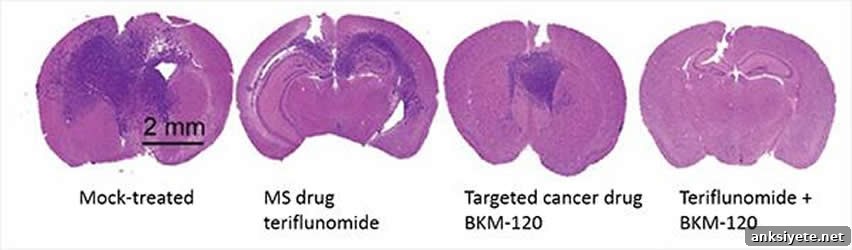
Researchers at the University of California San Diego School of Medicine investigated new therapeutic strategies using mice implanted with glioblastoma samples directly derived from patients. In that patient-derived model, the team found that combining a targeted cancer inhibitor with teriflunomide, an oral drug used to treat multiple sclerosis, effectively blocked glioblastoma stem cell activity, produced substantial tumor shrinkage, and significantly increased survival in the animals.
The study was published August 7, 2019 in Science Translational Medicine.
“We used to hope that a single magic bullet would treat everyone with glioblastoma,” said senior author Jeremy Rich, MD, professor of medicine at UC San Diego School of Medicine and director of neuro-oncology and the Brain Tumor Institute at UC San Diego Health. “Today we understand that each patient’s tumor is driven by different molecular vulnerabilities, and effective therapy will likely require tailored combinations that address the specific drivers in each tumor.”
Precision oncology has produced multiple targeted drugs that inhibit specific molecules cancer cells use to grow. These drugs can be more effective and cause fewer side effects than traditional chemotherapy or radiation. However, targeted agents often fall short in glioblastoma because blocking a single pathway is usually not enough—tumor cells adapt and activate alternate routes to survive.
“Laboratory studies can focus on narrow molecular snapshots, but as a clinician I try to view the whole system,” Rich said. “I don’t expect one or two drugs to cure these tumors. Instead, individualized cocktails that attack multiple essential processes in the cancer cell will be needed to put them on the defensive.”
One essential requirement for glioblastoma stem cells to proliferate is continuous DNA synthesis, which depends on the production of pyrimidines, key DNA building blocks. By analyzing genomic and transcriptomic data from hundreds of glioblastoma patients across multiple datasets, the researchers observed that tumors with higher pyrimidine metabolism activity were associated with worse patient outcomes, suggesting that pyrimidine synthesis is a metabolic vulnerability.
Teriflunomide inhibits enzymes involved in pyrimidine biosynthesis. In laboratory tests, the UC San Diego team showed that teriflunomide impaired glioblastoma cell survival, reduced self-renewal capacity, and blocked tumor initiation. In mice implanted with patient-derived tumors, teriflunomide alone produced modest tumor shrinkage and a small survival benefit compared with controls.
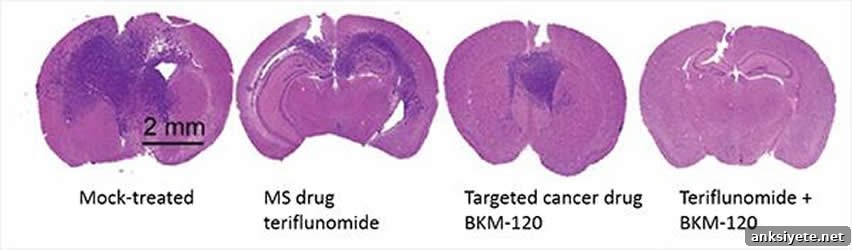
The investigators also tested two targeted inhibitors that act on distinct tumor-driving contexts. BKM-120 (a PI3K inhibitor) showed the greatest activity in tumors lacking the PTEN enzyme, while lapatinib targets tumors driven by mutations in the Epidermal Growth Factor Receptor (EGFR). BKM-120 alone produced moderate tumor regression and improved survival compared with either control or teriflunomide alone.
Most notably, combining teriflunomide with BKM-120 produced markedly greater tumor shrinkage and a significant survival advantage compared with single-agent treatment or control. The combination strategy appears to hit complementary vulnerabilities—blocking a tumor-specific signaling driver while simultaneously starving cancer stem cells of the pyrimidines needed for DNA replication.
“These results are encouraging because teriflunomide is already approved and has a known safety profile in humans,” Rich said. “Nevertheless, the mouse model—while valuable because it uses human tumor samples—does not recapitulate all aspects of disease in patients, such as immune interactions that influence tumor behavior. Human clinical trials will be necessary to determine whether this combination is safe and effective for people with glioblastoma.”
Co-authors on the study include Xiuxing Wang, Qiulian Wu, Shruti Bhargava, Zhe Zhu, Li Jiang, Zhixin Qiu, Linjie Zhao, Guoxing Zhang, Xiqing Li (UC San Diego); Kailin Yang (Cleveland Clinic and Case Western Reserve University); Leo J.Y. Kim, Ryan C. Gimple, Briana C. Prager (UC San Diego and Case Western Reserve University); Andrew R. Morton (Case Western Reserve University); Yu Shi (Ministry of Education of China); Wenchao Zhou, Weiwei Tao, Shideng Bao (Cleveland Clinic Lerner Research Institute); Sameer Agnihotri (Children’s Hospital of Pittsburgh and the University of Pittsburgh); Paul S. Mischel (Ludwig Institute for Cancer Research, UC San Diego); and Stephen C. Mack (Baylor College of Medicine).
Disclosure: Paul S. Mischel is a cofounder of Pretzel Therapeutics Inc., for which he holds equity and serves as a consultant.
Source:
UCSD
Media Contact:
Heather Buschman, Ph.D. – UCSD
Image Credit:
UC San Diego School of Medicine
Original Research: Closed access
Title: Targeting pyrimidine synthesis accentuates molecular therapy response in glioblastoma stem cells
Authors: Xiuxing Wang et al.
DOI: 10.1126/scitranslmed.aau4972
Published in: Science Translational Medicine
Abstract (condensed)
Glioblastoma stem cells reprogram glucose metabolism to maintain growth in a changing microenvironment. This study links common glioblastoma driver mutations to a dependence on de novo pyrimidine synthesis. Targeting key enzymes in pyrimidine biosynthesis, including CAD and DHODH, reduced glioblastoma stem cell survival, self-renewal, and tumor initiation in rodent models by depleting the pyrimidine nucleotide pool. EGFR and PTEN mutations produced distinct CAD phosphorylation patterns that increased carbon flux through the pyrimidine pathway. Combining inhibitors of tumor-specific drivers with DHODH inhibitors sustained suppression of pyrimidine metabolism and reduced tumorigenic capacity in vitro. Elevated expression of pyrimidine synthesis genes correlated with poorer patient prognosis. These findings support a precision-medicine strategy that targets the intersection of genetic drivers and metabolic reprogramming in cancer stem cells.