
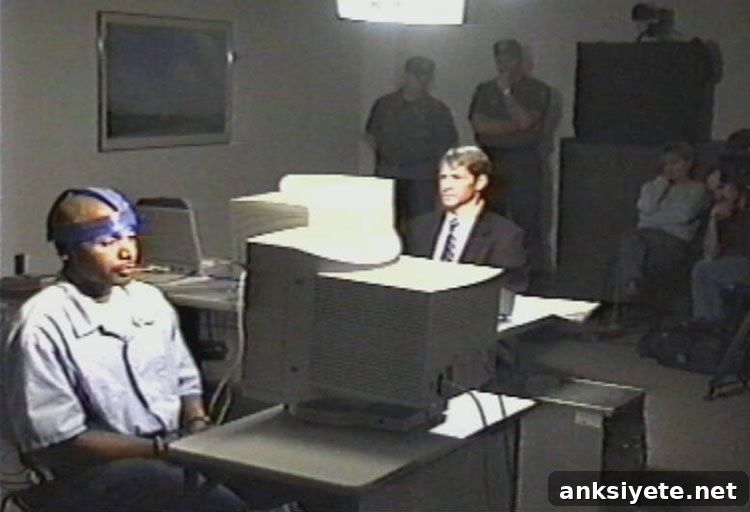
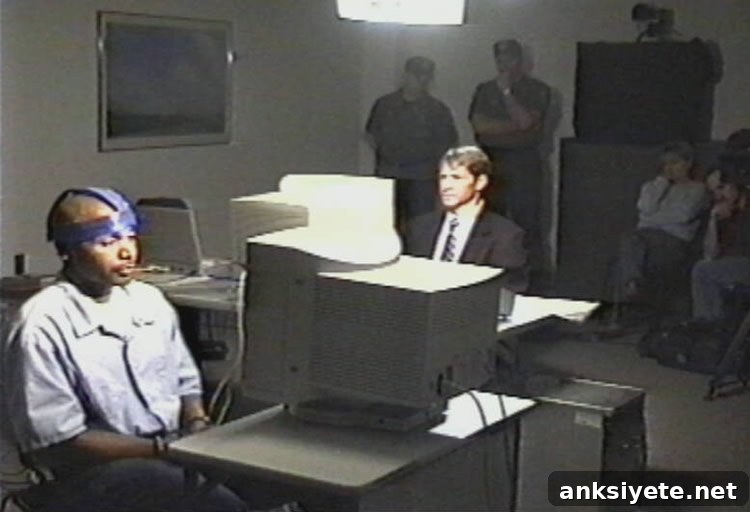
When police in Spain sought to locate two murder victims last year, they turned to a tool that measures brain activity in convicted and confessed offenders.
The technology, called Brain Fingerprinting and developed by the U.S. company Government Works Inc., attempts to use brain wave responses to specific stimuli to infer recognition and, by extension, possible guilt. In the United States, courts have allowed this higher-tech variant of the traditional polygraph in a limited number of cases. Proponents say it has helped both exonerate and convict individuals in some American cases.
As Brain Fingerprinting spreads beyond U.S. borders, a researcher at the University of Kansas argues the method rests on a flawed assumption about how human memory operates.
“At the very least, we need to perform several additional methodological checks and make certain that, whenever these technologies are used in legal settings, their limitations are stated clearly,” said Sarah Robins, an assistant professor of philosophy who specializes in the philosophy of neuroscience and neuroethics. “There may even be a stronger argument that such techniques should never be admitted in court, but my position is that we should carefully evaluate the technology and the assumptions that underpin it.”
Robins lays out the theoretical concerns about Brain Fingerprinting in her essay “Memory Traces, Memory Errors, and the Possibility of Neural Lie Detection,” which will appear in the edited volume Brain Theory. The book also features a chapter co-authored by KU philosophy professor John Symons titled “Computing with Bodies: Morphology, Function, and Computational Theory.”
Wolfe, a research fellow in the Department of Philosophy and Moral Sciences at the University of Ghent in Belgium, is scheduled to speak at 7 p.m. Friday, May 2, in the Kansas Room of the Kansas Union.
Robins emphasized that the principal problem with Brain Fingerprinting lies in its core assumption: the mind functions like an archive or “mental Rolodex,” where memories are stored intact and can be retrieved on demand.
“That assumption is the traditional default, but growing evidence from memory research suggests it is not the best way to conceptualize recollection,” Robins explained. “If we design tools and legal procedures based on that archived-memory model, we risk building them on an inaccurate picture of how memory actually works.”
Scientific findings, she said, increasingly support a constructive or reconstructive model of memory. Rather than acting as a perfect repository of past events, memory tends to track general patterns and adapt them with an eye toward future use.
“Memory is not a passive archive of the past,” Robins said. “It preserves patterns and probabilities rather than exact, isolated records. This means the brain has little incentive to retain perfect, discrete copies of events.”
Because memory favors patterns over particulars, people can struggle to recall precise details of past events—details that investigators often try to recover during criminal interrogations or eyewitness examinations.
“When I try to remember, I rely on typical patterns rather than exact particulars,” she said. “To answer a question about a specific past event, I reconstruct the event by assembling a representation that seems most likely, given what I know.”
Robins argues this understanding of memory should prompt caution in the use of Brain Fingerprinting. The technique typically measures an event-related potential called the P300: the brain’s electrical response within a particular time window after a stimulus is shown. Brain Fingerprinting interprets an elevated P300 as evidence of recognition. For example, if a suspect shows a P300 response when presented with a photo of a murder weapon—an image that, in principle, only the perpetrator would recognize—investigators may infer that the person has seen the weapon and thus was likely present at the crime scene.
“If I, as an interrogator, assume that a P300 indicates recognition, I might conclude you saw the murder weapon and therefore were probably there,” Robins said. “But if the P300 only indicates familiarity—perhaps the photo resembles a similar object you’ve seen before, like a hunting knife owned by a relative—then the inference of guilt is unjustified.”
Brain Fingerprinting, she notes, cannot reveal why an item is familiar. A P300 response does not tell investigators whether the subject recognizes the specific object in the photograph or merely something that resembles it in some respect.
“The underlying theoretical claim—that the measured signal equates to recognition of a particular detail—is problematic,” Robins said.
Recognizing the constructive nature of memory also points to safer interrogation practices. Certain techniques, such as leading questions, can unintentionally prime and alter a person’s memory in ways that are difficult or impossible to reverse.
“We need stricter rules governing how questions are asked and how suspects and witnesses are interviewed,” she said. “Interrogations should probe memory in as neutral a manner as possible, avoiding prompts that could distort recollection.”
As brain scanning becomes more accessible and law enforcement increasingly considers neural measures for investigative use, Robins urges continued methodological scrutiny.
“There is a growing belief that direct access to the brain will resolve complex legal, social, and ethical problems,” she said. “That idea is compelling in some situations, and certain facts about cognition may be recoverable through neural measures. But in most cases the situation is more complicated: the truth is not simply hidden inside the brain waiting to be unlocked by a single test.”
Contact: George Diepenbrock – University of Kansas
Source: University of Kansas press release
Image Source: Image credited to Lawrence Farwell; public domain
Original Research: The essay “Memory Traces, Memory Errors, and the Possibility of Neural Lie Detection” by Sarah Robins will appear in the book Brain Theory, published by Palgrave Macmillan. The book was released on May 14, 2014.