Summary: Researchers at Linköping University have created a miniature iontronic micropipette that delivers ions directly to single neurons and nearby glial cells without disturbing the delicate extracellular environment. This innovation lets scientists observe how localized shifts in ion concentrations influence neuronal and astrocytic activity with unprecedented spatial and temporal precision, revealing dynamics previously inaccessible with traditional fluid-based methods.
Initial tests in mouse hippocampal slices showed that astrocytes respond immediately and dynamically to targeted ionic changes, while neurons activate only after those astrocytes reach a saturation point. Beyond advancing fundamental neuroscience, the iontronic micropipette has potential applications for highly targeted therapies for neurological disorders such as epilepsy.
Key Facts:
- Targeted ionic delivery: The device releases specific ions (for example, K⁺ or Na⁺) into the extracellular space without co-delivering bulk solvent, avoiding the disturbance caused by conventional liquid injections.
- New window into cell interactions: Local ion manipulations revealed rapid astrocyte responses that gate subsequent neuronal activation, highlighting cell-type-specific dynamics within neural tissue.
- Therapeutic promise: The micropipette’s precision suggests future opportunities for localized chemical modulation as a treatment strategy for conditions like epilepsy.
Source: Linköping University
Researchers at Linköping University have engineered a novel micropipette that can deliver ions directly to individual neurons and glial cells without disturbing the surrounding extracellular milieu.
Precise control of local ion concentrations is central to understanding how single brain cells respond and how cellular networks coordinate activity. Traditional approaches for altering the extracellular environment typically involve introducing liquid solutions, which can disrupt local chemistry, pressure, and flow—confounding the interpretation of results. The iontronic micropipette overcomes these limitations by enabling ion-only delivery at micron-scale resolution.
“In the long term, this technology could be used to treat neurological diseases such as epilepsy with extremely high precision,” says Daniel Simon, professor at Linköping University.
The human brain contains roughly 85 to 100 billion neurons and a comparable number of glial cells—support cells that provide metabolic support, regulate extracellular composition, and participate in signaling. The tiny space between cells, the extracellular milieu, is rich in ions whose local concentrations critically influence cell excitability. For example, neuronal firing is strongly modulated by potassium levels.
While global shifts in extracellular ion composition are known to influence network activity, the effects of highly localized ionic changes on individual neurons and glial subtypes were poorly understood because previous methods could not deliver ions without also perturbing the surrounding fluid environment.
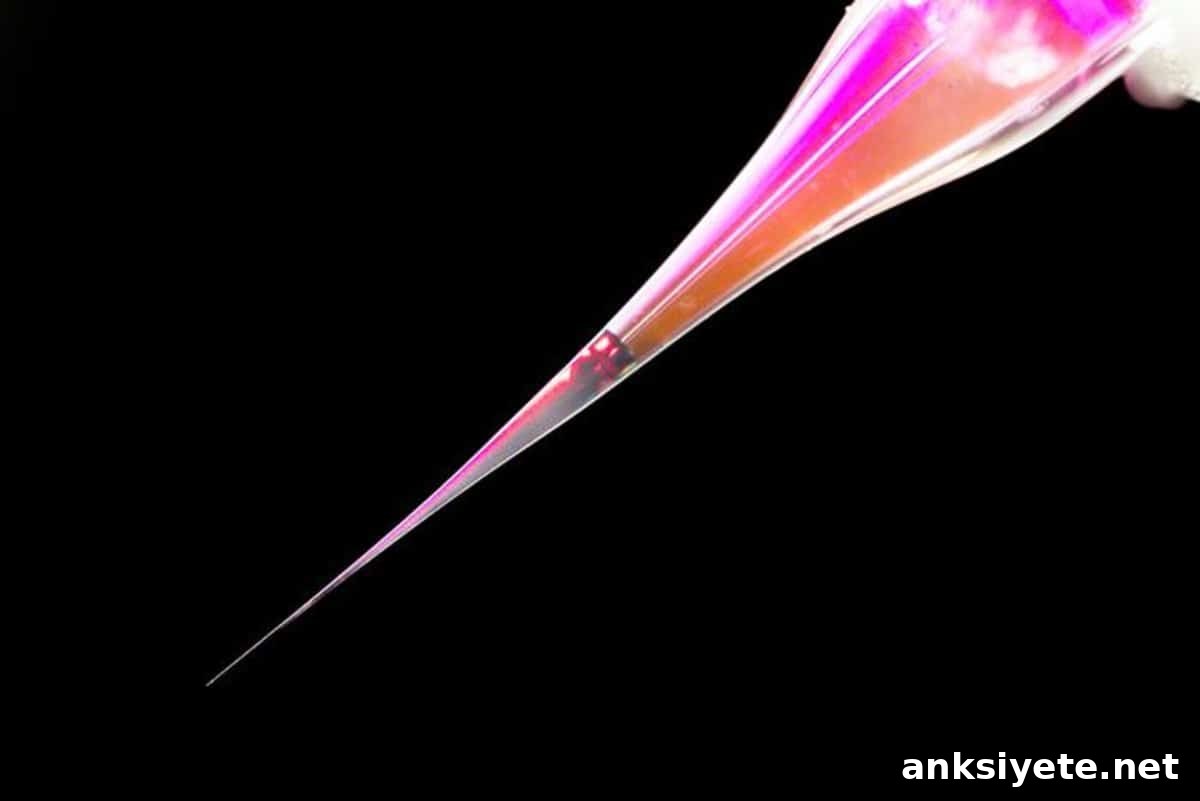
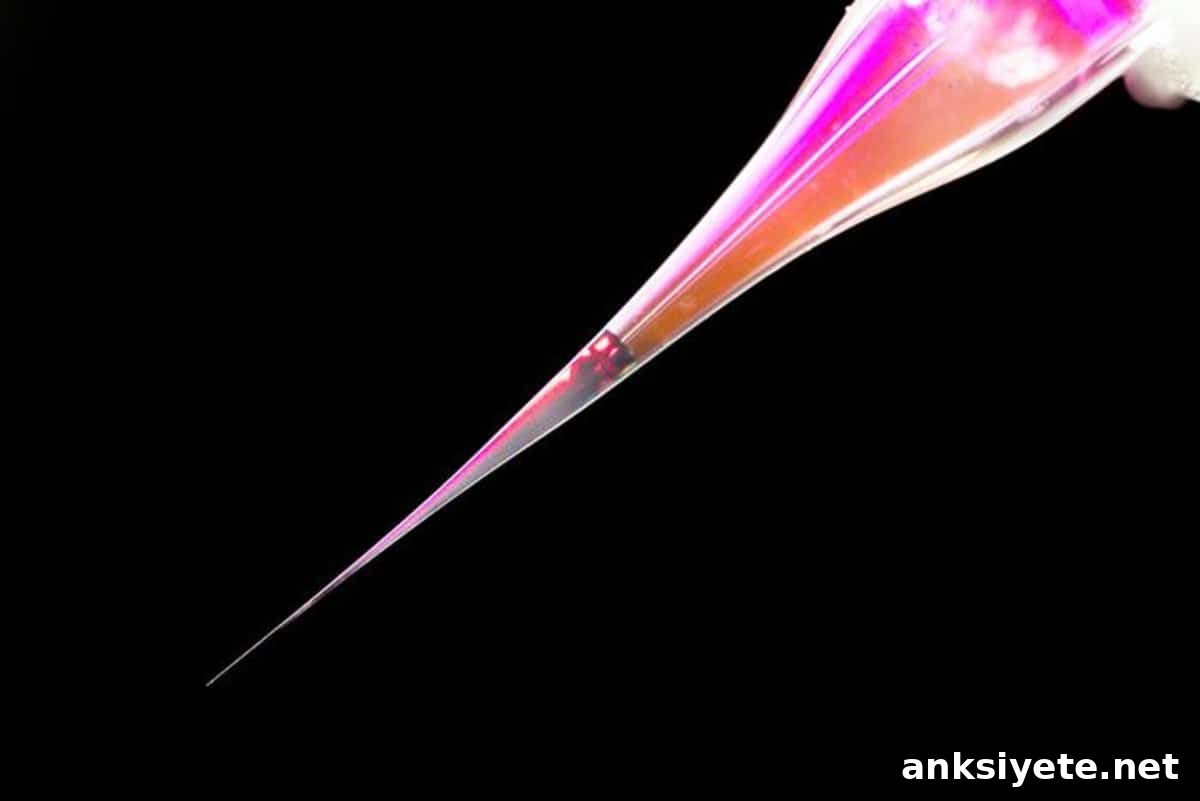
To address this, the Laboratory of Organic Electronics (LOE) at Linköping developed a micropipette with an outlet diameter below 2 micrometres—about one-twenty-fifth the width of a human hair and smaller than a typical neuron. The pipette’s tip contains a specially adapted ion-exchange membrane that permits controlled, on-demand ion flux while preventing bulk solvent flow.
This iontronic micropipette functions similarly to the familiar glass micropipettes used in electrophysiology, but its ion-exchange-filled tip enables chemical stimulation without mechanical disturbance. Tens of thousands of researchers worldwide already use the standard micropipette format, which should facilitate adoption of the iontronic variant.
Experiments conducted on mouse hippocampal tissue slices used the micropipette to release potassium ions with low electrical currents (<200 nA). The researchers combined electrical and optical recordings with computational modeling to verify that the device produces rapid, reversible, and spatially confined ionic changes that selectively modulate targeted neurons and astrocytes.
Results revealed that astrocytes respond almost immediately and with rich dynamics to local ionic perturbations. Neuronal responses lagged behind and emerged only after astrocytic buffering or saturating processes had progressed, demonstrating a tightly coupled but sequential interplay between glial and neuronal signaling that was difficult to resolve with prior techniques.
The authors describe a straightforward fabrication approach: a glass capillary is heated and pulled to form an extremely fine tapered tip, which is then filled with a polyelectrolyte membrane suited for ion exchange. The final iontronic micropipette looks and is handled like a conventional pipette, but it enables chemical stimulation at cellular resolution.
Future work will apply this tool to study chemical signaling in both healthy and diseased brain tissue, refine controlled drug delivery at the microscale, and investigate therapeutic modulation in models of epilepsy and other neurological disorders. The iontronic micropipette opens a new experimental avenue for dissecting ionic signaling and cross-talk between neurons and glia with high precision.
About this neuroscience research news
Author: Anders Törneholm
Source: Linköping University
Contact: Anders Törneholm – Linköping University
Image: Photo credit: Thor Balkhed
Original Research: Open access. “Miniaturized Iontronic Micropipettes for Precise and Dynamic Ionic Modulation of Neuronal and Astrocytic Activity” by Daniel Simon et al., published in Small.
Abstract
Miniaturized Iontronic Micropipettes for Precise and Dynamic Ionic Modulation of Neuronal and Astrocytic Activity
Local composition of the extracellular milieu varies under physiological and pathological conditions and can shift the functional set point of brain cells. Although global ionic changes influence network activity, the cell-level impact of specific ionic species has been difficult to resolve because conventional approaches typically co-deliver solvent and solutes, reducing spatial and temporal precision.
This study presents a miniaturized iontronic micropipette with a polyelectrolyte-filled tip below 2 µm that enables on-demand ionic manipulation of individual cells without concurrent solvent delivery. Electrical, chemical, and optical characterizations, supported by computational modeling, validate the device’s high spatial and temporal control. In hippocampal slices, iontronic release of potassium ions with low currents effectively, rapidly, and reversibly modulated single neurons and astrocytes. These results demonstrate the micropipette’s potential to disentangle distinct neuronal and glial responses to local ionic changes and to inform both neuroscience research and future therapeutic strategies.