
How the Film Memento Reveals the Brain’s Memory and Narrative Processing
Summary: Researchers used Christopher Nolan’s film Memento to reveal how the brain uses repeated cues to reconstruct and connect memories, offering insight into memory processes and narrative understanding.
Source: Aalto University
Key repeated scenes in the film provide viewers with the information needed to piece together the story. Those scenes trigger nearly identical brain responses across viewings and across different viewers, deepening our understanding of memory, narrative comprehension in film, and how memory may be affected in conditions such as Alzheimer’s disease.
Researchers from Aalto University and the NeuroCine research group examined how viewers reconstruct a complex story by showing participants Christopher Nolan’s 2000 film Memento while recording brain activity with functional magnetic resonance imaging (fMRI). Memento’s protagonist has severe anterograde amnesia and cannot form new long-term memories. The film’s scenes are presented in reverse chronological order, and key moments recur at intervals to function as narrative clues that help viewers reconstruct the plot.
Each time these clue-like key scenes appear, the same brain regions respond in a remarkably similar way. Moreover, different viewers show similar patterns of activity during those essential scenes, indicating a shared neural process for interpreting the cues and integrating past events with the ongoing narrative.
“People usually interpret a film’s plot in individual ways,” explains Professor Pia Tikka of Tallinn University, leader of the NeuroCine research group, which began at Aalto University. “It has been difficult to identify simultaneous markers of understanding across multiple viewers with brain imaging. The repeated key moments in Memento let us pinpoint cognitive processes: viewers’ brains react similarly to the cue information, reflecting the story being reconstructed in the mind.”
The study used fMRI to measure changes in blood oxygenation and applied multivariate analysis to compare brain activity across viewers. The researchers divided the brain into three-dimensional units called voxels and examined activation patterns across these voxels. During the film’s repeated key scenes, consistent and recurring activation patterns emerged—patterns the team describes as near “neural fingerprints.”
“We identified 15 key moments in Memento that provide viewers with opportunities to better understand the plot—brief revelations that connect scenes together,” says Professor Iiro Jääskeläinen of Aalto University. “Outside of those scenes, voxel activation varies more randomly. But at each of the 15 moments, certain voxels fall into the same configuration across viewers and form an identical fingerprint-like pattern.”
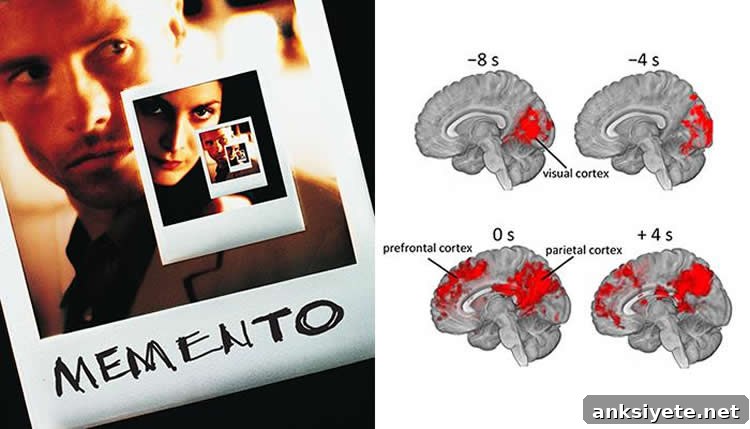
The fingerprint patterns appeared across broad brain regions, notably in the prefrontal and parietal lobes—areas commonly associated with memory retrieval, attention, and the reinterpretation of earlier events. Remarkably, some anticipatory activity also appeared in the visual cortex several seconds before the key scenes began, suggesting that the brain uses subtle cinematic cues to predict when important information will arrive.
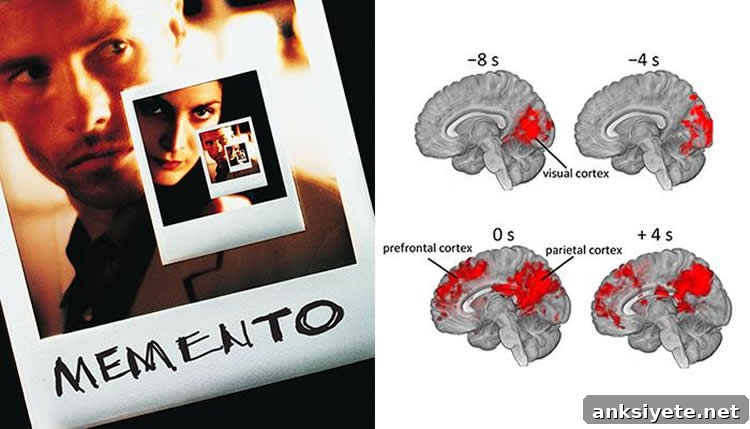
Control participants watched a chronological version of the same film in which the key moments were not repeated. In that condition, fingerprint patterns did not emerge and there was no measurable anticipatory activity, reinforcing the conclusion that repeated cueing drives the observed neural signatures.
An unusual aspect of this study is that subjects were allowed to view a full-length, 105-minute feature film in the MRI scanner. Typical brain-imaging studies use short clips or isolated stimuli to answer narrowly defined questions, but such designs can miss how narrative structure and character development unfold over time. By studying free viewing of an entire movie, the researchers were able to examine brain processes that operate during real-life-like cinematic experiences.
The findings illuminate how the human brain uses external cues to recall and connect relevant memories with ongoing events. Memento, which simulates the experience of impaired long-term memory—often caused by hippocampal damage—serves as an effective model for understanding cue-based memory reconstruction. The hippocampus is also vulnerable to damage from prolonged stress, and dysfunction in memory networks is a hallmark of dementias such as Alzheimer’s disease. These results therefore add valuable insight into the neural basis of memory retrieval and the mechanisms that might compensate for or fail in memory disorders.
Source: Iiro Jääskeläinen – Aalto University
Publisher: NeuroscienceNews.com (organized reporting)
Image credit: Oy Nordisk Film Ab and Iiro Jääskeläinen
Original research: Published in NeuroImage (see abstract and article DOI)
DOI: 10.1016/j.neuroimage.2018.01.068
Abstract
Brain mechanisms underlying cue-based memorizing during free viewing of the movie Memento
How does the human brain recall and connect relevant memories with unfolding events? To address this, researchers presented 25 healthy subjects with the film Memento while recording fMRI. In the movie, scenes are shown in reverse chronological order with certain scenes briefly overlapping earlier events; these overlapping “key-frames” act as effective memory cues by prompting recall of related prior scenes and linking them to the current action. The authors hypothesized that repeating key-frames would serve as immediate recall cues and help viewers reconstruct the story piece-by-piece. A chronological version of Memento, shown to a separate control group, served as the comparison condition. Using multivariate event-related pattern analysis and representational similarity analysis, consistent fingerprint-like patterns of hemodynamic activity were observed during presentation of the key-frame scenes. These effects emerged within a distributed, higher-order cortical network—including precuneus, angular gyrus, cingulate gyrus, and lateral, superior, and middle frontal gyri within frontal poles—with a right-hemispheric dominance. These distributed patterns appear to support the ability to recall relevant memories and connect them with ongoing events, i.e., to determine “what goes with what” in a complex narrative. Given the cinematic realism of the task, the results provide new insight into how the human brain uses appropriate cues to recall memories and anticipate and understand everyday life events.