
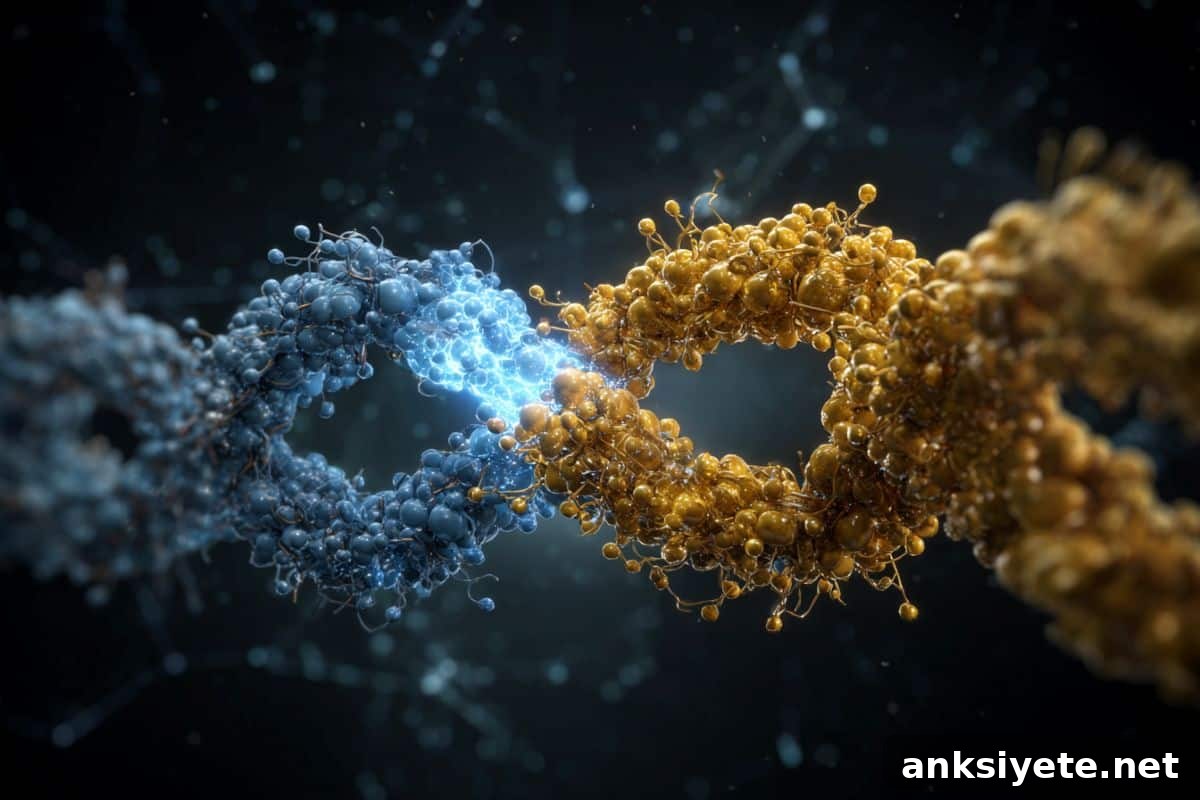
Summary: Researchers at Kobe University have developed a novel approach to neutralize a key driver of Alzheimer’s disease by using mirror-image protein fragments. These synthetic “right-handed” peptides bind tightly to the naturally occurring “left-handed” amyloid-beta, preventing it from aggregating into toxic brain plaques.
Conventional drug design struggles with intrinsically disordered proteins like amyloid-beta because they lack a fixed structure for drugs to target. By exploiting molecular chirality—the mirror-image relationship between biomolecules—the team designed a compact D-peptide that recognizes and locks onto amyloid-beta, blocking the chain reactions that produce neurotoxic aggregates.
Key Facts
- The structural challenge: Amyloid-beta is intrinsically disordered and constantly changes shape, making it difficult for standard small-molecule drugs to bind effectively.
- Chirality-based strategy: Natural proteins use L-amino acids. The researchers synthesized D-amino-acid peptides—mirror images—that can form stable complexes with their natural counterparts.
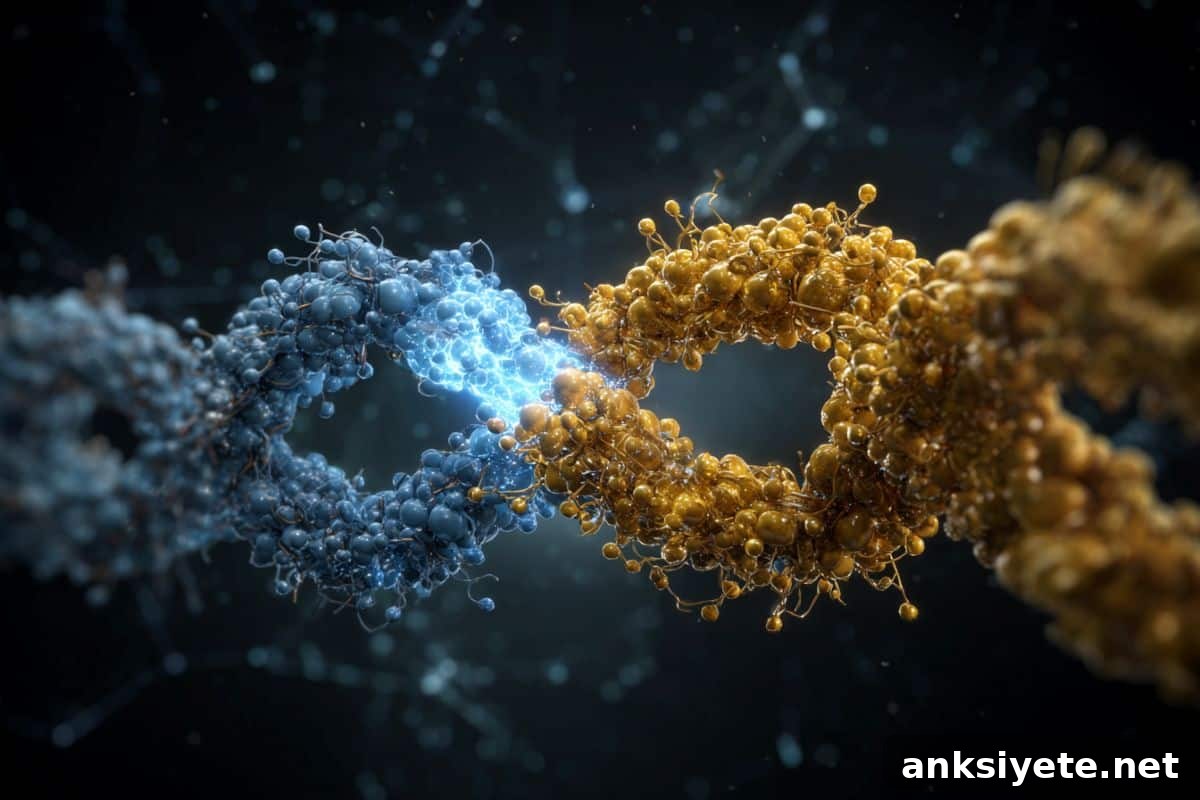
- “Handshake” binding: The D-peptide and L-amyloid-beta fit together like a right and left hand, creating a locked complex that prevents amyloid-beta from recruiting other proteins and forming plaques.
- Biological protection: In mouse neuronal cell cultures, amyloid-beta exposure reduced cell viability to about 50%. Adding the mirror-image peptide preserved cell viability at 100% under the tested conditions.
- Broader implications: This rational, chirality-guided design could be adapted to other intrinsically disordered proteins implicated in Parkinson’s disease and certain cancers.
Source: Kobe University
Using mirror-image molecular recognition, a Kobe University team created a small synthetic protein that disables a principal cause of Alzheimer’s disease—amyloid-beta.
Alzheimer’s pathology is driven in part by proteins that lose their stable three-dimensional folds and become disordered. Amyloid-beta is one such protein; when it misfolds and aggregates, it forms plaques that interfere with neuronal function and contribute to cell death. Because disordered proteins continually change conformation, they have been considered difficult or “undruggable” targets for traditional structure-based drug discovery.
Tatsuo Maruyama, a biochemical engineer at Kobe University, notes the difficulty of targeting proteins without fixed structures: “Many drug design methods depend on a stable target shape. Those approaches fall short when faced with highly flexible proteins like amyloid-beta.” Drawing inspiration from materials science, his team explored whether mirror-image peptide fragments could intercept and stabilize amyloid-beta before it aggregates.
Amino acids and the proteins they form are chiral—each residue can exist in left-handed (L) or right-handed (D) forms. Biology overwhelmingly uses L-amino acids, while D-amino acids are rare in nature. Previous work showed that short L- and D-peptide chains can interact to form stable stereocomplexes, but a systematic, sequence-based design strategy had been lacking.
In a paper published in Chemistry — A European Journal, Maruyama and colleagues report a systematic analysis of short model peptides to identify the sequence and interaction features that promote efficient stereocomplexation between L- and D-forms. They examined aggregation behavior, solved crystal structures, and used calorimetry, simulations, and fluorescence assays to map the thermodynamic and structural drivers of binding.
Armed with these insights, the team designed a D-peptide—Ac-fffakr5-NH2—that targets the –FFAE– motif in amyloid-beta 42 (Aβ42). Under experimental conditions, this mirror-image peptide inhibited fibril formation and neutralized cytotoxicity in neuronal-like cells, outperforming an existing clinical peptide candidate, RD2, in their assays. The interaction behaves like a physical lock: once the D-peptide binds Aβ42, the complex cannot recruit additional monomers to form larger, toxic assemblies.
The researchers validated their approach in cultured mouse brain cells. They confirmed the D-peptide alone did not harm healthy cells and demonstrated that co-incubation with the mirror peptide prevented amyloid-beta–induced cell death, maintaining full cell viability in their experiments.
Because intrinsically disordered proteins also play roles in Parkinson’s disease and some cancers, Maruyama suggests the chirality-guided design strategy could enable more rational development of therapeutics against a broader class of previously intractable targets. “This work is a starting point,” he says, “showing how a basic chemical principle can be turned into a practical molecular-recognition tool in biology.”
Funding: This research received support from the Nakatani Foundation for Advancement of Measuring Technologies in Biomedical Engineering (grant 2022S230), Toyota Physical and Chemical Research, Noritz Nukumori Foundation (grant RS2408), Koyanagi Zaidan, the Canon Foundation, the Suzuken Memorial Foundation, the Japan Agency for Medical Research and Development (grants 24ek0109691, 24ym0126808j0003) and the Japan Society for the Promotion of Science (grants 23H01774, 23K13610). The study was carried out in collaboration with researchers from Kindai University.
Key Questions Answered:
A: Natural proteins are composed of L-amino acids and often evade or misreact with other L-peptides. A D-peptide is the mirror image and can form a specific, stable complex with the target, effectively “grabbing” proteins that are otherwise too flexible for conventional drugs to bind.
A: The study demonstrates inhibition—preventing amyloid-beta from aggregating into toxic fibrils. The mirror peptide captures fragments early, stopping the cascade that leads to plaque formation and neuronal damage.
A: Early results are promising: the mirror peptide did not harm healthy neuronal cells in culture. D-peptides are also resistant to many natural proteases that degrade L-peptides, which could mean longer persistence and different safety and efficacy profiles compared with conventional candidates—but further studies are required.
Editorial Notes:
- This article was edited by a Neuroscience News editor.
- The journal paper was reviewed in full.
- Additional context was added by editorial staff.
About this Alzheimer’s disease research news
Author: Daniel Schenz
Source: Kobe University
Contact: Daniel Schenz – Kobe University
Image: The image is credited to Neuroscience News
Original Research: Closed access.
“A Chirality-Guided Molecular Recognition Strategy for Targeting Intrinsically Disordered Proteins” by Kenta Morita, Shiho Seguchi, Ayaka Hayashi, Haruhiko Miwa, Satoru Uchida, Kunihisa Sugimoto, Eri Chatani, Atsuo Tamura, Tatsuo Maruyama. Chemistry – A European Journal
DOI:10.1002/chem.70889
Abstract
A Chirality-Guided Molecular Recognition Strategy for Targeting Intrinsically Disordered Proteins
Some peptide sequences can stereocomplex with their mirror-image counterparts, but the sequence and conditions that favor stereocomplexation have not been fully characterized. This study presents a systematic investigation of peptide stereocomplexation using short tripeptides and their enantiomers.
Stereocomplexation was assessed by aggregate formation in mixed aqueous solutions, and single-crystal X-ray diffraction identified racemic crystals. Hydrophobic interactions among phenylalanine residues and electrostatic interactions involving lysine and the C-terminus were major drivers of complex formation.
Thermodynamic and structural features were further explored by calorimetry, simulations, and fluorescence assays. Based on those insights, a D-peptide (Ac-fffakr5-NH2) was designed to target the –FFAE– motif of amyloid-β42 (Aβ42). This D-peptide inhibited fibrillization and cytotoxicity of Aβ42 in neuronal-like cells and outperformed a clinical candidate, RD2, under the tested conditions.
These results establish peptide stereocomplexation as a practical strategy for designing sequence-specific ligands capable of recognizing and neutralizing intrinsically disordered proteins.