
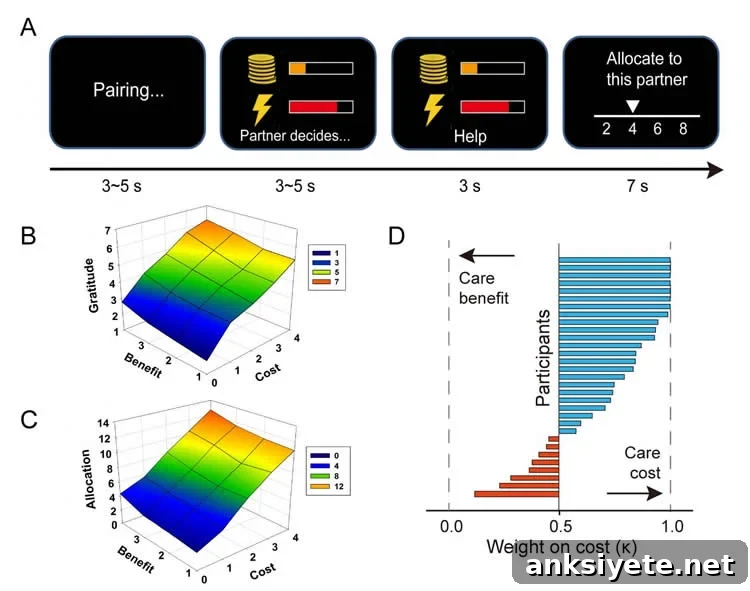
Summary: New research finds that feelings of gratitude after an altruistic act are formed when social information about benefactor cost and beneficiary benefit is integrated in the perigenual anterior cingulate cortex (pgACC).
Source: SfN.
A neural network linked to gratitude has been identified in a new fMRI study published in the Journal of Neuroscience. The findings shed light on how the brain transforms social information about help and sacrifice into the subjective experience of thankfulness and subsequent reciprocal behavior.
Previous neuroimaging work had associated the medial prefrontal cortex and the perigenual anterior cingulate cortex (pgACC) with feelings of gratitude, including studies in which participants imagined receiving help in extreme historical scenarios. What remained unclear was how neural systems convert specific features of an altruistic act—how costly it is for the helper and how much it benefits the recipient—into the emotion of gratitude.
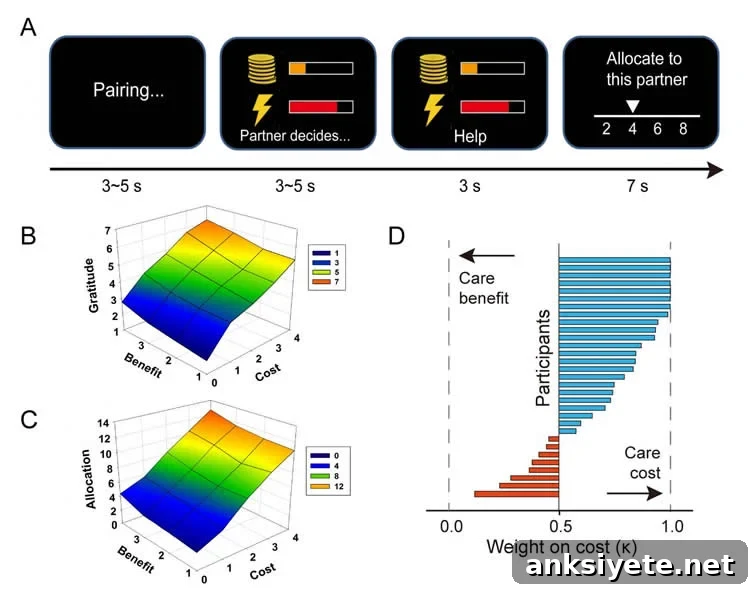
To answer this, Xiaolin Zhou and colleagues designed a controlled social interaction task while recording brain activity with fMRI. In each trial, a participant was paired with a co-player who chose whether to pay varying amounts of money to prevent the participant from receiving a brief pain stimulus. The experimenters independently manipulated two critical antecedents of gratitude: the monetary cost incurred by the co-player (benefactor cost) and the degree of pain reduction experienced by the participant (beneficiary benefit).
Behavioral measures collected during and after scanning included trial-by-trial self-reported gratitude ratings and the participant’s willingness to share a monetary bonus with the co-player when informed the co-player would not learn of this transfer. These measures allowed the researchers to link subjective gratitude to subsequent reciprocal choices.
Neural analyses separated the representation of beneficiary benefit and benefactor cost. Reductions in pain for the participant were encoded in reward-related regions, notably the ventral striatum, consistent with processing of self-benefit and positive outcome value. In contrast, the co-player’s monetary cost recruited brain areas implicated in mentalizing and perspective-taking, such as the temporoparietal junction. Effective connectivity and dynamic modeling showed that both types of information converge on the pgACC.
The pgACC tracked moment-to-moment variations in reported gratitude across trials, suggesting an integrative role: it appears to combine signals about how much the recipient benefited with signals about how much the benefactor sacrificed. The strength of pgACC activity was also correlated with individual differences in trait gratitude, linking neural representation to stable emotional disposition.
Further analyses indicated that additional anterior cingulate regions help translate the neural representation of gratitude in pgACC into reciprocal actions, providing a pathway from emotion to social behavior. In other words, the brain first encodes the components of an altruistic act, integrates them into an experience of gratitude, and then engages circuitry that supports giving back.
Funding: Supported by the Natural Science Foundation of China, the National Basic Research Program of China, and the British Academy.
Source: David Barnstone – SfN
Publisher: NeuroscienceNews.com.
Image Source: NeuroscienceNews.com image credited to Yu et al., JNeurosci (2018).
Original Research: “Decomposing gratitude: representation and integration of cognitive antecedents of gratitude in the brain” by Hongbo Yu, Xiaoxue Gao, Yuanyuan Zhou and Xiaolin Zhou. Journal of Neuroscience. Published May 7, 2018. DOI: 10.1523/JNEUROSCI.2944-17.2018
Decomposing gratitude: representation and integration of cognitive antecedents of gratitude in the brain
Gratitude is a social-moral emotion that supports cooperation and healthy interpersonal relationships. While previous work has identified neural correlates of gratitude, the neurocognitive processes that compose gratitude—how its cognitive antecedents are represented and integrated—have been unclear. Using fMRI and a novel interpersonal task, the authors independently manipulated benefactor cost and beneficiary benefit to examine how these antecedents are encoded and integrated in the beneficiary’s brain, and how neural processing of gratitude relates to reciprocity. Beneficiary self-benefit was encoded in reward-sensitive regions such as the ventral striatum, while benefactor cost was encoded in mentalizing regions including the temporoparietal junction. The perigenual anterior cingulate cortex represented gratitude itself, with activity levels correlating with trait gratitude. Dynamic causal modeling showed information about benefactor cost and self-benefit was routed to pgACC, supporting its integrative role. Gyral anterior cingulate cortex contributed to converting gratitude representation into reciprocal behavior. These findings offer a neural mechanistic account of how gratitude arises and guides social-moral behavior.
Understanding how the brain forms gratitude helps clarify how social information about helping actions promotes well-being and stable cooperation. By dissociating benefit to the recipient from cost to the benefactor and tracing their neural pathways, this study highlights distinct roles for reward and mentalizing circuits and identifies the pgACC as a key integrator that links these signals to the subjective experience of gratitude and to reciprocal choices.