
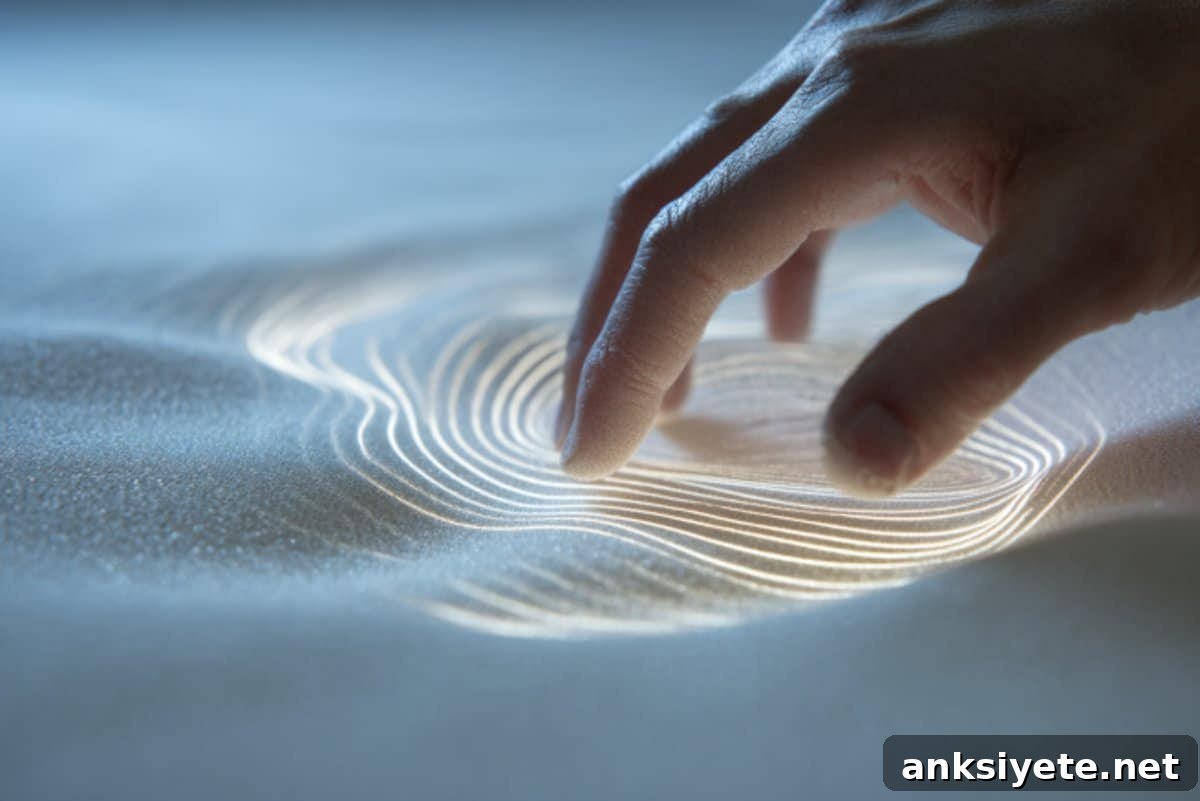
Summary: New research demonstrates that humans can use a form of “remote touch” to detect objects buried in sand before making direct contact. Volunteers sensed concealed cubes by feeling subtle mechanical reflections transmitted through the granular medium as their fingertips moved across the surface.
Participants performed near the theoretical limits predicted by physical models of detectability and outperformed a robotic tactile system trained with a Long Short-Term Memory (LSTM) model in precision. These findings broaden our understanding of human tactile capabilities and offer practical guidance for developing robotic and assistive systems that must operate in vision-limited, delicate environments.
Key Facts
- Human remote touch: People can detect buried objects in sand before direct contact by sensing tiny mechanical disturbances.
- High precision: Human participants achieved roughly 70% precision in the detectable range, outperforming a robotic sensor that detected objects from slightly farther away but produced more false positives.
- Technological relevance: The results provide benchmarks for improving tactile-based robotics, assistive devices, and exploration technologies for granular terrains.
Source: Queen Mary University London
Overview
A collaborative study by researchers at Queen Mary University of London and University College London investigated whether humans possess a form of remote touch similar to that observed in some shorebirds. While human touch is usually considered a proximal sense—limited to surfaces we physically contact—certain animals, including sandpipers and plovers, detect prey hidden beneath sand by sensing mechanical cues transmitted through the substrate. This study asks whether human fingertips can do the same.
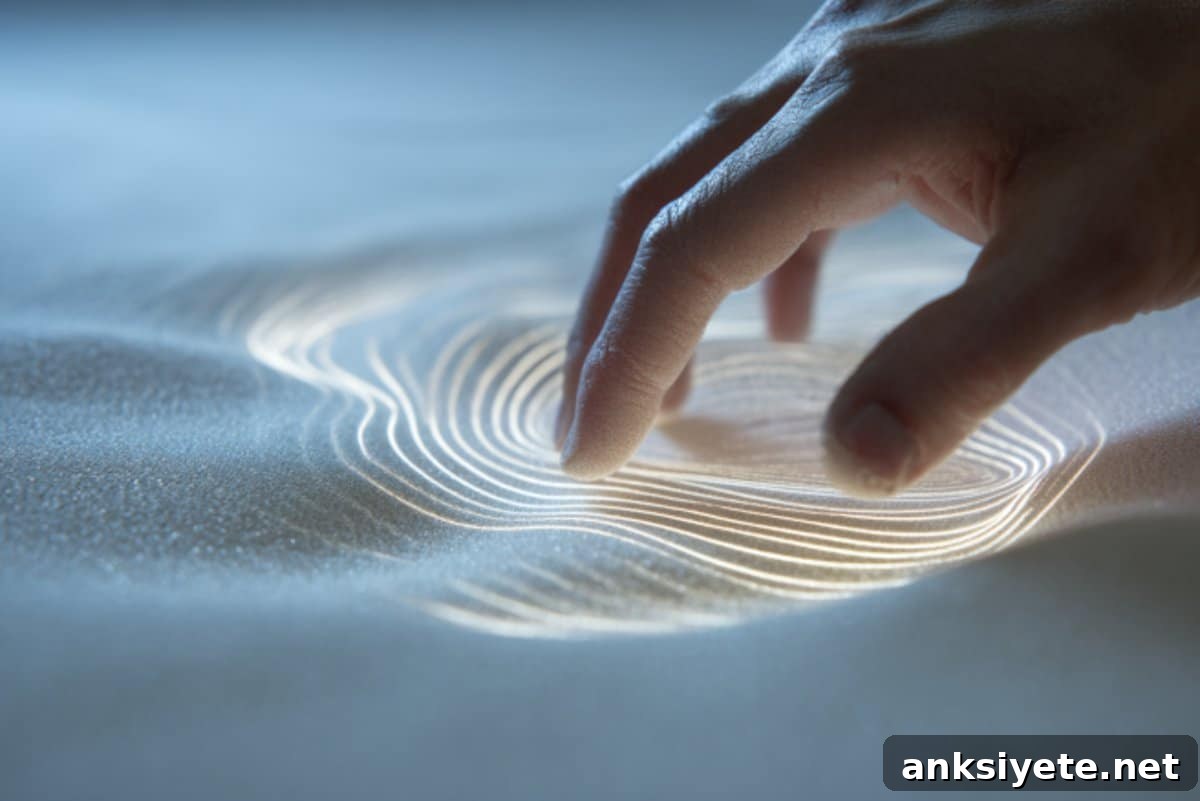
Remote touch in granular media relies on tiny mechanical cues: when a finger moves through sand, minute displacements travel through the particles and reflect off buried objects. Those reflections produce subtle changes in the forces and motions experienced by the fingertip. By carefully measuring human responses and comparing them to physical models, the researchers quantified how far and how reliably these tactile cues extend.
Human sensitivity approaches physical limits
Using theoretical models of particle interactions in granular materials, the team predicted that tactile cues could be detectable up to about 7 cm from a buried object. In controlled experiments, participants moved their fingertips gently across sand and attempted to detect a hidden cube before touching it directly. Results showed humans could detect buried objects with about 70.7% precision at a median detectable distance near the model prediction (median detection distance 2.7 cm, and detectable range up to roughly 6.9 cm). This indicates human fingertip sensitivity can approach the theoretical physical threshold for sensing mechanical reflections in sand.
Humans versus robots: strengths and trade-offs
The study also compared human performance to a tactile-equipped robotic arm trained with an LSTM model to recognize the same cues. The robot could, on average, report detections from slightly farther away (mean detection distance around 7.1 cm and median 6 cm), but it produced many false positives and thus showed lower overall precision (about 40%). In contrast, human responses were more conservative and accurate within the reliably detectable range. Both human and robotic performances were close to the sensitivity limits predicted by the physical displacement models, highlighting complementary strengths: robots may extend reach, while humans excel at avoiding false alarms.
Why this matters
This research documents, for the first time in humans, a measurable capacity for remote touch in granular media. Establishing that people can perceive buried objects before direct contact expands our understanding of the tactile receptive field and provides quantitative benchmarks for engineering. By modeling human perception, designers can build robotic and assistive tools that mimic natural tactile strategies, improving performance in tasks such as archaeological probing, careful excavation, search and rescue in debris, and exploration of sandy or granular environments like planetary regolith.
Wider implications and multidisciplinary value
Lead researchers emphasized the importance of interdisciplinary collaboration. Integrating psychology, robotics, and artificial intelligence allowed the human experiments to inform robotic training and vice versa. The interaction between human data and robotic models not only advanced basic science about tactile perception but also suggested concrete directions for developing touch-based systems that are safer, more effective, and better suited to delicate or vision-limited operations.
Authors and affiliations
The study team includes Zhengqi Chen (Advanced Robotics Lab), Dr. Laura Crucianelli (Psychology), and Dr. Elisabetta Versace (Prepared Minds Lab) from Queen Mary University of London, together with Lorenzo Jamone, Associate Professor in Robotics & AI at University College London.
Key Questions Answered:
A: Humans can detect objects buried in sand before making physical contact, demonstrating a form of remote touch previously documented in some animals.
A: Small mechanical displacements in the sand reflect off hidden objects; the human fingertip picks up these subtle cues while moving through the material.
A: Humans reached about 70.7% precision within the detectable range, while the LSTM-trained robot detected objects slightly farther on average but produced more false positives, yielding roughly 40% precision.
About this tactile perception and neuroscience research news
Author: Lucia Graves
Source: Queen Mary University London
Contact: Lucia Graves, Queen Mary University London
Image: The image is credited to Neuroscience News
Original Research: Closed access. “Exploring Tactile Perception for Object Localization in Granular Media: A Human and Robotic Study” by Elisabetta Versace et al., presented at the IEEE International Conference on Development and Learning.
Abstract
Exploring Tactile Perception for Object Localization in Granular Media: A Human and Robotic Study
Localizing buried objects in granular media such as sand presents a challenge for robotics and raises questions about human tactile capabilities in these environments. This study combines a human experiment with twelve participants—measuring fingertip sensitivity to tactile cues from buried objects—and a robotic experiment using a tactile-equipped arm with an LSTM model to detect object presence.
Grounded in granular media interaction theory, the team hypothesized that tactile cues extend up to about 7 cm. Human participants confirmed detection with 70.7% precision at a 6.9 cm detectable range (median detection distance 2.7 cm). The robotic system detected cues up to about 7.1 cm with a better median distance (6 cm) but lower precision (40%).
These findings improve our understanding of tactile perception in granular media and introduce a robotic platform to study human exploration strategies and enable autonomous applications in archaeology, space exploration, and search and rescue.