Summary: New research shows mice display two distinct forms of regret driven by different brain circuits. The study links one form of regret to a genetic marker associated with maladaptive stress responses and depression vulnerability, while a second form is found in stress-resilient animals.
Source: Mount Sinai Hospital
Researchers at the Icahn School of Medicine at Mount Sinai report that how the brain processes regret is connected to stress coping ability and may be altered in mood disorders such as depression.
Published October 19 in Science Advances, the study demonstrates that mice are sensitive to two separate kinds of regret and that these forms arise from distinct brain regions. The team also linked sensitivity to one regret type with a genetic factor known to influence stress vulnerability, while sensitivity to the other regret type corresponded with stress resilience.
These findings may affect psychiatry, psychology, and behavioral economics by clarifying how different regret processes influence decision-making and by suggesting new, targeted treatment strategies for mood disorders.
“Until now, we have lacked clarity about how regret is expressed in conditions like depression,” says Brian Sweis, MD, PhD, an instructor in the Department of Neuroscience and a psychiatry resident at Icahn Mount Sinai and the senior author. “Is regret amplified so patients ruminate excessively on past choices, or are they emotionally numb to missed opportunities? Understanding whether regret is adaptive or maladaptive — and whether patients can learn from mistakes — is essential.”
Previous work showed rodents can experience regret-like thoughts; this study expands what rodent models can reveal about complex emotional and cognitive processes relevant to mental illness. The researchers combined methods from behavioral economics, chronic stress models, and viral gene manipulation to study how choices, brain circuits, and molecular mechanisms shape regret-related behavior.
Using principles from neuroeconomics, the team examined how the brain’s limitations produce decision biases, and how past choices and missed opportunities affect future decisions. Their experimental approach tracked how animals mentally represent alternative actions they could have taken — the counterfactual thinking that underlies regret — and how that representation interacts with affective states to bias later behavior.
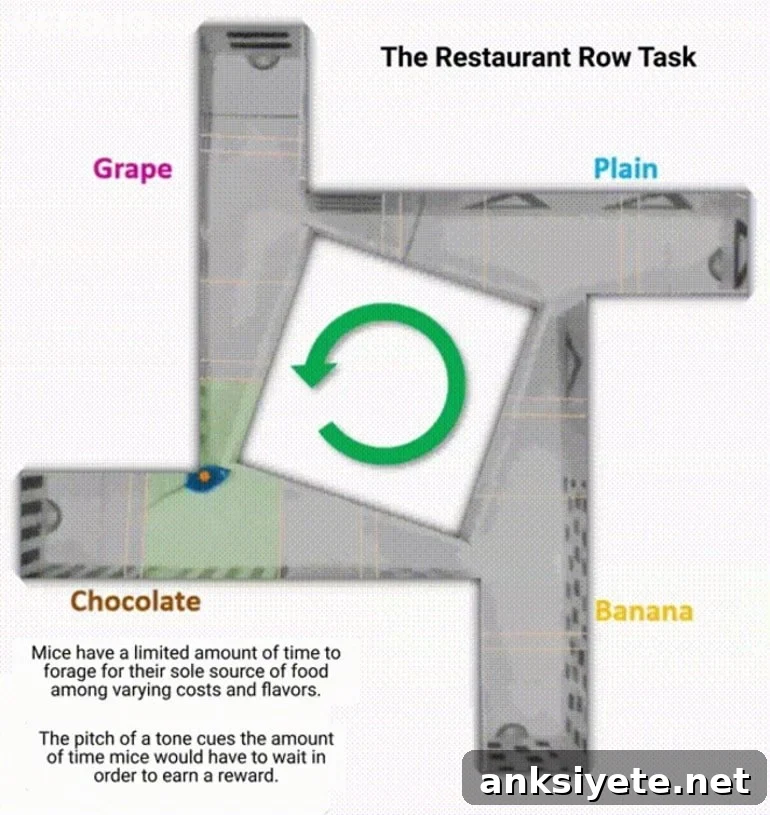
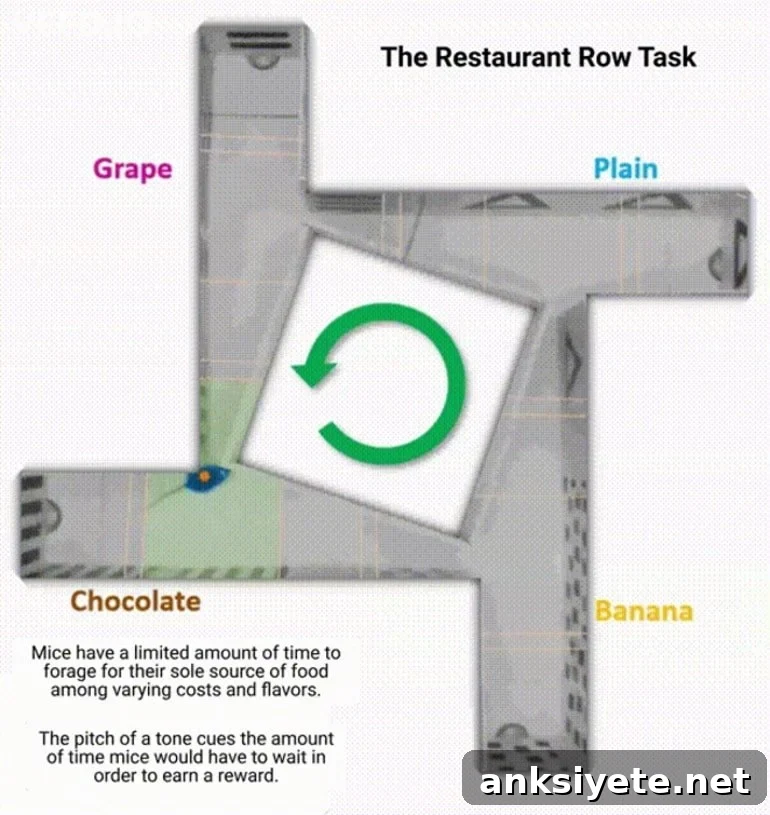
Mice were trained on a foraging task called “Restaurant Row,” in which they navigated a maze for food under a strict time budget. Rewards varied by cost (a delay signaled by tone pitch, ranging from 1 to 30 seconds) and by subjective value (distinct flavors available at four different locations). Mice decided to accept or skip offers based on the perceived cost and flavor; accepting required waiting the indicated delay to earn the reward.
Animals developed consistent preferences for how long they were willing to wait for each flavor. When mice violated their own decision policy, those violations set up the conditions for regret-like processing: they either walked away from a favorable offer or committed to a costly offer they normally would avoid.
The researchers identified two qualitatively different types of regret that affect subsequent choices and map onto separate neural circuits. Type I regret, described as an “economic violation,” occurs when an animal rejects a low-cost, high-value offer and then encounters poorer options, realizing the missed opportunity. Type II regret happens when an animal accepts a high-cost offer it typically would refuse, forcing a reconsideration of having invested limited time in a poor choice.
Both types involve reflecting on alternatives, but they carry different psychological weights: type I centers on letting a good opportunity pass, whereas type II centers on reversing or cutting losses after making a bad investment. The study shows these regret subtypes are biologically distinct and are differentially linked to stress-related traits.
“Stress-susceptible mice were hypersensitive to type I regret and relatively insensitive to type II, while healthy and stress-resilient mice showed the opposite pattern — insensitive to type I and sensitive to type II,” explains co-author Scott Russo, PhD, Professor of Neuroscience and Psychiatry at Icahn Mount Sinai. “This suggests that the brain’s processing of mistakes is multifactorial: one form of regret may be adaptive and part of healthy emotional functioning, while another may contribute to pathology,” he adds.
The research also implicates the gene CREB, which regulates many stress-sensitive responses, in shaping these regret processes. CREB activity produces opposite effects depending on brain region: in both humans and mice, CREB in the medial prefrontal cortex has been linked to stress resilience, while CREB in the nucleus accumbens is associated with stress vulnerability.
By experimentally altering CREB function in these regions, the team showed a molecular connection between regional CREB activity and sensitivity to the two regret types. This provides a potential, region-specific molecular target for therapies intended to restore balanced emotional processing — enhancing adaptive regret responses while reducing maladaptive patterns linked to mood disorders.
Dr. Sweis notes the findings could influence clinical practice by encouraging clinicians to probe regret more precisely during psychiatric evaluations. Differentiating subtypes of regret and understanding which thought patterns to reinforce or extinguish may help clinicians identify underlying circuit dysfunction and choose targeted interventions.
Romain Durand-de Cuttoli, PhD, first author and postdoctoral researcher, emphasizes the translational potential: “Knowing that distinct regret subtypes arise from separate brain regions helps pinpoint which circuits drive different ways of reflecting on the past. That opens the door to more precise treatments — whether pharmacological or neuromodulatory — tailored to specific pathological emotional traits in mood disorders.”
About this depression research news
Author: Elizabeth Dowling
Source: Mount Sinai Hospital
Contact: Elizabeth Dowling – Mount Sinai Hospital
Image: The image is credited to Brian Sweis, Mount Sinai Health System
Original Research: The findings are published in Science Advances