
Dartmouth researchers reveal how the brain interprets motion and still images to help us navigate a complex visual world
A Dartmouth College study shows how the human brain combines information about motion and object identity to interpret dynamic scenes, even when motion is only implied in a still image. The findings, published in the journal Neuroimage, have practical implications ranging from improved diagnosis and rehabilitation strategies for people with motion blindness or object agnosia to enhanced motion recognition algorithms for public safety systems.
The research demonstrates that the brain’s two major visual pathways—commonly described as the dorsal “where” pathway and the ventral “what” pathway—do not operate entirely independently when processing motion and object information. Instead, these pathways interact to encode both the location and the expected motion characteristics of objects, and they do so differently for animate and inanimate categories.
Co-lead author Zhengang Lu, a doctoral student in Psychological and Brain Sciences, notes the broad relevance of this work: by understanding how motion signatures are represented in the brain, it may be possible to refine pattern-recognition systems used in security settings and to design better clinical interventions for visual disorders. For example, incorporating characteristic motion cues into automated detection systems could complement or improve on facial-feature–based recognition methods.
In healthy vision, the dorsal pathway helps locate objects and track motion, while the ventral pathway is specialized for identifying what objects are. Some neurological patients demonstrate how these pathways contribute differently: people with damage to the dorsal pathway can often recognize objects but struggle to localize or judge movement, while patients with ventral pathway damage may be able to point to objects but cannot readily identify them.
The study emphasizes the adaptive importance of detecting motion cues. Akinetopsia, the inability to perceive motion, makes everyday tasks such as crossing a street dangerous because moving objects appear as disjointed still frames. Conversely, object agnosia—difficulty recognizing objects—impairs many routine activities. Understanding how the brain integrates motion and object identity is therefore critical both for basic neuroscience and for clinical applications.
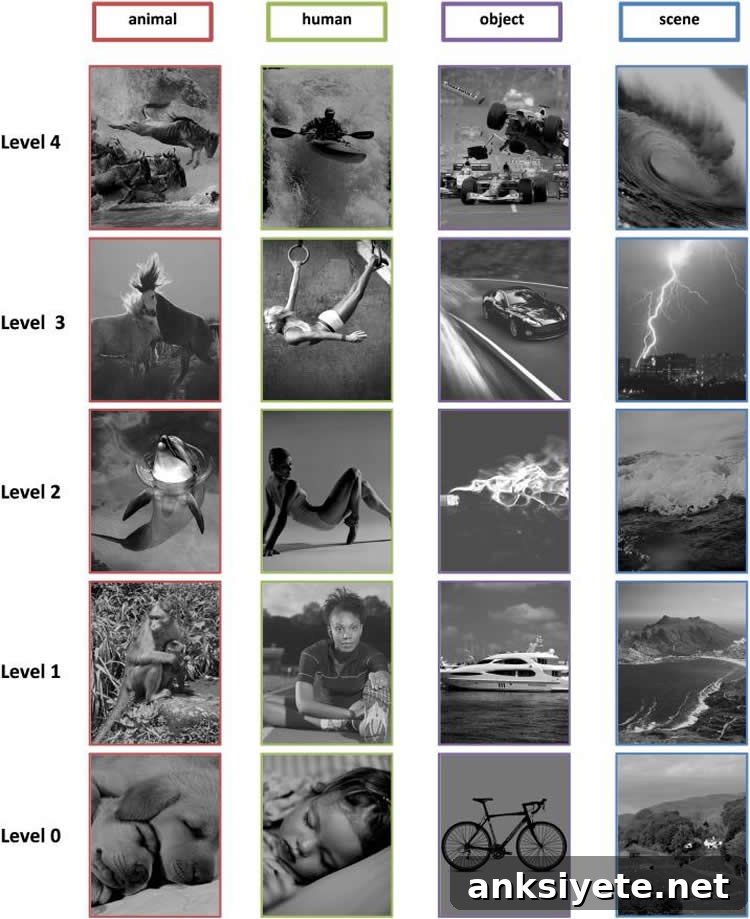
Using functional magnetic resonance imaging (fMRI), the Dartmouth team measured brain activity across regions in both visual pathways while participants viewed still images from different categories that varied in implied motion speed. Stimuli included images of humans and animals (animate categories) and scenes or objects (inanimate categories) with cues suggesting different levels of motion.
The researchers found a striking difference in how implied motion affected neural responses depending on category. In both dorsal and ventral visual areas, images of humans and animals evoked activity that was largely unaffected by the degree of implied motion. By contrast, neural activity for inanimate objects and scenes correlated strongly with implied motion speed. This interaction indicates that the brain treats implied motion differently for animate and inanimate categories, encoding motion cues in a way that depends on what kind of object is depicted.
Multivariate pattern analysis further showed that the dorsal pathway carries category-specific information comparable to the ventral pathway, challenging the strict separation of “where” and “what” functions. Notably, still images of inanimate objects or scenes with high implied motion produced activation patterns that sometimes resembled those evoked by animate images, suggesting that implied motion can influence categorical representations.
Lu explains, “Our results imply that the two visual pathways interact rather than function entirely separately when processing motion and objects. To interpret a complex scene with multiple objects moving at different speeds, the brain integrates motion signals with prior knowledge about how particular objects typically move. This integrated encoding should inform both clinical approaches to motion blindness and object agnosia and the development of more robust motion-recognition algorithms.”
Funding: The research was supported by the National Science Foundation.
Source: Dartmouth College
Image credit: Zhengang Lu
Original research: “Encodings of implied motion for animate and inanimate object categories in the two visual pathways” by Zhengang Lu, Xueting Li, and Ming Meng, published in Neuroimage. Published online November 17, 2015. doi:10.1016/j.neuroimage.2015.10.059
Abstract
Encodings of implied motion for animate and inanimate object categories in the two visual pathways
Previous work has proposed separate visual streams for spatial/motion (“where”) and object identity (“what”) processing. However, middle temporal cortex (MT), a dorsal area traditionally associated with motion, also represents implied motion from still images, suggesting interaction between motion and object representations. To probe how implied motion and object categories relate across the two pathways, fMRI measured responses to still pictures from animate and inanimate categories that varied in implied motion speed. In visual areas of both pathways, activity elicited by human and animal images was relatively insensitive to implied motion speed, whereas responses to inanimate objects and scenes correlated with implied motion speed. This interaction indicates different encoding mechanisms for implied motion across animate and inanimate categories. Multivariate pattern analysis revealed significant category information in the dorsal pathway comparable to the ventral pathway, and inanimate images with strong implied motion evoked patterns less distinguishable from animate images, suggesting implied motion contributes to category representation. These results support integrated encoding of motion and object categories and call for a revised view of the relationship between the two visual pathways.